The Gyeongnam branch of the Korean Teachers and Education Workers Union (KTU) has voiced its opposition to the decision by the Teachers' Rights Protection Committee in the Gyeongnam region, which ruled that a student's use of abusive language toward a teacher did not constitute an infringement of teachers' rights.
On June 9, the Gyeongnam branch of the KTU held a press conference in the briefing room of the Gyeongnam Office of Education, stating, "A student used abusive language toward a teacher who was providing guidance, yet it was determined not to be a violation of teachers' rights," and calling for a review of the committee's standards and an increase in the number of teacher members on the committee.
The Teachers' Rights Protection Committee is an organization that investigates cases where teachers suffer psychological, verbal, or physical harm during educational activities, and deliberates on damage recovery and protection measures. The committee is composed of education-related professionals, including teachers, parents, professors, lawyers, police officers, and psychological counselors.
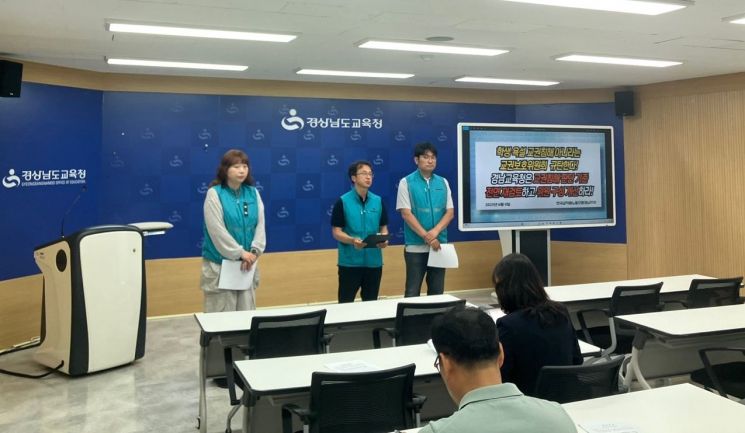 The Gyeongnam Branch of the Korean Teachers and Education Workers Union is holding a press conference in the Gyeongnam Office of Education briefing room to protest the decision of the Teachers' Rights Protection Committee. Photo by Lee Seryoung
The union stated, "At one school, a student repeatedly used abusive language in response to a teacher's instruction to clean up litter the student had scattered. However, the Teachers' Rights Protection Committee of the relevant education support office ruled that, due to the difficulty of obtaining objective evidence, it did not constitute an infringement of educational activities."
The union also said, "At another school where the committee's investigation is ongoing, a student used abusive language toward a teacher and even wrote the abusive words on a worksheet. However, we were told by the school official in charge of teachers' rights that, because it is unclear to whom the abusive language on the worksheet was directed, it may not be recognized as a violation of teachers' rights."
They emphasized, "Many students witnessed the student using abusive language toward the teacher, and this was revealed during the investigation process, yet the committee's decision is difficult to accept. A student's abusive language toward a teacher is a clear infringement of educational activities, as it constitutes an act of insult as specified in Article 19 of the Act on the Status of Teachers."
The union pointed out that the result stemmed from a structural problem in the composition of the Teachers' Rights Protection Committee.
According to materials obtained by the union from the provincial office of education and the office of Democratic Party lawmaker Kim Moonsu, among the 287 total committee members across 18 regional committees in the province in 2024, only 25 were teachers, accounting for just 8.71%.
The union argued, "In Changwon, Geoje, Haman, Changnyeong, and Hapcheon, there are no teacher members at all, and in Jinju, Uiryeong, Goseong, Sancheong, Hamyang, and Geochang, there is only one teacher member each. In a structure where the voices of rank-and-file teachers, who are the direct victims of teachers' rights violations, are barely reflected, it is only natural that decisions are made that do not recognize students' abusive language as a violation of teachers' rights."
The union demanded that the proportion of rank-and-file teacher members on regional committees be increased to at least 30%, and that students' use of abusive language toward teachers be recognized as an infringement of educational activities.
Additionally, the union called for: ▲ measures to enhance the expertise of regional committees ▲ a comprehensive review of the criteria for determining violations of teachers' rights ▲ regular professional training and education for committee members ▲ and an increase in the number of teachers' rights specialists assigned to education support offices.
In response, the provincial office of education stated, "Based on the statements and written confirmations from the teacher, student, and witnesses, we determined that the legal requirements for a violation of teachers' rights were not met. While no legal action will be taken, we believe disciplinary guidance is necessary for the student who used abusive language, and the school will convene a disciplinary committee."
The office added, "Since the committee operates in accordance with legal requirements, the outcome may differ from teachers' sentiments, but we are fulfilling our responsibilities."
The office further explained, "In accordance with the enforcement decree of the Act on the Status of Teachers, committee members are appointed from among those with educational experience, such as professors, lawyers, parents, and retired teachers. While there is no provision in the relevant laws requiring the inclusion of teacher members, in response to requests from teachers' organizations to increase the proportion of teacher members, we are expanding their numbers by appointing teachers when vacancies arise or additional members are needed on the committee."
"Compared to last year, the number of teacher members on regional committees in the province has increased by 27, bringing the total number of teacher members to 97 when combined with the remaining 70 members. We will continue to strive to restore teachers' rights and prevent the recurrence of students' inappropriate behavior," the office stated.
© The Asia Business Daily(www.asiae.co.kr). All rights reserved.
![Clutching a Stolen Dior Bag, Saying "I Hate Being Poor but Real"... The Grotesque Con of a "Human Knockoff" [Slate]](https://cwcontent.asiae.co.kr/asiaresize/183/2026021902243444107_1771435474.jpg)















