From a Deficit of 22.9 Billion Won Two Years Ago to a Surplus of 5.5 Billion Won, Says Seo Myeongok
Overall Health Insurance Surplus for Foreigners Rises by 29% in One Year
The health insurance financial balance for Chinese nationals residing in Korea, which had previously recorded large deficits, turned to a surplus last year. This change is attributed to the stricter eligibility requirements for foreign dependents under the health insurance system, which have been in effect since April of last year.

According to data titled 'Foreigners' Health Insurance Financial Balance' submitted by the National Health Insurance Service to Seo Myeongok, a member of the National Assembly's Health and Welfare Committee from the People Power Party, the total health insurance premiums collected from Chinese nationals in 2024 amounted to 936.9 billion won, while their medical expenses at healthcare institutions totaled 931.4 billion won. As a result, the financial balance (premiums minus benefits) recorded a surplus of 5.5 billion won.
Previously, the health insurance financial balance for Chinese nationals recorded a deficit of 22.9 billion won in 2022 and a deficit of 2.7 billion won in 2023. Notably, before the COVID-19 pandemic, there were significant deficits such as -110.8 billion won in 2017, -150.9 billion won in 2018, and -98.7 billion won in 2019, which led to ongoing controversy over so-called 'Chinese health insurance freeloading.'
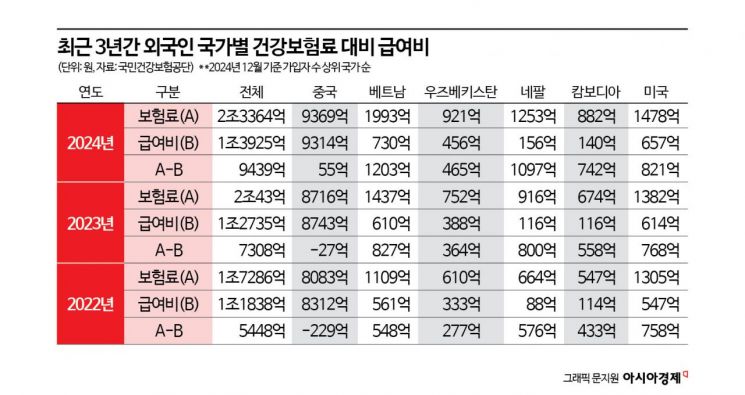
However, the size of last year's health insurance surplus for Chinese nationals was smaller compared to other countries. Vietnamese nationals paid 193.3 billion won in premiums and spent 73 billion won in benefits, resulting in a surplus of 120.3 billion won. Nepalese nationals paid 125.3 billion won in premiums and spent 15.6 billion won in benefits, resulting in a surplus of 109.7 billion won. In contrast, Chinese nationals paid 936.9 billion won in premiums, but the surplus amounted to only 5.5 billion won.
The overall health insurance financial balance for all foreigners also recorded a surplus of 943.9 billion won last year, a 29.2% increase from the 730.8 billion won surplus in 2023. The office of the lawmaker analyzed that this was due to the revision of the National Health Insurance Act, implemented in April of last year, which requires foreigners to reside in Korea for more than six months to qualify as dependents, thereby reducing cases of 'health insurance freeloading.'
Seo Myeongok stated, "It is encouraging that the health insurance financial balance for Chinese nationals, which used to record deficits of over 100 billion won, has turned to a surplus." However, she emphasized, "More efforts are needed in the future to prevent controversies over foreigners freeloading on health insurance and to ensure the soundness of the health insurance finances."
© The Asia Business Daily(www.asiae.co.kr). All rights reserved.
![Clutching a Stolen Dior Bag, Saying "I Hate Being Poor but Real"... The Grotesque Con of a "Human Knockoff" [Slate]](https://cwcontent.asiae.co.kr/asiaresize/183/2026021902243444107_1771435474.jpg)
















