First Travel Specialty Section: Linked with Alibaba Group's Fliggy
Promoting a "One-Stop Travel Service" for Booking Flights, Accommodations, and Tickets All at Once
Explosive Overseas Travel Demand in Korea Presents an Opportunity
"A Strategy for Business Diversification"
The industry is paying close attention as Chinese e-commerce platform AliExpress (Ali) has launched its first travel specialty section, "AliExpress Travel," in South Korea. The service aims to provide a "one-stop travel solution," allowing users to book flights, accommodations, transportation, and tickets all at once. This move is seen as a strategy to target the rapidly increasing number of Chinese travelers, following China's decision in November last year to allow visa-free entry for South Koreans.
According to industry sources on June 14, AliExpress officially announced the launch of AliExpress Travel earlier this month at the 40th Seoul International Travel Fair held in Seoul. AliExpress Travel is integrated with "Fliggy," Alibaba Group's online travel platform, and offers a system where users can book over 1.5 million hotels, more than 25,000 direct flights, and tickets to over 8,000 tourist attractions and theme parks worldwide, all in one place.
Ali plans to operate a Korean-language customer service center at all times, aiming to address consumer complaints?a major drawback of global online travel agencies (OTAs) such as Agoda.
This is the first time Ali has introduced a travel specialty section in any country, with South Korea as the launch market. This move appears to be a strategy to capture the explosive demand for overseas travel following the transition to the post-COVID-19 endemic phase.
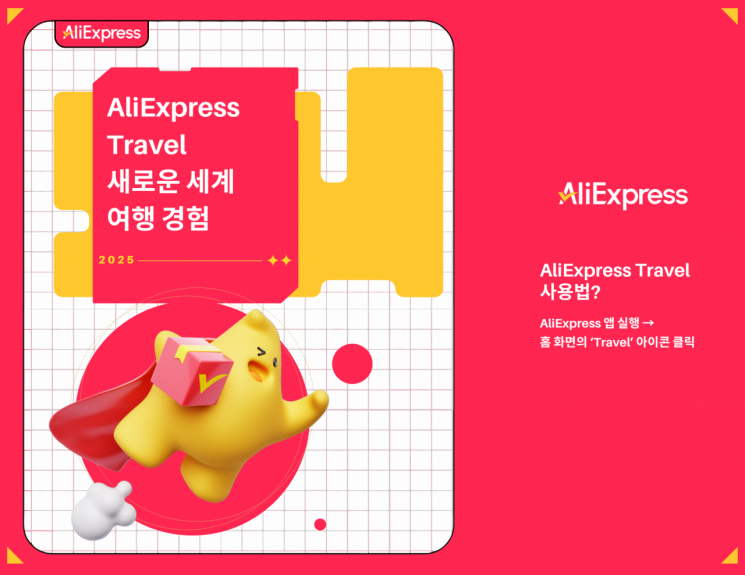 Chinese e-commerce platform AliExpress (Ali) has launched its first travel specialty section, "AliExpress Travel," in South Korea.
 [Photo by AliExpress]
Overseas Travel Surges... Ali Enters Korean Travel Market
In the first quarter of this year, the number of outbound Korean travelers reached 7,797,000, an increase of about 5% compared to the same period last year. The number of outbound travelers has continued to rise for three consecutive quarters since the second quarter of last year (6,598,000). In the first quarter, overseas card spending by Korean residents amounted to $5.35 billion (about 7.4 trillion won), up 3.1% year-on-year. Last year, overseas card spending by residents reached an all-time high of $21.72 billion (about 31 trillion won). If this growth continues, another record-breaking year is expected.
In particular, travel to China has surged due to the Chinese government's visa-free policy for South Koreans. According to the Ministry of Land, Infrastructure and Transport's Aviation Information Portal System, the number of passengers on Korea-China routes in May totaled 1,471,186, up 8.9% from the previous month and 29.5% from a year earlier.
 Travelers are crowding Incheon International Airport Terminal 1 on the 24th, ahead of the Lunar New Year holiday including the temporary public holiday. Incheon International Airport Corporation announced that during the special traffic control period for this Lunar New Year holiday, from the 24th to the 2nd of next month, a total of 2,141,000 passengers are expected to use Incheon Airport, averaging 214,000 passengers per day. Photo by Kang Jinhyung
Fliggy, which is integrated with AliExpress Travel, is an Alibaba-affiliated travel platform established in 2016 and is the second most popular travel platform in China after Trip.com. Since AliExpress Travel is based on a China-focused travel platform, there are expectations that it can absorb the rapidly growing demand for travel to China this year.
All-in-One Ali... A Platform for Everything
In August 2023, Ali established its Korean subsidiary, AliExpress Korea, and in October of the same year, launched its Korean sales channel, "K-Venue." In the early stages of entering the Korean market, the company focused on ultra-low-priced daily necessities, but later expanded its product lineup through K-Venue to include fashion, fresh food, and home appliances. As a result, it has evolved from a value-for-money channel for ultra-low-priced goods to a comprehensive platform encompassing high-priced products and services.
This launch of the travel specialty section is also interpreted as a strategic move to become a "platform where everything can be solved in one place." Since the end of last year, Ali has been promoting the "All-in-One Ali" keyword.
Selling travel products can also help increase the average order value. According to Mobile Index, a data analytics solution by IGAWorks, estimated per capita credit/debit card spending on AliExpress last month was 101,740 won, which is lower than other platforms such as Coupang (193,081 won), Gmarket (124,320 won), and SSG.com (143,430 won). As products like airline tickets and hotel bookings have higher prices, sharp sales growth is anticipated.
The travel section is also expected to boost user numbers. According to WiseApp/Retail, an app and retail analytics service, AliExpress recorded 8.85 million monthly active users (MAU) last month, ranking third after Coupang (34 million) and 11st (9.41 million). In April, 11st overtook AliExpress to claim the second spot in user numbers. If Ali secures demand from Korean travelers, there is a possibility it could reclaim second place from 11st.
© The Asia Business Daily(www.asiae.co.kr). All rights reserved.
![Clutching a Stolen Dior Bag, Saying "I Hate Being Poor but Real"... The Grotesque Con of a "Human Knockoff" [Slate]](https://cwcontent.asiae.co.kr/asiaresize/183/2026021902243444107_1771435474.jpg)
















