Shin Kaksoo: "The critical moment for North Korean denuclearization was missed during the first Trump administration"
Experts: "North Korea-U.S. talks unlikely to resume this year... North Korea, China, and Russia's solidarity has grown stronger"
Shin Kaksoo, former ambassador to Japan (vice chairman of the Near Foundation and former vice minister of foreign affairs), stated on the 9th, "The critical moment for resolving the North Korean nuclear issue was during the first Trump administration. If negotiations had included not only the United States but also China and Russia, a mid-level agreement might have been possible." He added, "China was sidelined during the North Korea-U.S. dialogue phase, and after President Xi Jinping visited North Korea following the 2019 Hanoi no-deal summit, the prospects for progress in denuclearization negotiations became slim."
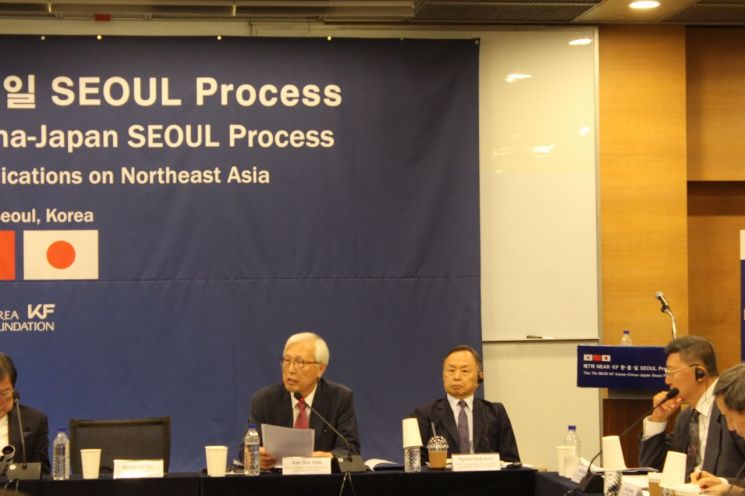 Sungak Su, former ambassador to Japan and vice chairman of the Near Foundation, is speaking at the 7th Korea-China-Japan Seoul Process held on the 9th at the Korea Chamber of Commerce and Industry in Jung-gu, Seoul. Near Foundation
On this day, Shin attended the "7th Korea-China-Japan Seoul Process: The Trump 2.0 Era and Its Impact on the Strategic Environment in Northeast Asia," co-hosted by the Near Foundation and the Korea Foundation. He remarked, "Six years have passed since the Hanoi no-deal, and we are now witnessing a North Korean nuclear capability that is incomparable to the past," and continued, "There are significant unrealistic aspects in thinking about whether this can be reversed."
Shin also said, "North Korea is increasing its nuclear material production capacity, and in about five years, it may reach the level of the United Kingdom or France. With the launch of the second Trump administration, there is a possibility that the South Korea-U.S. alliance will be recalibrated. We must keep in mind that negotiations could proceed in a way that limits attacks on the U.S. mainland."
He further pointed out, "The solidarity among North Korea, China, and Russia is becoming much stronger. Although the Multinational Sanctions Monitoring Team (MSMT) has been launched, it does not seem to be functioning properly. Ultimately, China and Russia are providing North Korea with alternative routes to circumvent sanctions." He added, "As North Korea-Russia military cooperation strengthens, the North Korean economy, which had been struggling since the COVID-19 pandemic, is now breathing easier, and as a result, North Korea no longer feels pressure regarding the nuclear issue."
Shin continued, "Since the Trump administration's priorities are Ukraine and the Gaza situation, there are many negative views about the possibility of any visible movement in North Korea-U.S. dialogue within this year. It seems that there may be room for movement around next year, when the possibility of a ceasefire negotiation in Ukraine becomes clearer."
During the session on "The Possibility of North Korean Denuclearization and Resumption of North Korea-U.S. Talks" held on the same day, Shin and other experts from Korea, China, and Japan exchanged opinions.
Chun Jaesung, professor of political science at Seoul National University, said, "Since the launch of the Trump administration, U.S. officials have begun using the term 'nuclear power' instead of 'complete denuclearization,' which suggests that the U.S. is willing to start talks." However, he analyzed, "Traditionally, the U.S. has played the role of a regional observer, balancer, or mediator, but President Trump personally acts more as a 'broker,' seeking short-term solutions and maximizing U.S. interests. This represents a structural difference."
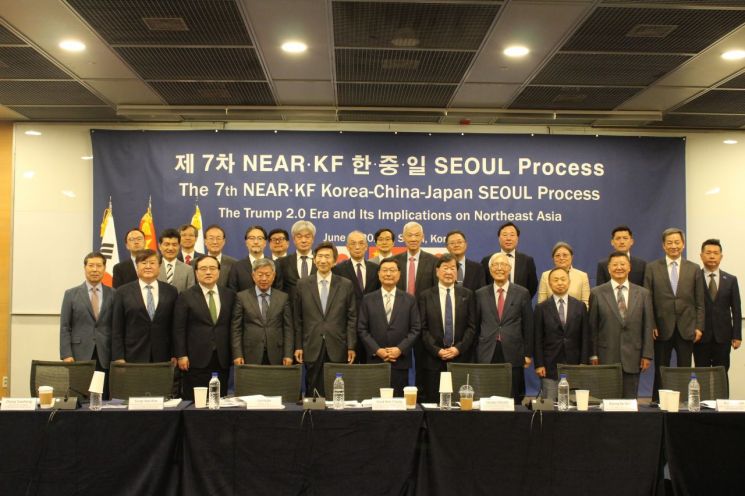 Participants of the 7th Korea-China-Japan Seoul Process held on the 9th at the Korea Chamber of Commerce and Industry in Jung-gu, Seoul, are taking a commemorative photo. Photo by Near Foundation
Narusige Michishita, professor at the National Graduate Institute for Policy Studies in Japan, expressed skepticism, saying, "Even if North Korea-U.S. talks are held in the future, I expect the content to be basically similar to the past. The likelihood of North Korea changing its policy through negotiations with the U.S. is extremely low."
Zhang Tuxing, director of the China Foundation for International and Strategic Studies, also commented, "President Trump faces a long list of issues, including the Russia-Ukraine war, the Middle East situation, and the tariff war. Therefore, the resumption of North Korea-U.S. dialogue is not a high priority, and it is highly uncertain whether any discussions will take place this year." He continued, "From North Korea's perspective, there is no motivation to engage in nuclear negotiations with the U.S. The failure of previous summits has completely destroyed trust in the U.S. and President Trump, and North Korea's goal now is likely to establish itself as a nuclear state by taking advantage of the current great power confrontation."
Yun Byungse, former minister of foreign affairs, said in his keynote speech before the discussion, "If a North Korea-U.S. summit, especially at the leader level, is held in the future regarding North Korean denuclearization, North Korea will be negotiating from the most advantageous strategic position since the Korean War. Depending on the outcome, another shock could be delivered to the Northeast Asian landscape." He added, "In addition to prior coordination among South Korea, the U.S., and Japan, close consultations with China will be necessary. Following the successful Korea-China-Japan foreign ministers' meeting in April, various opportunities for a trilateral summit are expected to arise later this year."
© The Asia Business Daily(www.asiae.co.kr). All rights reserved.
![Clutching a Stolen Dior Bag, Saying "I Hate Being Poor but Real"... The Grotesque Con of a "Human Knockoff" [Slate]](https://cwcontent.asiae.co.kr/asiaresize/183/2026021902243444107_1771435474.jpg)
















