"Unstable Politics Heighten Citizens' Anxiety"
"Humans Have an Innate Desire to Belong to Groups"
"Political Attacks on Opposing Groups Are Inherent to Conspiracy Theories"
The conspiracy theory of election fraud, which has surfaced during every major election, has once again emerged in the 21st presidential election. Lim Myungho, a professor of psychology at Dankook University, explained that the spread of conspiracy theories is fundamentally rooted in a sense of anxiety.
In a phone interview with Asia Economy, Professor Lim stated, "The starting point for conspiracy theories gaining traction among certain people is anxiety," adding, "Just as anxious individuals are more likely to turn to fortune-telling or superstition, anxious citizens are also more prone to believe in conspiracy theories." He explained that the rapidly changing domestic situation following the December 3 Martial Law Incident last year heightened citizens' anxiety, making the 21st presidential election susceptible to conspiracy theories about election fraud.
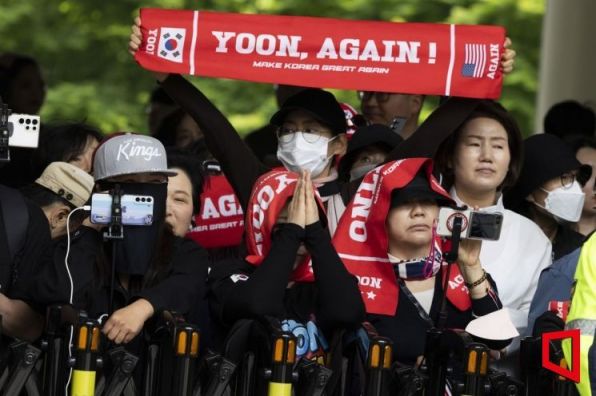 Former President Yoon Sukyeol, who was indicted on charges of leading an insurrection and abuse of power obstructing the exercise of rights, appeared at the Seoul Central District Court in Seocho-gu on the morning of the 19th last month for a hearing, where supporters were chanting "President Yoon Sukyeol." Photo by Joint Press Corps
He said, "From a psychological perspective, humans have a desire to belong to a particular group, and this desire becomes even stronger when they feel anxious. In particular, conspiracy theories are often used by certain groups to politically attack their opponents. Therefore, if political polarization intensifies, conspiracy theories are likely to continue to flourish in Korea."
Professor Lim added, "Now that a new administration has taken office, maintaining political consistency could help alleviate this sense of anxiety."
However, he emphasized that the responsibility for curbing conspiracy theories lies not with the government but with civil society. He said, "Conspiracy theories spread due to 'confirmation bias,' a psychological tendency to selectively believe information that aligns with one's preferences. Since confirmation bias is a result of individual voluntary choice, there are limits to what the government can do. To suppress conspiracy theories, voluntary fact-checking by the media and active communication among citizens are far more important," he stressed.
Some organizations, concerned about election fraud, stirred controversy during the 21st presidential election by announcing plans to monitor the voting process. Even immediately after President Lee Jaemyung's election victory, groups of people chanted slogans such as "election fraud" and "refuse to accept the election results." On the first weekend after President Lee took office, rallies were held across Seoul where participants waved Korean and American flags and claimed election fraud.
© The Asia Business Daily(www.asiae.co.kr). All rights reserved.
![Clutching a Stolen Dior Bag, Saying "I Hate Being Poor but Real"... The Grotesque Con of a "Human Knockoff" [Slate]](https://cwcontent.asiae.co.kr/asiaresize/183/2026021902243444107_1771435474.jpg)















