A system capable of measuring carbon dioxide concentration in real time and transmitting the data wirelessly without any external power source has been developed in South Korea.
On June 9, KAIST announced that a research team led by Professor Kyungha Kwon from the Department of Electrical Engineering, in collaboration with Professor Hanjun Ryu’s team from Chung-Ang University, has developed a “self-powered wireless monitoring system” that periodically measures carbon dioxide concentration by harvesting ambient micro-vibration energy.
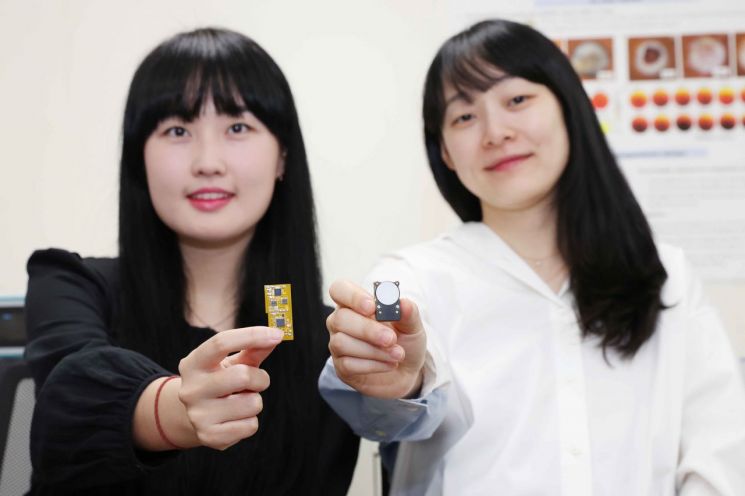 (From left) Master’s student Kyurim Jang, Department of Electrical Engineering, Professor Kyungha Kwon. Provided by KAIST
Carbon dioxide is a major contributor to global warming and is used as a key indicator for evaluating industrial sustainability. The European Union (EU) has already implemented regulations on factory emissions. In line with these regulatory trends, carbon dioxide monitoring systems are becoming essential for environmental management and industrial process control.
However, most existing carbon dioxide monitoring systems rely on either batteries or wired power sources, which imposes limitations on installation and maintenance. This is why the joint research team set out to develop a self-powered wireless carbon dioxide monitoring system that can operate without any external power supply.
The core of the developed system is an “inertia-driven triboelectric nanogenerator (TENG),” which converts vibrations (with amplitudes of 20 to 4000 μm and frequencies ranging from 0 to 300 Hz) generated by industrial equipment or pipelines into electricity. Using this technology, the joint research team enabled periodic measurement and wireless transmission of carbon dioxide concentration without the need for batteries.
The system utilizes a four-layer stacked inertia-driven triboelectric nanogenerator combined with elastic springs to amplify micro-vibrations, induce resonance, and stably generate electricity. This electricity is then used to power the carbon dioxide sensor and a low-power Bluetooth communication system.
Professor Kyungha Kwon explained, “For efficient environmental monitoring, it is essential to have a system that can operate continuously without power constraints. This research focused on implementing a self-powered system capable of periodically measuring and wirelessly transmitting carbon dioxide concentration using energy generated from an inertia-driven triboelectric nanogenerator.”
He added, “This technology could serve as a foundational technology for future self-powered environmental monitoring platforms that integrate various sensors.”
This research was supported by the Saudi Aramco-KAIST CO2 Management Center. The first authors of the research paper are Kyurim Jang, a master’s student at KAIST, and Daniel Manaye Tiruneh, a master’s student at Chung-Ang University, who both contributed jointly.
© The Asia Business Daily(www.asiae.co.kr). All rights reserved.
![Clutching a Stolen Dior Bag, Saying "I Hate Being Poor but Real"... The Grotesque Con of a "Human Knockoff" [Slate]](https://cwcontent.asiae.co.kr/asiaresize/183/2026021902243444107_1771435474.jpg)















