Russian Intelligence Agency: "China is an Adversary Threatening Security"
Difficult to Form an Alliance Despite Closer Economic and Military Ties
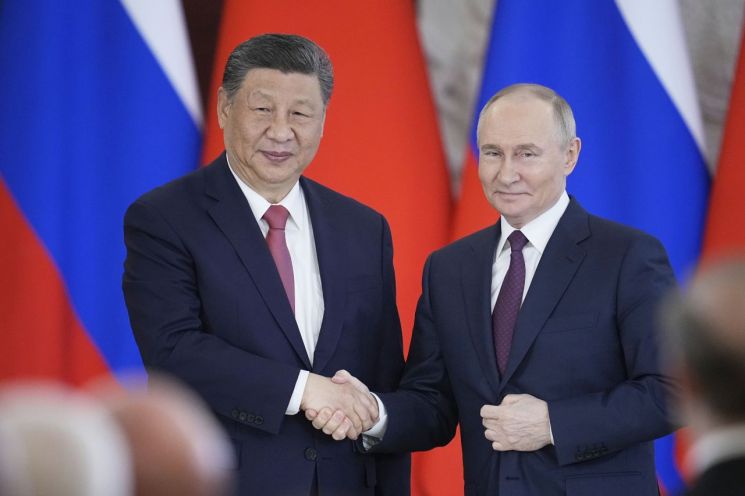 On the 8th of last month (local time), Chinese President Xi Jinping (left) and Russian President Vladimir Putin (right) shook hands during Xi's visit to Moscow for Russia's Victory Day. Photo by AP Yonhap News
A classified document has revealed that Russian intelligence agencies consider China an adversary, citing Chinese espionage and technology theft attempts as threats to Russian security. Analysts note that despite the two countries' public display of close ties, they are engaged in a covert intelligence war, leading to a decline in mutual trust. Even if China and Russia continue to strengthen military cooperation to jointly counter the United States and the West, it is expected that it will be difficult for them to develop a relationship of genuine trust or a true alliance.
Russian Intelligence Agency Classified Document: "China is an Adversary...a Serious Threat to Security"
The New York Times (NYT) reported on June 7 (local time) that a draft of a classified document from the Russian Federal Security Service (FSB), which the NYT had obtained, contained content indicating that the FSB regards China as an adversary and is wary of Chinese espionage activities. The NYT said it received the document from the cybercrime group Ares Leaks, and after sharing and verifying it with six Western intelligence agencies, it was deemed authentic.
According to the NYT, the document states, "China is an adversary that poses a serious threat to Russian security," and "China is intensifying efforts to recruit Russian spies and is attempting to lure Russian scientists dissatisfied with the regime in order to obtain sensitive technologies." The document alleges that the Chinese government is attempting to bribe senior Russian government officials, executives of private defense companies, and journalists to steal Russia's advanced military technologies.
The document also reveals that, immediately after the outbreak of the war in Ukraine, Russian intelligence agencies launched a new counterintelligence program out of concern for Chinese espionage. The NYT reported, "The document states that three days before the outbreak of the war in Ukraine in February 2022, President Vladimir Putin of Russia approved a new counterintelligence program called 'Entente-4.' The true intention of this program is to prevent Chinese spies from undermining Russian interests."
Multiple Security Agreements Signed, but China Continues Cyber Technology Theft
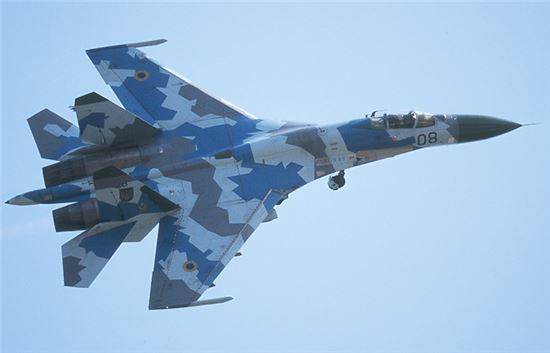 Russian Su-27 fighter jet, known to have had its engine technology illegally copied by China during the development of the J-10 fighter jet. U.S. Air Force National Museum website
China and Russia signed agreements in 2009 and 2015 to refrain from military technology theft, espionage, and cyberattacks. However, the activities of Chinese spies within Russia have hardly diminished. Citing a representative from Taiwanese security firm TeamT5, U.S. political media outlet Politico reported, "Recently, Chinese cyberattacks have targeted Russia's advanced weapons programs, especially aiming to steal sensitive information about nuclear submarines," and "Not only the Russian government, but also some Russian private companies are concerned about Chinese hacking groups stealing their technologies."
In March 2022, immediately after the outbreak of the war in Ukraine, Chinese hackers were caught sending mass emails containing malicious code to scientists at research institutes under Rostec, Russia's largest defense company. CNN reported that Chinese spies attempted to hack Russian military organizations and defense companies to gather information on various Russian military technologies deployed in the Ukraine war, as well as data on the actual use of drones on the battlefield.
China has also been accused of illegally appropriating Russian military technology since the collapse of the former Soviet Union. The Chinese government signed a license production agreement for the Soviet-made Su-27 fighter jet in 1990, and after the Soviet Union collapsed the following year, it was suspected of stealing engine manufacturing technology. In 2006, the Russian government, protesting the theft of engine manufacturing technology, announced the cancellation of the Su-27 license production agreement.
Border Territorial Disputes Continue...Selective Cooperation Rather Than Alliance
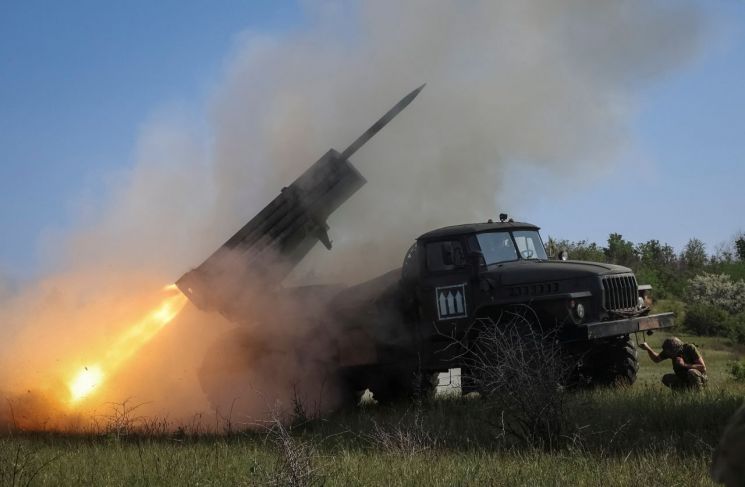
Border territorial disputes between Russia and China, which have continued since before the war in Ukraine, are also hindering the development of bilateral relations. There are assessments that, especially in the Far East, where many men have been conscripted due to the Ukraine war, there is potential for future border conflicts.
The NYT pointed out, "Russian intelligence agencies believe that the Chinese government is searching for traces of ancient Chinese people in the Far East and is trying to shape local public opinion in favor of China's claims." The NYT added, "Russia's economy has been severely weakened by the prolonged war in Ukraine and extended sanctions, and its ability to counter China's territorial claims is weaker than ever."
China engaged in a border dispute with the former Soviet Union in March 1969 over Zhenbao Island (Russian name: Damansky) on the Ussuri River in the Primorsky Krai region. At that time, the two countries' militaries suffered more than 2,000 casualties, and the alliance between China and the Soviet Union subsequently collapsed. After forming an alliance with the Soviet Union in 1950, China did not establish another alliance with Russia following the breakdown of relations due to the border dispute.
The diplomatic media outlet The Diplomat noted, "Although relations between China and Russia appear to have become very close on the surface, since the second quarter of last year, the assets of the Bank of China and the Industrial and Commercial Bank of China in Russia have decreased by about 30 percent, and the 'Power of Siberia 2' gas pipeline project, which was supposed to expand energy trade, has stalled." The Diplomat added, "China will maintain military cooperation with Russia in responding to the United States and the West, but will only continue a limited and selective partnership, not an alliance."
© The Asia Business Daily(www.asiae.co.kr). All rights reserved.
![Clutching a Stolen Dior Bag, Saying "I Hate Being Poor but Real"... The Grotesque Con of a "Human Knockoff" [Slate]](https://cwcontent.asiae.co.kr/asiaresize/183/2026021902243444107_1771435474.jpg)

















