MSIT Completes External Research Project
To Be Used for Internal Review
SMEs: "Stable Sales Channels Are Urgently Needed"
Existing Operators: "Economic Viability Is Lacking"
A Solution Needed to Reconcile Both Sides
With the official launch of the Lee Jaemyung administration, the proposal to establish a T-commerce channel exclusively for small and medium-sized enterprises (SMEs)?one of President Lee's key policies for SMEs and small business owners?is once again drawing attention. The SME community argues that new sales channels are necessary for SMEs and small business owners, who are often at a disadvantage when competing with large corporations. On the other hand, existing operators oppose the idea, citing concerns over economic viability. As a result, debate continues and the outlook for the proposal's realization remains uncertain.
According to industry sources on June 9, the Ministry of Science and ICT (MSIT) is in the final stages of reviewing the feasibility of the T-commerce business, based on the results of an external research project titled "Analysis of the Ripple Effects of Home Shopping Regulatory Reforms."
T-commerce, a combination of "television" and "commerce," refers to an interactive service that allows viewers to purchase products using a dedicated remote control without making a phone call while watching TV. Currently, there are 10 operators in total: 5 independent operators running dedicated T-commerce channels, such as SK Stoa and KT Alpha Shopping, and 5 affiliated operators, such as CJ O Shopping Plus, GS My Shop, and Hyundai Homeshopping Plus Shop, which operate T-commerce channels in addition to their existing TV home shopping channels. Among the seven home shopping operators, Home&Shopping and Gongyoung Homeshopping are the only ones without a T-commerce channel. If an SME-exclusive T-commerce channel is established, these two are seen as the most likely candidates to be selected as new operators.
The MSIT, which holds the authority to grant T-commerce business licenses, commissioned the Korea Information Society Development Institute at the end of last year to analyze the following: the effects of regulatory reforms on data home shopping (T-commerce), cooperation measures for home shopping transmission fees, and the economic impact of establishing a T-commerce channel exclusively for SMEs and small business owners. The intention was to examine the highly contentious issue of whether to establish an SME-exclusive T-commerce channel from multiple perspectives, based on the research findings. An industry insider explained, "It remains to be seen whether the government will fully accept the research results, but the findings themselves indicate that an SME-exclusive T-commerce channel would be economically viable for SMEs and small business owners to some extent."
The SME community expects that if a dedicated T-commerce channel handling only SME products is established, SMEs and small business owners?who are vulnerable to competition with large corporations?will be able to secure new sales channels and increase their revenue. An industry insider said, "T-commerce allows for 24-hour sales through pre-recorded broadcasts and, compared to TV home shopping, does not require large inventories. This makes it a relatively accessible sales channel for SMEs and small business owners with limited capacity. The need for new sales channels has become even more urgent as major platforms like TMON and WEMAKEPRICE, which previously played a key role in SME and small business sales, have disappeared."
In contrast, existing operators argue that an SME-exclusive T-commerce channel would not be economically viable. They claim that the TV home shopping and T-commerce markets are already saturated, so the establishment of an SME-exclusive T-commerce channel would merely divide the existing market share among more players. Additionally, since many operators running both TV home shopping and T-commerce channels often feature the same products on both platforms, it would be difficult for new SMEs to benefit. Another point they raise is that, even now, operators are already selling 50?80% SME products on T-commerce channels to meet license renewal requirements.
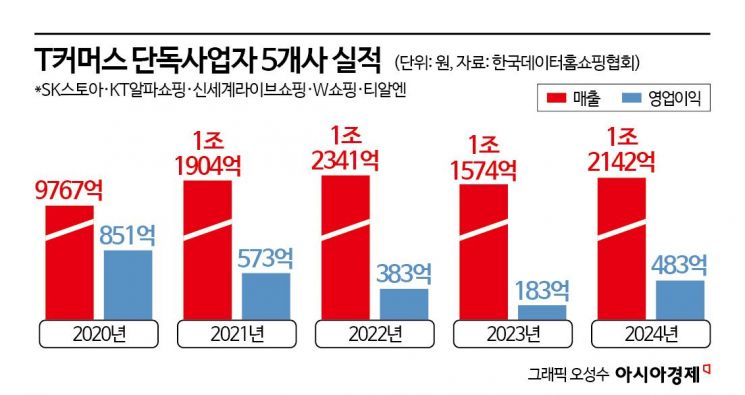
Ultimately, the consensus is that a solution must be found to reconcile the differing positions of both sides. During the previous Yoon Suk-yeol administration, the MSIT, as the responsible ministry, began considering the establishment of an SME-exclusive T-commerce channel by reviewing policy proposals from the National Integration Committee. However, the initiative was repeatedly thwarted by industry opposition. Lee Jeonghee, a professor of economics at Chung-Ang University, said, "The claim that the market is saturated is a judgment made by existing players, so opportunities should not be hastily taken away for that reason alone. If the business is not economically viable, new operators will simply choose not to enter the market." An SME representative suggested, "It may be worth considering establishing an SME-exclusive T-commerce channel while giving certain advantages to existing operators. For example, the government could adjust transmission fees for existing operators, and in return, require them to lower sales commissions charged to SME tenants."
© The Asia Business Daily(www.asiae.co.kr). All rights reserved.


















