Research Paper in the Latest Issue of the Korean Journal of Gerontology
"We Need to Create Opportunities for Communal Dining"
Low-income elderly individuals were more likely to eat alone, which negatively affected their mental health.
According to the latest issue of the Korean Journal of Gerontology published on June 8, a study titled "Path Analysis of Income and Depression in the Elderly: The Mediating Effect of Eating Alone" found that elderly people who ate alone experienced higher levels of depression.
The research team used data from the 2020 Korea National Health and Nutrition Examination Survey conducted by the Korea Disease Control and Prevention Agency to investigate the impact of eating alone on the mental health of the elderly. They analyzed household income, whether individuals ate alone, and depression levels among 1,712 people aged 65 or older. The average age of the participants was 72.3 years, with 739 men (43.2%) and 973 women (56.8%).
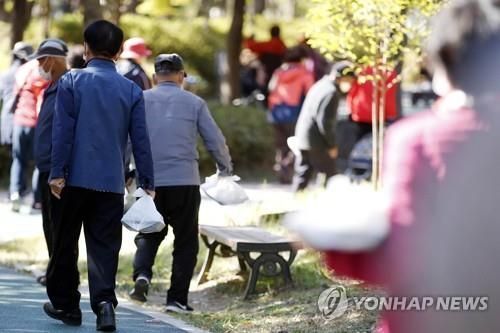 Elderly People Receiving Lunchboxes. Provided by Bukgu District, Gwangju. Photo by Yonhap News Agency
Based on this analysis, the results showed that elderly individuals with higher household income were less likely to eat alone and had lower levels of depression. Conversely, those with lower income ate alone more frequently, and elderly people who ate alone exhibited higher levels of depression. The likelihood of eating alone was higher among men and among those without a spouse.
These findings are significant in light of the increasing number of elderly people living alone, a trend driven by changing values regarding parental support and longer life expectancy.
Previously, it was reported that the proportion of single-person households aged 70 or older surpassed that of those in their twenties or younger. As the population ages rapidly, there are now more elderly people living alone than young people living independently.
According to "2024 Statistics on Single-Person Households," the proportion of single-person households aged 70 or older was 19.1% last year, the highest among all age groups. This was followed by those in their twenties or younger (18.6%) and those in their sixties (17.3%). The previous year, in 2022, the proportion of single-person households in their twenties or younger was the highest at 19.2%, with those aged 70 or older at 18.6%. The rankings reversed last year for the first time since related statistics began in 2015.

The research team stated, "Meals are not only a nutritional necessity but also a representative act of forming social interactions," and explained, "For elderly people with limited economic resources, the burden of maintaining social relationships often leads them to prioritize economic survival over the emotional enjoyment gained from relationships."
They also pointed out, "Although local governments and private organizations provide lunchbox or side dish delivery services for low-income elderly people, these services focus on nutritional support and offer limited opportunities for social interaction."
They further suggested, "It is necessary to establish communal dining opportunities using community infrastructure such as senior welfare facilities to enhance the social relationships and support available to impoverished elderly individuals."
Previous data from Statistics Korea also reflected the needs of elderly people living alone when asked about the support required by single-person households. Last year, the proportion of single-person households that cited housing stability support as most needed was 37.9%, down from 50.1% three years earlier. However, the need for care service support increased from 13.4% to 13.9%, psychological and emotional support for loneliness and isolation rose from 6% to 10.3%, and support for household services grew from 7% to 10.1%.
© The Asia Business Daily(www.asiae.co.kr). All rights reserved.


















