Total ETF Net Assets Surpass 201 Trillion Won in 23 Years
A Surge of ETFs Reflecting Diverse Investor Needs
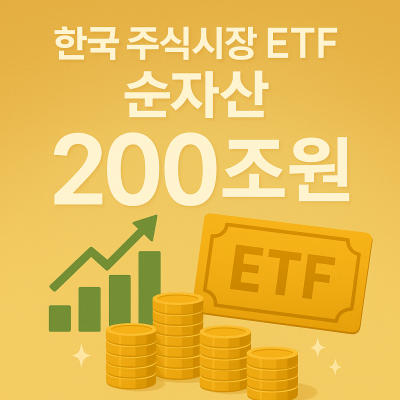
It has been about 23 years since exchange-traded funds (ETFs) were first introduced in Korea in 2002, and now the total domestic net assets have surpassed 200 trillion won. The domestic ETF market began in October 2002 with the listing of four ETFs based on the KOSPI 200 index. In June 2023, 21 years later, the era of 100 trillion won in net assets began. Just two years after that, the total net assets have doubled.

According to the Korea Exchange and the Korea Securities Depository on June 6, the total net assets of ETFs listed in Korea stood at 201.2845 trillion won as of the closing price on June 4. On June 2, the day before the presidential election, the figure was 199.1531 trillion won, marking an increase of 2.1314 trillion won in just one day. This was influenced by the KOSPI hitting a yearly high following the presidential election, as expectations grew for economic and stock market stimulus measures from the new administration.
Seo Taehyun, a researcher at DB Securities, explained, "After the presidential election, the domestic stock market is clearly reflecting expectations of policy benefits," and added, "We anticipate a revaluation of valuations and improved foreign inflows as a result of stock market activation policies."
Growth Continues, Centered on ETFs Meeting Investor Needs
In fact, the ETFs chosen by individual investors on June 4, the day President Lee Jaemyung was inaugurated following the presidential election, clearly demonstrate expectations for policy benefits. Individual investors heavily bought the 'TIGER Holding Company ETF.' Individuals purchased 14.9 billion won worth of the TIGER Holding Company ETF, making it the number one net purchase among all equity-type ETFs by individuals. This appears to reflect expectations for 'value-up' policies to enhance shareholder value, which are set to begin with the launch of the new administration.
The TIGER Holding Company ETF is the only ETF in Korea that invests in holding companies. It is expected to benefit from new government policies centered on packages to enhance shareholder value. Jung Hyun, head of ETF management at Mirae Asset Global Investments, explained, "Policies such as dividend expansion and strengthening the fiduciary duty of directors by the new administration will trigger a revaluation of holding companies that have been undervalued due to their ties to major shareholders."
The perception that ETFs are as easy to trade as stocks, while offering greater stability than stocks, is spreading. ETFs are typically 'passive' products that track stock indices rather than individual stock prices. Another advantage is that management fees are lower than those of ordinary funds. Lower management fees are more advantageous for long-term investors. The fact that major domestic asset management companies are consistently identifying investor needs and launching new ETFs has also been cited as a driver of market growth.
Last month, 17 new ETFs were launched in the domestic stock market, including five China-themed ETFs and three U.S. dividend-related ETFs. The number of ETFs listed in Korea has increased to 984. The number of ETF products grew from four in 2002 to 135 in just ten years, and surpassed 500 in 2021.
As a variety of ETFs meet investor needs, the ETF market is growing rapidly. The asset management industry is launching not only ETFs that track major indices of stock markets in Korea, the United States, and other countries, but also ETFs based on various assets such as bonds and foreign exchange rates. Through derivative, thematic, active, and covered call ETFs, investors are able to employ a wide range of investment strategies.
Products such as ▲ACE US Dividend Quality ETF ▲ACE US Dividend Quality+Covered Call Active ETF ▲ACE US Dividend Quality Bond Mix 50 ETF, launched last month by Korea Investment Management, are the result of accurately identifying investor needs.
Nam Yongsoo, head of ETF management at Korea Investment Management, said, "Domestic monthly dividend investors have been disappointed as the effect of compound interest for high-dividend U.S. ETFs in tax-efficient accounts has diminished following changes in foreign tax credit regulations," and added, "We determined that new products were needed to meet the demand from investors seeking high total returns from long-term investment and monthly cash flow from dividend distributions, which is why we launched the ACE US Dividend Quality series."
When asset managers identify global stock market trends and launch ETFs that investors want, market funds flow in rapidly. The 'RISE Tesla Fixed Tech 100 ETF,' launched by KB Asset Management on May 13, surpassed 50 billion won in net assets just 14 trading days after listing. KB Asset Management designed this ETF by fixing the allocation to Tesla at 25%, while diversifying the remaining 75% across 100 leading U.S. technology stocks, taking into account the holdings of Korean retail investors in U.S. stocks.
Lee Sujin, head of ETF product marketing at KB Asset Management, said, "The RISE Tesla Fixed Tech 100 ETF aims for higher returns than market indices and more stable performance than individual stocks," and added, "We recommend it for investors who expect Tesla's long-term growth in sectors such as electric vehicles, robotics, artificial intelligence (AI), and energy."
Not only stock market investors, but also those interested in real estate are entering the ETF market. The 'KODEX Korea Real Estate REITs Infrastructure ETF' managed by Samsung Asset Management achieved net purchases by individuals for 100 consecutive trading days this year, without missing a single day. Over these 100 trading days, a cumulative 116.6 billion won in individual funds flowed in. KODEX Korea Real Estate REITs Infrastructure is a product that diversifies investments across leading REITs and infrastructure assets listed on the domestic stock market, aiming for stable dividend income as well as capital gains from a recovering real estate market. It is analyzed that individual investors are highly interested in stable returns and future capital gains even amid market volatility.
ETFs Related to Government Policy Are Promising
Experts recommend ETFs related to government policy in the rapidly growing ETF market. Representative policy-related ETFs include ▲TIGER Korea Dividend Dow Jones ▲TIGER Holding Company ▲Kodex Financial High Dividend TOP10 Target Weekly Covered Call ▲Kodex Renewable Energy Active ▲TIGER Korea Dividend Dow Jones ▲TIGER Holding Company ▲Kodex Financial High Dividend TOP10 Target Weekly Covered Call, among others.
If policies such as dividend income reform and improvements in corporate governance are realized, it is expected that cash dividend expansion and valuation rerating will be possible across large-cap high-dividend stocks.
Kim Junghyun, head of ETF business at Shinhan Asset Management, said, "If the amendments to the Commercial Act are fully implemented, various shareholder return policies such as dividend expansion, protection of minority shareholders, and treasury stock cancellation will come to the fore, increasing expectations for enhanced shareholder value at financial holding companies." He added, "Financial holding companies have been the most proactive sector in responding to government system improvements and the advancement of financial markets, and are likely to emerge as the primary beneficiaries of the Commercial Act amendments."
© The Asia Business Daily(www.asiae.co.kr). All rights reserved.
![Clutching a Stolen Dior Bag, Saying "I Hate Being Poor but Real"... The Grotesque Con of a "Human Knockoff" [Slate]](https://cwcontent.asiae.co.kr/asiaresize/183/2026021902243444107_1771435474.jpg)

















