A Framed Birth Certificate of Trump's German-Born Grandfather as a Gift
Trump Criticizes Merkel's Refugee Policy... German Media Calls Merz a "Fellow Critic"
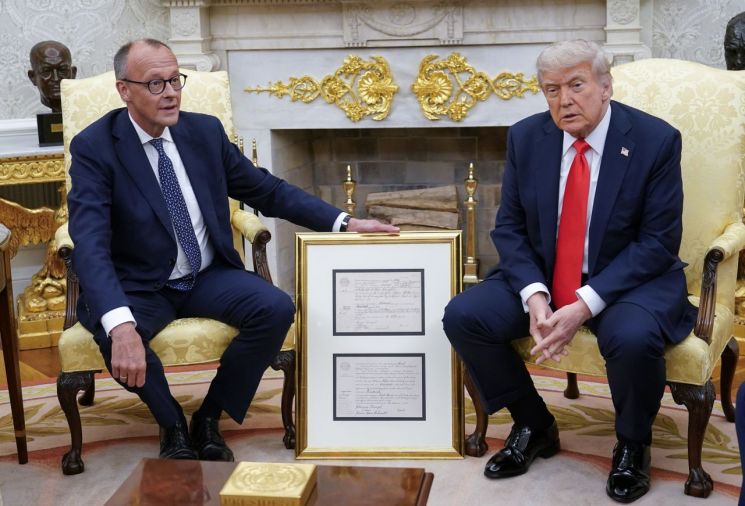
German Chancellor Friedrich Merz appealed to President Donald Trump by emphasizing his 'German heritage' and requesting increased pressure on Russia. However, President Trump responded coldly.
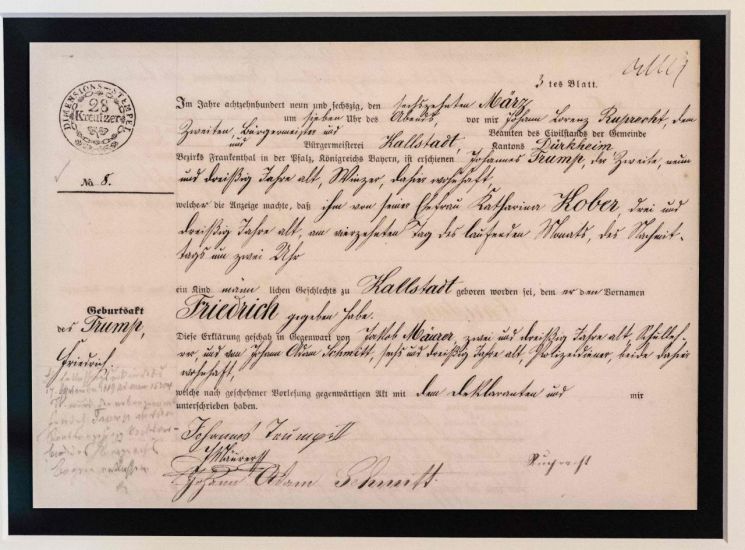
On June 5 (local time), Chancellor Merz visited the White House and met with President Trump. Before the meeting, Merz presented Trump with a gold-framed birth certificate of Trump's grandfather, Frederick Trump (German name: Friedrich Trump). Frederick Trump was born in 1869 in Rhineland-Palatinate, southwestern Germany, and emigrated to the United States in 1885.
Chancellor Merz referred to the immigration background, stressing that it provides "a solid foundation for cooperation between Germany and the United States." He also noted, "Tomorrow is D-Day," referencing June 6, 1944, when Allied forces began the Normandy landings during World War II. He stated, "It is the day our country was liberated from Nazi dictatorship," adding, "This is why I say the United States is in a strong position to end this war (the war in Ukraine)."
After easing the atmosphere by discussing family history and the two countries' shared past, Chancellor Merz said he was considering additional pressure on Russia to stop the war in Ukraine and sought Trump's agreement. However, President Trump avoided specific comments, saying, "Sometimes it's better to let the kids fight and separate them later," using a metaphor to refer to Russia and Ukraine. In response, Merz did not directly argue but simply stated, "Ukraine does not target Russian civilians."
Before the meeting, the German government announced that the two leaders were scheduled to discuss Ukraine, the situation in the Middle East, and trade policy. On the same day, President Trump stated, "The United States is rich in oil and gas," indicating his intention to use this as leverage in trade negotiations with the European Union (EU).
However, Germany is not a direct negotiating party on any of these three issues, and reporters' attention was focused on U.S. domestic politics, such as the Elon Musk tax cut plan. Chancellor Merz had little opportunity to speak. In a pre-meeting interview, he said, "I do not expect any major breakthroughs."
German media, on the contrary, viewed this atmosphere as "fortunate." Previously, Ukrainian President Volodymyr Zelensky and South African President Cyril Ramaphosa had experienced difficulties due to Trump's unexpected remarks.
During the meeting, there was no mention of issues likely to provoke a sensitive reaction from Trump, such as the principle of political isolation from Alternative for Germany (AfD), Germany's push for a digital tax, or the imbalance in automobile trade.
Instead, President Trump positively evaluated Germany's increased defense spending and its policy to curb illegal immigration. Regarding former Chancellor Angela Merkel's refugee acceptance policy, he expressed discomfort, saying, "That was not your fault. I told her (former German Chancellor Angela Merkel) that it should never have happened."
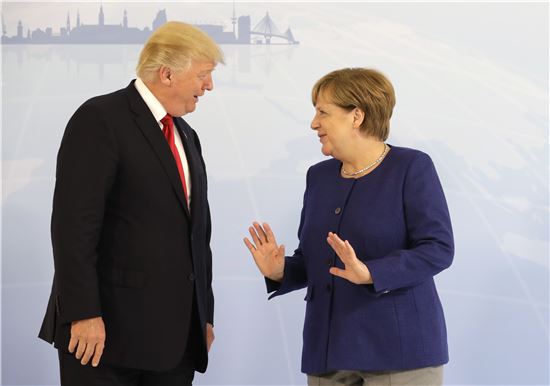 President Trump (left) and former Chancellor Merkel in 2019. Photo by AP and Yonhap News
For Chancellor Merz, who has been in office for just one month, this White House meeting served as a quiet diplomatic debut. German magazine Der Spiegel commented, "Taking into account Trump's short attention span, Merz did not say much, but he said what needed to be said."
Chancellor Merz also expressed his intention to invite President Trump to his grandfather's hometown. As a token of appreciation for staying at Blair House, the official guest residence, he presented Trump with a collection of letters from 19th-century German immigrants. However, according to German media, Trump showed little reaction to the gift of his grandfather's birth certificate.
Although Trump has previously stated that he is "proud of his German blood," after becoming president, he frequently clashed with former Chancellor Angela Merkel, who criticized his America First policy.
German daily Sueddeutsche Zeitung (SZ) reported, "Trump does not object to this German (Merz) at all. The main reason is that he is not Merkel," adding, "He seems to see Merz as a good companion for criticizing Merkel together." Chancellor Merz and former Chancellor Merkel had a long-standing rivalry after Merkel ousted him in an internal party power struggle in the early 2000s.
© The Asia Business Daily(www.asiae.co.kr). All rights reserved.
![Clutching a Stolen Dior Bag, Saying "I Hate Being Poor but Real"... The Grotesque Con of a "Human Knockoff" [Slate]](https://cwcontent.asiae.co.kr/asiaresize/183/2026021902243444107_1771435474.jpg)
















