Stalemate Repeatedly Occurred Due to Opposition from Business Circles After Discussions Began in 1998
It Took Seven Years for the Five-Day Workweek to Become Fully Established After Implementation
As anticipation grows for shorter working hours, such as the 4.5-day workweek promised by President Lee Jae Myung during his candidacy, the process of implementing the five-day workweek (40-hour workweek) in the past is being revisited. The five-day workweek, which took a long time to move from discussion to legislation, required seven years to become fully established after its implementation.
 President Lee Jae Myung is having a cordial conversation with Woo Won Sik, Speaker of the National Assembly, and other ruling and opposition party leaders before lunch at Sarangjae of the National Assembly on June 4, 2025. Photo by Kim Hyun Min
Stalemate Repeatedly Occurred Due to Opposition from Business Circles After Discussions Began in 1998
The five-day workweek was first discussed during the Kim Dae Jung administration in 1998, when the number of new unemployed people in a single year reached 920,000. Compared to the United States, which adopted the five-day workweek in the 1930s, the United Kingdom in the 1970s, and neighboring countries such as Japan in 1987 and China in 1995, Korea was relatively late in introducing the system.
The Kim Dae Jung administration, which began its term amid the IMF financial crisis, proposed the five-day workweek as one of the measures to address mass unemployment. While improving workers’ quality of life was one reason, the main priority at the time was to reduce unemployment by sharing jobs through shorter working hours.
However, there was little progress in the discussions. Business leaders opposed the five-day workweek, citing management difficulties and weakened corporate competitiveness, while labor unions demanded its introduction without wage cuts, and the gap between the two sides could not be bridged.
When the economy showed signs of recovery in 2000, discussions on the issue gained momentum.
Ahead of Labor Day, labor unions demanded the five-day workweek, and the National Assembly also lent its support. Both the Millennium Democratic Party and the Grand National Party pledged to implement the five-day workweek as a campaign promise for the 16th general election. As a result, in May 2000, the Tripartite Commission (now the Economic, Social and Labor Council) formed a Special Committee on Reducing Working Hours to address the issue, and in September of the following year, full-scale negotiations began. However, negotiations stalled again after the Grand National Party sided with business circles, stating, “We are in principle in favor of reducing working hours, but now is not the right time given the difficult economic conditions” (Kim Manje, Chairman of the Grand National Party Policy Committee, July 2021).
It Took Seven Years for the Five-Day Workweek to Become Fully Established After Implementation
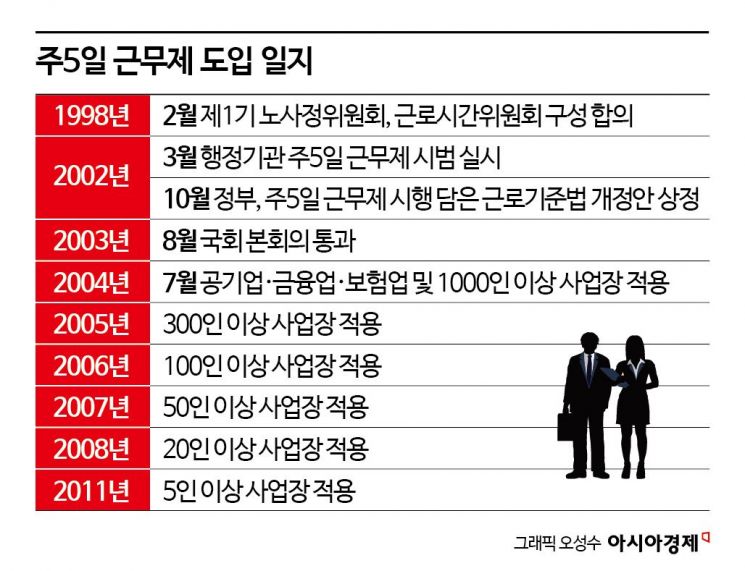
The government began pilot operations of the five-day workweek in 2002. In April 2002, a Saturday-off system was piloted in some government ministries, and three months later, banks nationwide officially implemented the five-day workweek. In October of the same year, the government submitted an amendment to the Labor Standards Act to introduce the five-day workweek, and it was not until August of the following year that the bill passed the National Assembly’s plenary session.
Starting in July 2004, the five-day workweek was first implemented at public enterprises, financial institutions, insurance companies, and workplaces with 1,000 or more employees, and it was not until 2011 that it became fully established. It took seven years to gradually expand the scope of application by workplace size: ▲workplaces with 300 or more employees in 2005 ▲100 or more in 2006 ▲50 or more in 2007 ▲20 or more in 2008. In 2011, the five-day workweek was fully implemented at workplaces with between 5 and 20 employees. In line with this, schools adopted the five-day school week system starting in 2012.
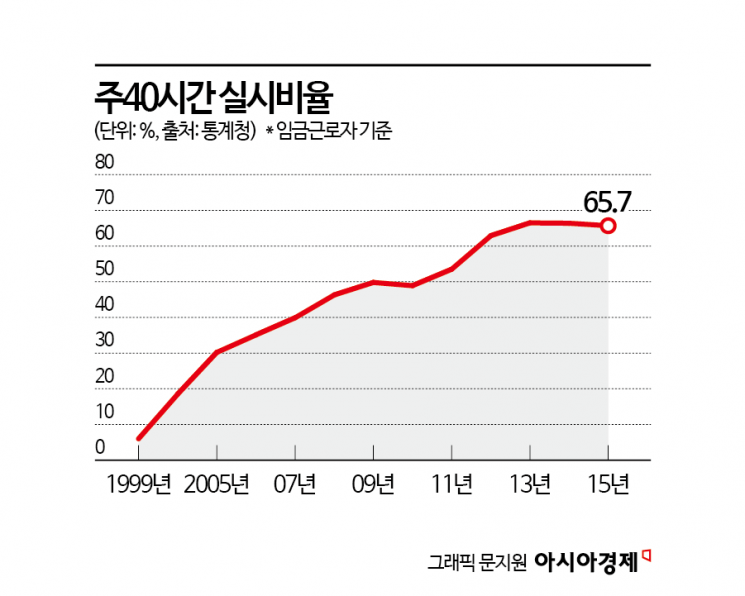
The proportion of wage workers covered by the five-day workweek increased sharply from 2004. According to Statistics Korea’s “Proportion of 40-Hour Workweek Implementation,” only 6.0% of wage workers were covered by the 40-hour workweek in 1999, but this figure rose to ▲18.5% in 2004 ▲30.2% in 2005 ▲35.1% in 2006 ▲39.9% in 2007. By 2009, the proportion of wage workers covered by the 40-hour workweek approached half at 49.8%, and by 2015, it reached 65.7%. Afterwards, the relevant statistics were changed to working conditions by employment type, such as weekly working hours, as the 40-hour workweek became established.
It also takes a long time to implement working hour reduction systems in other countries. In Iceland, it took about five years from experimentation to full-scale adoption. From 2015 to 2019, a working hour reduction experiment without wage cuts was conducted among public sector workers, and the results showed that workers’ quality of life improved while productivity remained the same or improved. Based on these results, working hour reductions were gradually expanded starting in 2020.
© The Asia Business Daily(www.asiae.co.kr). All rights reserved.



















