Video Featuring Presidential Office Raises Controversy
Alleged Violations of Military Facilities Protection Act and Other Regulations
A former employee who worked at the Presidential Office during the Yoon Sukyeol administration has sparked controversy by uploading a video of their last day at work on YouTube.
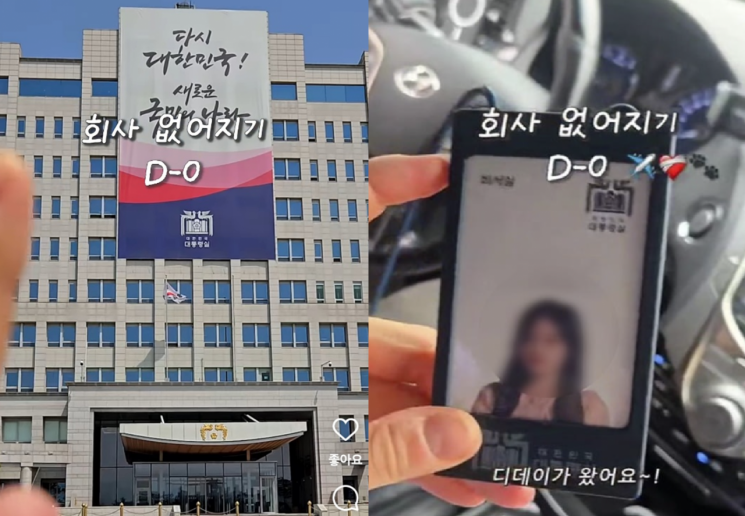 A former employee who worked at the Presidential Office during President Yoon Sukyeol's administration has sparked controversy by posting a resignation vlog on Instagram.
Identified as a photographer for the Presidential Office's secretariat, the individual, referred to as A, released a video titled "D-Day Until the Company Disappears: Last Commute, Moving, and After" on June 4 via their YouTube and Instagram accounts.
The video shows A returning their Presidential Office access badge and then going home to unpack after moving. The badge displayed in the video features the Presidential Office logo and the word "Secretariat."
A reflected on their experience, stating, "My first job, which I started at twenty-five, was a lot of fun, but I also endured a lot. I think I moved forward as much as I endured." They added, "During that process, I became both desensitized and stronger. For me, new experiences are important, and this job gave me many. I was happy because of that, but saying I was only happy would be a lie."
Previously, A had posted vlogs about their work life. On March 1, they uploaded a video of themselves taking photos at a protest against the impeachment of former President Yoon Sukyeol. In a video posted after Yoon's impeachment and removal from office in April, A said, "With the company disappearing, I have 40 days left until resignation. It seems like they're promoting people before the company disappears, but of course, not me. I really hate this damned company. I'm so sick of it."
The video spread across social networking services (SNS) and online communities, fueling controversy. The Presidential Office is a top-level security facility, and filming is restricted under the Military Facilities Protection Act. The controversy arose because A did not comply with these regulations.
It is also being pointed out as problematic that a public servant ran a YouTube channel and participated in political protests. According to the Ministry of Personnel Management's regulations, public officials must obtain permission from their agency head to engage in personal broadcasting. For YouTube, if the channel meets the monetization requirements?at least 1,000 subscribers and 4,000 cumulative watch hours per year?dual employment approval is required.
The current National Public Service Act and Local Public Service Act prohibit individual political expression by public officials. Specifically, Article 65 of the National Public Service Act and Article 57 of the Local Public Service Act ban political activities by public officials. Violations are punishable by up to three years in prison and up to three years of disqualification.
Meanwhile, as the controversy grew, A set all their YouTube videos to private.
© The Asia Business Daily(www.asiae.co.kr). All rights reserved.

















