Per Capita GNI Surpasses 50.12 Million Won, Dollar Equivalent at $36,745
Achieving $40,000 Requires "Fundamental Economic Vitality Through Structural Reform"
Q1 Growth Rate Preliminary Figure: -0.2%
Marked Weakness in Construction Investment and Private Consumption
Domestic Demand Hits Bottom, Expected to Improve in Q2
Exports Need Monitoring for Potential Impact from US Tariffs
Last year, South Korea's per capita Gross National Income (GNI) surpassed 50 million won for the first time. When converted to US dollars, it amounted to $36,745, allowing South Korea to outpace Japan for the second consecutive year. Among countries with a population of over 50 million, this ranks sixth. In the first quarter of this year, real GNI increased by 0.1% compared to the previous quarter. The preliminary growth rate for real Gross Domestic Product (GDP) in the first quarter was -0.2%, unchanged from the advance estimate.
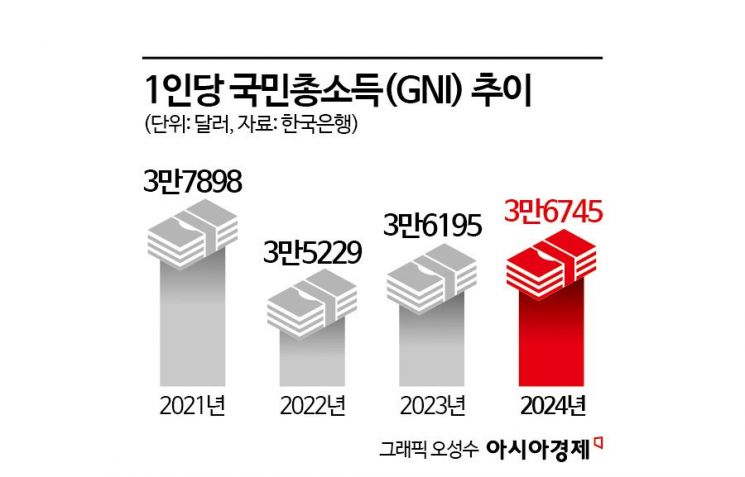
Per Capita GNI $36,745... Achieving $40,000 Requires Fundamental Changes That Bring Real Economic Vitality
According to the "2024 National Accounts (Preliminary)" and "2025 Q1 National Income (Preliminary)" released by the Bank of Korea on June 5, last year's per capita GNI was 50.12 million won. This represents a 6.1% increase from the previous year, marking the first time it has exceeded 50 million won. In terms of US dollars for international comparison, it reached $36,745, up 1.5% from $36,195 in 2023. Per capita GNI is a representative economic indicator that shows national purchasing power and living standards, calculated by dividing the total income earned by residents both domestically and abroad by the population. However, since GNI includes income earned by households, corporations, and the government, it may differ from the income actually felt by individuals.
Last year, South Korea's per capita GNI is expected to rank sixth among countries with populations over 50 million, following the United States, Germany, the United Kingdom, France, and Italy, as it did the previous year. Once again, it surpassed the levels of Japan and Taiwan. However, South Korea's per capita GNI has remained in the $30,000 range for 10 years since first surpassing $30,000 in 2014. While there is keen interest in when the $40,000 era will begin, some analysts argue that the content and quality of growth are more important than the timing. Kang Changgu, Director of the National Income Statistics Division 2 at the Bank of Korea, emphasized, "With South Korea's potential growth rate continuing to decline, it will be difficult to restore fundamental economic vitality without structural reforms to strengthen growth drivers. Meaningful progress in the numbers will only come after substantive and dynamic changes and improvements are made."
In the first quarter, real GNI was 572 trillion won, up 0.1% from 571.4 trillion won in the previous quarter and 0.7% higher than the same period last year. Despite worsening terms of trade, which expanded real trade losses from 10.8 trillion won to 13 trillion won, real net factor income from abroad increased from 8.9 trillion won to 13 trillion won, outpacing the real GDP growth rate of -0.2%. The GDP deflator rose 2.4% year-on-year. The GDP deflator, calculated by dividing nominal GDP by real GDP, reflects the overall price level, including exports and imports.

Q1 Growth Rate Preliminary Figure: -0.2%... Marked Weakness in Construction Investment and Private Consumption
In the first quarter of this year, South Korea's real GDP growth rate (preliminary) decreased by 0.2% compared to the previous quarter. This result is the same as the advance estimate announced on April 24. This marks the first return to negative growth in three quarters since the second quarter of last year. After a surprise 1.2% growth in the first quarter of last year, the economy immediately dropped to -0.2%. Both the third and fourth quarters recorded only 0.1% growth.
Both domestic demand and exports were sluggish. Looking at the growth rates by expenditure item for the first quarter, government consumption remained at the previous quarter's level, but private consumption decreased by 0.1%. This was due to an increase in goods such as telecommunications devices, but a decrease in services such as entertainment and culture. Construction investment fell by 3.1%, mainly due to a decline in building construction. Facility investment decreased by 0.4% as machinery, including semiconductor manufacturing equipment, declined. Exports decreased by 0.6% due to lower shipments of chemical products, machinery, and equipment, while imports fell by 1.1%, mainly due to reduced imports of energy products such as crude oil and natural gas. Compared to the advance estimate, facility investment (+1.7 percentage points) and exports (+0.5 percentage points) were revised upward, but imports, which are a subtractive factor, were also revised upward by +0.9 percentage points.
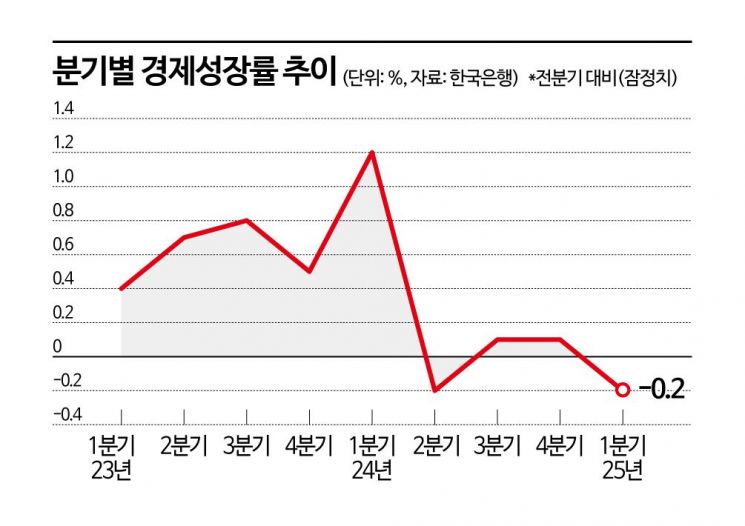
Looking at the contribution to first-quarter growth by expenditure item, domestic demand, including consumption and investment, contributed -0.5 percentage points, while net exports (exports minus imports) contributed 0.2 percentage points, indicating clear weakness in domestic demand. By item, private consumption contributed -0.1 percentage points and construction investment -0.4 percentage points, both dragging down the growth rate. Net exports contributed positively to growth because the decrease in imports (-0.5 percentage points) was greater than the decrease in exports (-0.3 percentage points).
By industry, manufacturing declined by 0.6% from the previous quarter due to decreases in chemicals, chemical products, machinery, and equipment. Construction fell by 0.4%, mainly due to a reduction in building construction. The service sector decreased by 0.2% as increases in finance, insurance, and information and communication were offset by declines in transportation and real estate.
Last month, the Bank of Korea projected a 0.5% growth rate for the second quarter. Director Kang said, "Based on trends in April and May, domestic demand is expected to improve compared to the previous sluggish performance. Durable goods, wholesale and retail, and facility investment have improved compared to the first quarter, and although credit card spending was not as strong as expected during the early May holidays, it was not bad toward the end of the month. As for exports, we will need to monitor for potential negative impacts from expanded US tariffs in the future."
© The Asia Business Daily(www.asiae.co.kr). All rights reserved.
![Clutching a Stolen Dior Bag, Saying "I Hate Being Poor but Real"... The Grotesque Con of a "Human Knockoff" [Slate]](https://cwcontent.asiae.co.kr/asiaresize/183/2026021902243444107_1771435474.jpg)

















