"It was great to receive immediate answers, and it was practical in terms of enhancing my understanding of the class." This is a review from a user of the "Artificial Intelligence (AI) Teaching Assistant" introduced in a KAIST lecture.
On June 5, KAIST announced that the research team led by Professor Choi Yoonjae of the Kim Jaechul Graduate School of AI and the team led by Professor Hong Hwajeong of the Department of Industrial Design have developed an "AI Teaching Assistant (Virtual Teaching Assistant, hereafter VTA)" that provides personalized feedback to individual students in large-scale lectures, and have successfully applied it in actual classes.
This research was conducted by introducing the VTA into the "Programming for Artificial Intelligence" course at the Kim Jaechul Graduate School of AI, which was attended by 477 master's and doctoral students in the fall semester of last year, in order to verify its effectiveness and practicality.
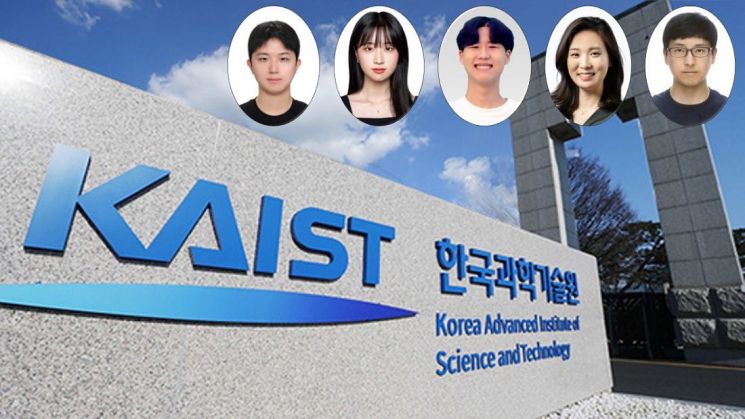 Members of the joint research team involved in the development of the "Artificial Intelligence Teaching Assistant." Provided by KAIST
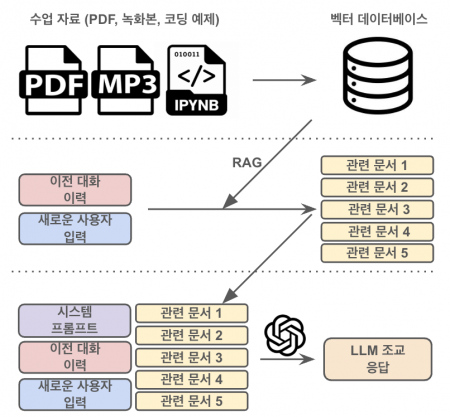
The VTA developed by the joint research team is distinguished from existing chatbots such as ChatGPT in that it is an agent specialized for classroom use. The VTA automatically vectorizes a vast amount of course materials, including lecture slides, coding practice materials, and lecture videos, and implements a Retrieval Augmented Generation (RAG) structure that enables question-and-answer based on these materials.
When the VTA receives a question, it identifies the context of the question, selects the most relevant course materials, conducts a real-time search, and then generates a response. This process is not simply a call to a large language model (LLM), but is designed as a material-based question-and-answer system corresponding to the course content, thereby ensuring both learning reliability and accuracy.
Through this, students are able to use the VTA to review (and understand) content they missed or did not understand during class. In addition, the teaching assistant, who previously played the role of VTA, is now able to focus on higher-level learning support rather than responding to simple and individual student questions.
In fact, in lectures where the VTA was introduced, the number of questions that required a direct response from the teaching assistant decreased by about 40% compared to previous classes. The VTA, which was operated for 14 weeks, was used by more than 50% of all students, and the number of question-and-answer interactions between the VTA and students totaled 3,869.
In particular, the question-and-answer function of the VTA was used more frequently by students who were not majoring in AI or who lacked prior knowledge. This suggests that the VTA provided substantial assistance as a learning aid in the lectures.
Students also tended to ask the VTA more questions about theoretical concepts than they did to human teaching assistants. This is interpreted as the result of providing an environment where students can ask questions freely to the VTA without feeling evaluated or uncomfortable by the teaching assistant, thereby actively encouraging participation in learning.
Supporting this, in surveys conducted three times before, during, and after the course, students cited increased trust, appropriateness of responses, and comfort as advantages of using the VTA compared to the initial stage. According to the joint research team, students who had previously hesitated to ask questions directly to the teaching assistant showed even higher satisfaction with interacting with the VTA.
Professor Choi Yoonjae said, "The significance of this research lies in confirming that AI technology provides practical assistance to both students and instructors," and added, "We hope that this technology will be applied in a variety of courses in the future."
This research was supported by the KAIST Center for Teaching and Learning Innovation, the National Research Foundation of Korea, and the Institute of Information & Communications Technology Planning & Evaluation.
© The Asia Business Daily(www.asiae.co.kr). All rights reserved.
![Clutching a Stolen Dior Bag, Saying "I Hate Being Poor but Real"... The Grotesque Con of a "Human Knockoff" [Slate]](https://cwcontent.asiae.co.kr/asiaresize/183/2026021902243444107_1771435474.jpg)
















