Despite Increased Investment Income, Foreign Currency Deposits at Financial Institutions Decline
Lowest Level Since April 2020... Maintains 10th Place Globally
South Korea's foreign exchange reserves have declined for two consecutive months, reaching their lowest level since April 2020. Despite an increase in investment income, a larger decrease in foreign currency deposits at financial institutions contributed to this trend.
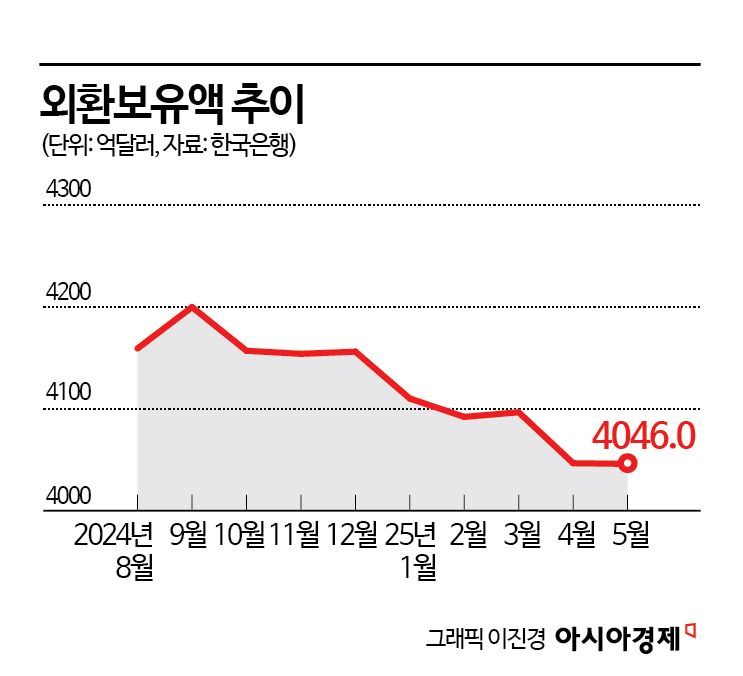
According to the Bank of Korea on June 5, as of the end of May, South Korea's foreign exchange reserves stood at $404.6 billion. This represents a decrease of $70 million from the end of the previous month ($404.67 billion), marking the fourth consecutive month that reserves have remained below $410 billion.
South Korea's foreign exchange reserves have been on a downward trend since October last year, as the strong US dollar persisted due to uncertainties surrounding US trade policy under Donald Trump, compounded by domestic political uncertainties. In response, the country sold dollars to defend the exchange rate. The reserves continued to decline through February this year, then saw a slight rebound in March due to dollar weakness and quarter-end effects. However, with the quarter-end effect dissipating in April, the reserves resumed their decline and have now decreased for two consecutive months.
The $404.6 billion figure is the lowest since April 2020, when reserves stood at $403.98 billion. A Bank of Korea official explained, "Although investment income increased, foreign currency deposits at financial institutions declined, leading to a decrease in foreign exchange reserves." Typically, in March, banks deposit dollars intensively with the Bank of Korea to meet the Bank for International Settlements (BIS) ratio requirements, but as the quarter-end effect disappears from April, foreign currency deposits have also decreased for two consecutive months.
In fact, among the components of the foreign exchange reserves, securities?which include government bonds, corporate bonds, and agency bonds?increased by $3.48 billion from the previous month to $359.97 billion. In contrast, deposits decreased by $3.55 billion over the same period to $19.69 billion. In May, the US Dollar Index (DXY) was 99.28, similar to the previous month's 99.24.
As of the end of April, South Korea's foreign exchange reserves ranked 10th in the world, maintaining the same position as the previous month. Among the top 10 countries, those that saw a decrease in reserves were 8th-ranked Saudi Arabia ($439.2 billion), 9th-ranked Hong Kong ($408.7 billion), and South Korea.
Looking at South Korea's ranking in foreign exchange reserves, the country overtook Hong Kong in June 2023 to rise to 8th place, but fell back to 9th after just two months. South Korea maintained this position for 1 year and 8 months, but in March this year, it was overtaken by Germany and dropped to 10th place globally.
© The Asia Business Daily(www.asiae.co.kr). All rights reserved.
![Clutching a Stolen Dior Bag, Saying "I Hate Being Poor but Real"... The Grotesque Con of a "Human Knockoff" [Slate]](https://cwcontent.asiae.co.kr/asiaresize/183/2026021902243444107_1771435474.jpg)
















