ADP Private Sector Jobs Rise by 37,000 in May, Lowest in Two Years
Trump Urges "Powell, Cut Rates Now"
Focus on May Labor Department Jobs Report to Be Released on June 6
Treasury Yields Plunge on Safe-Haven Demand
The three major indices on the New York Stock Exchange opened slightly higher on June 4 (local time). However, gains were limited as concerns about an economic downturn grew following a sharp slowdown in private sector job growth last month. Ongoing uncertainty over tariff policy continues to weigh on the U.S. economy.
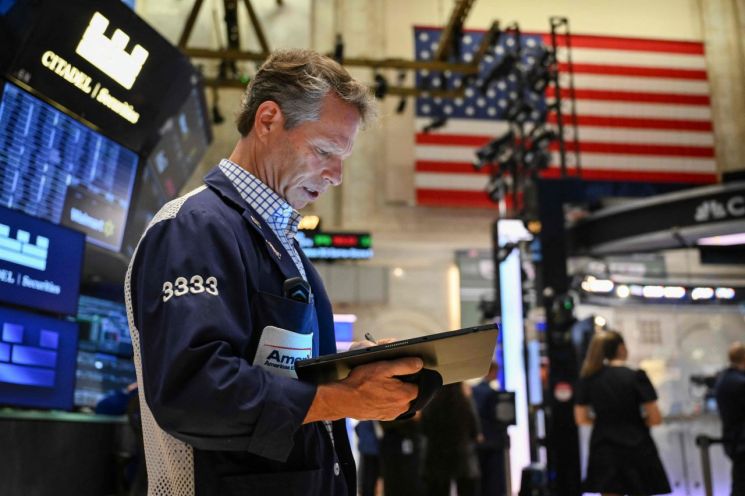
As of 11:24 a.m. on the same day at the New York Stock Exchange, the blue-chip Dow Jones Industrial Average (Dow Index) was up 51.15 points (0.12%) from the previous trading day, standing at 42,570.79. The large-cap S&P 500 Index rose by 12.19 points (0.2%) to 5,982.56, while the tech-heavy Nasdaq Index was up 58.97 points (0.3%) at 19,457.92.
Last month, the increase in U.S. private sector employment reached its lowest level in two years. According to the U.S. employment report released by private labor market research firm ADP on this day, new jobs in the private sector increased by 37,000 in May. This marks the lowest level since May 2023, two years ago. The figure was significantly below the market expectation of 111,000 and also represented a sharp slowdown compared to April, when private sector employment increased by 60,000.
Following the 'shock' in private sector employment, there is growing caution ahead of the U.S. Department of Labor's May employment report to be released on June 6. Experts predict that nonfarm payrolls last month will increase by 125,000, falling short of April's figure of 177,000. While labor demand is expected to remain solid, it is projected to have slowed. The unemployment rate is expected to have remained unchanged from the previous month at 4.2%.
U.S. President Donald Trump, immediately after the release of the ADP private employment figures, once again urged Federal Reserve Chair Jerome Powell to cut interest rates. On his self-created social networking service, Truth Social, he stated, "The ADP numbers are out," and added, "Too Late Powell must cut rates now." He continued, "He is truly unbelievable," and noted, "Europe has cut rates nine times."
There is also an assessment that the market has developed a certain 'immunity' to recent trade policy uncertainty. This is based on analyses that President Trump has reversed tariff policies and that the White House is using tariff threats as a negotiation card. Investors are awaiting a scheduled call this week between President Trump and Chinese President Xi Jinping, watching closely to see if there will be any progress in the stalled U.S.-China trade negotiations.
Jeff Roach, Chief Economist at LPL Financial, analyzed, "Trade uncertainty is weighing on certain sectors such as healthcare, technology, and construction, but not everything is bleak or gloomy." He added, "Retailers and financial services companies have signaled growth potential despite tariff volatility." He advised, "Given the widely divergent outlooks across sectors, investors need to make wise asset allocation decisions."
Due to the safe-haven preference triggered by weakening employment indicators, U.S. Treasury yields have plummeted. The yield on the benchmark 10-year U.S. Treasury note fell by 8 basis points (1bp=0.01 percentage point) from the previous day to 4.37%, while the yield on the 2-year Treasury note, which is sensitive to monetary policy, dropped by 6 basis points to 3.88%.
By stock, Dollar Tree plunged 8.41%. The sell-off intensified after the company announced that second-quarter profits could drop by as much as 50% year-on-year due to tariff-related costs. Nvidia was up 0.16%, while Tesla was down 2.99%.
© The Asia Business Daily(www.asiae.co.kr). All rights reserved.
![Clutching a Stolen Dior Bag, Saying "I Hate Being Poor but Real"... The Grotesque Con of a "Human Knockoff" [Slate]](https://cwcontent.asiae.co.kr/asiaresize/183/2026021902243444107_1771435474.jpg)















