Seungwon Seo's 'The Interplay'
On view at PKM Gallery until July 12
Depicting Sunlight and Moonlight Shimmering on Changhoji
The pastel tones, each resembling the other yet distinct, fill the canvas and create a subtle harmony. The interplay of yellow and green, pink and yellow, and even blue in various combinations forms a captivating balance that draws viewers in, making them lose track of time as they become absorbed in the artwork.
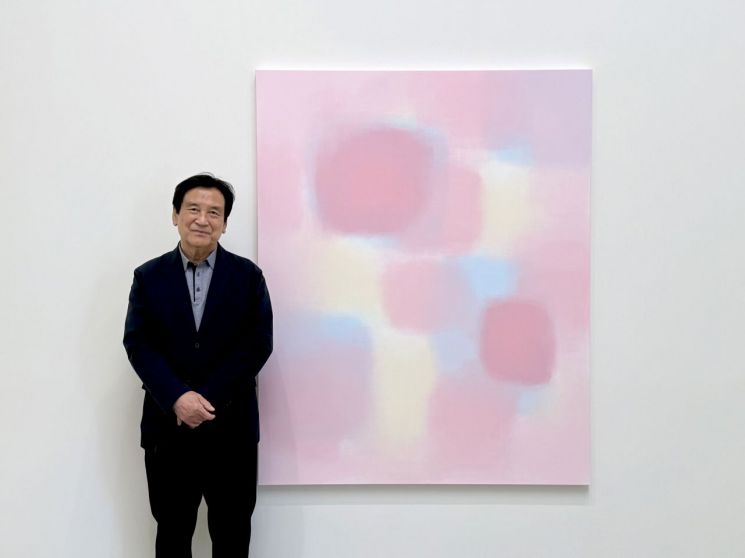
The exhibition 'The Interplay' by artist Seungwon Seo at PKM Gallery features works that develop the concept of 'simultaneity' through the harmony of light, color, and composition. Simultaneity is an original concept Seo has explored for over 50 years since around 1967. Seo describes it as "the manifestation of form, color, and space as values of equal importance."
Now in his mid-80s, Seo challenged the realism-focused styles that arrived from the West after Korea's liberation, instead dedicating himself to "a new art movement unique to us." While Lee Jungseop expressed Korean identity through bulls, Kim Whanki chose roosters, and Park Sookeun depicted women, Seo found inspiration in the traditional Korean hanok window paper, changhoji.
Born in Seoul, Seo grew up in a hanok, and as a child, he would poke holes in the windproof paper layered over the windows with his fingers. Each time, his grandfather would affectionately patch the paper with more changhoji. These memories are reflected in his works, which is why the patterns and colors in this exhibition evoke the appearance of layered changhoji.
Seo did not always work in this geometric style. Early on, he presented paintings with ruler-straight lines, which drew criticism from the public and media, questioning whether such works could even be called art. Nevertheless, Seo persisted for decades, determined to stay true to his vision, even if his works did not sell. His obsession with "not allowing even the slightest error" only began to soften after he turned fifty. One day, he found himself drawn to more organic forms, and the rigid angles in his paintings began to dissolve. The artist describes this transformation as "moving from a period of contemplation to a period of deconstruction."
The colors in his works depict the sunlight and moonlight shimmering beyond the changhoji. Inspired by the filtered colors he observed as his mother washed white clothes on a laundry stone, Seo incorporates these 'filtered hues' into his art. He pays meticulous attention to the preparation of his canvases, applying the base color a dozen times, then layering white paint five or six times before finally adding the desired colors. Seo continues to handle this laborious process himself, without assistants, because, as he says, "The value must be preserved by the artist." He records each work in his own notation in a work journal and photographs every piece. For this reason, Seo asserts, "There can be no forgeries of my work."
This exhibition features over 20 new, previously unseen works, each under size 100, created over the past four years. The exhibition runs until July 12.
© The Asia Business Daily(www.asiae.co.kr). All rights reserved.

















