Moon Jungin Predicts a Pragmatic Approach to North Korea Policy by President Lee Jaemyung and President Trump
Emphasizes the Need for a Step-by-Step Process Starting With a Nuclear Freeze
Suggests Inter-Korean Dialogue Will Only Resume After U.S.-North Korea Talks
Advocates for Preventive Diplomacy and Realistic Solutions for Peace on the Korean Peninsula
Moon Jungin, Honorary Special Professor at Yonsei University (former Special Advisor for Unification, Foreign Affairs, and Security to the President, age 74), predicted that President Lee Jaemyung and U.S. President Donald Trump will pursue a 'pragmatic approach' in their future North Korea policies. He suggested that rather than putting 'denuclearization' directly on the agenda, the only way to resolve the current complicated North Korean nuclear issue is to first push for a phased process starting with a nuclear freeze. He believes that, to break the deadlock in inter-Korean relations since the so-called 'Hanoi No Deal' in 2019, President Lee's bold initiatives will be necessary.
During an exclusive interview with Asia Economy at the Jeju International Convention Center on the 30th of last month, while attending the '2025 Jeju Forum,' Professor Moon said, "Unless we make a statement regarding Article 3 of the Constitution (which defines the territory of the Republic of Korea as the Korean Peninsula and its adjacent islands), or unless we explicitly declare that we accept North Korea's claim of two hostile states, North Korea will not come to the negotiating table."
Regarding the issue of the redeployment of U.S. Forces Korea, he said, "If the United States decides to do so, there is no way for us to stop it." Instead, he suggested that this could be an opportunity to pursue negotiations to reclaim wartime operational control, which currently resides with the ROK-U.S. Combined Forces Command.
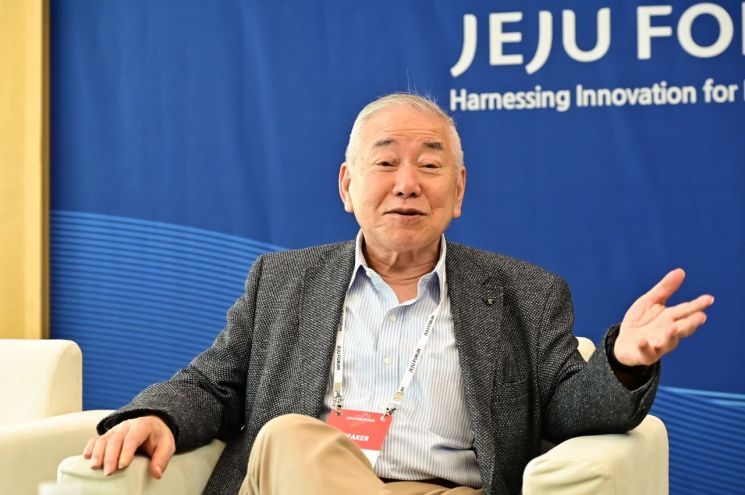 Moon Jungin, Honorary Special Professor at Yonsei University (former Special Advisor for Unification, Foreign Affairs, and Security to the President), is giving an interview to Asia Economy at the Jeju International Convention Center on the 30th of last month. Jeju Forum Secretariat
The following is a Q&A with Professor Moon.
-During the presidential campaign, President Lee proposed a comprehensive and phased denuclearization roadmap of 'nuclear freeze → reduction → elimination of nuclear threats.' How do you assess this?
▲There is no other option. North Korea possesses nuclear facilities, nuclear materials, and nuclear missiles, and has already conducted six nuclear tests. U.S. President Trump and Secretary of Defense Pete Hegseth also referred to North Korea as a 'nuclear power.' This is a highly pragmatic recognition of reality. Of course, as members of the Nuclear Non-Proliferation Treaty (NPT), we cannot officially recognize North Korea as a nuclear state. However, 'recognition' and 'acknowledgment' are different. We must take a realistic approach based on an acknowledgment of North Korea's reality. If denuclearization (starting with nuclear dismantlement) becomes the agenda, dialogue with North Korea will become impossible. Ultimately, only after nuclear arms reduction can we move toward denuclearization.
-Is the goal of denuclearization still maintained?
▲Of course. Both South Korea and the United States are NPT member states. Naturally, we normatively desire denuclearization, but how can we achieve dismantlement without reductions? The dismantlement of nuclear facilities is a long-term task that takes more than 10 to 15 years. A gradual approach is desirable, and President Lee's method is a pragmatic, reality-based solution. In this respect, I believe President Trump and President Lee can find common ground.
-In the past, former President Moon Jaein declared a temporary suspension of ROK-U.S. joint military exercises ahead of the 2018 PyeongChang Winter Olympics to bring North Korea to the negotiating table. What cards could the Lee Jaemyung administration use?
▲I believe that simply suspending ROK-U.S. joint military exercises is no longer enough. Fundamentally, North Korea has defined the two Koreas as 'two hostile states.' What North Korea is demanding is that the two Koreas, as separate states, respect each other's territory and sovereignty and refrain from interfering in each other's internal affairs. Ultimately, unless we make a statement regarding Article 3 of the Constitution, or unless we explicitly declare acceptance of North Korea's claim of two hostile states, North Korea will not come to the negotiating table. In this case, it will be North Korea's Ministry of Foreign Affairs, not the United Front Department (currently the 10th Bureau of the Workers' Party Central Committee), that will engage, and on our side, it should be the Ministry of Foreign Affairs, not the Ministry of Unification, that leads the discussions. However, this essentially moves toward division, which is not easy given domestic sentiment and is a very difficult task.
-When do you expect dialogue with North Korea to resume?
▲Dialogue between North Korea and the United States will likely take place first. Under the current circumstances, it is realistically very difficult to find a breakthrough between the two Koreas. While the humiliation and sense of betrayal North Korea experienced at the Hanoi North Korea-U.S. summit will play a significant role, North Korea is also closely watching the situations in Ukraine and the U.S.-Iran nuclear negotiations. If these two situations develop, there is a high possibility that Kim Jongun, Chairman of North Korea's State Affairs Commission, will seek dialogue with the United States. If the Ukraine situation is resolved and President Trump and President Vladimir Putin of Russia become closer, President Putin could step in to mediate between North Korea and the United States.
-There are concerns about 'Korea Passing.' What is your view?
▲If it is for the sake of peace on the Korean Peninsula, it does not matter whether it is President Xi Jinping of China or President Putin who is involved. There is no reason for our president to oppose this. Under the grand principle that 'dirty peace is better than a victorious war' (a statement by then Democratic Party leader Lee Jaemyung on July 5, 2023), if anyone can prevent war and increase the possibility of peace on the Korean Peninsula, we should welcome it. In that process, we should facilitate dialogue with North Korea by talking with the United States and Russia. President Trump is the person who has met Chairman Kim the most and believes he knows him best. They have exchanged letters 28 times. However, since there is the alliance and the issue of U.S. Forces Korea, the United States will consult with South Korea. As long as a consultation mechanism is established between South Korea and the United States, we will not be sidelined. We can deliver messages to North Korea through President Trump. This would be a reversal of the situation in 2018.
-How can trust between the two Koreas be restored?
▲It is very difficult at the moment. We cannot escape the international regime of sanctions against North Korea. However, what matters is how to change the 'hostile' aspect of Kim Jongun's 'two hostile states' theory into a 'friendly and amicable' one. If we completely recognize the Democratic People's Republic of Korea (North Korea) as a separate state and agree to a two-state system, North Korea would accept it.
-Does this mean the dream of unification is disappearing?
▲Originally, South Korea's unification proposal was fundamentally based on the two-state theory. The concept of a South-North Confederation is that one nation maintains two states and two governments. This is similar to the European Union (EU), where sovereign states come together to form an economic system. If a situation arises where people and goods can move freely, the homogeneity between the two Koreas will increase, and eventually, North Korea will likely move toward a market system. Then, in the future, the form of unification can be decided through a national referendum.
-What is your view on the redeployment of U.S. Forces Korea?
▲Redeployment, reduction, and withdrawal based on strategic flexibility must each be distinguished. If the United States decides to redeploy U.S. Forces Korea based on strategic flexibility, there is no way for us to stop it. However, reduction or withdrawal must be discussed and agreed upon between South Korea and the United States. Even if it is not President Trump, the issue of stationing U.S. forces overseas will continue to be debated within the United States. Naturally, the issue of transferring wartime operational control will arise. If this debate emerges, we should not try to avoid it, but instead, proactively negotiate with the Trump administration, which would be much more advantageous.
-There are concerns that this could be interpreted as involvement in the Taiwan Strait (China-Taiwan) issue.
▲China also knows that the redeployment of U.S. Forces Korea is a U.S. decision, so it is not a major issue. However, if the United States seeks to deploy additional intermediate-range ballistic missiles or Terminal High Altitude Area Defense (THAAD) systems aimed at China, our position becomes much more difficult. Fundamentally, I oppose this. The Republic of Korea must not become the front line of a new Cold War structure.
-What advice would you give regarding the new government's foreign and security policy?
▲I fully agree that preventive diplomacy to avoid war should be the foundation of President Lee's foreign and security policy. Since South Korea has no leverage for dialogue with North Korea, it is extremely important to create a new breakthrough for denuclearization of the Korean Peninsula through close consultations with the United States. If President Lee pursues 'pragmatic diplomacy' based on national interest, it will also be possible to maintain trilateral cooperation among South Korea, the United States, and Japan, as well as good neighborly diplomatic relations with China and Russia. In the past, the idea of a 'Korean Peninsula without the United States' was unthinkable, but now things are different. Today's United States is not the same ally we once knew.
Furthermore, diplomacy is ultimately an extension of domestic affairs. National consensus must be built. Creative ideas and the determination of a leader are also necessary.
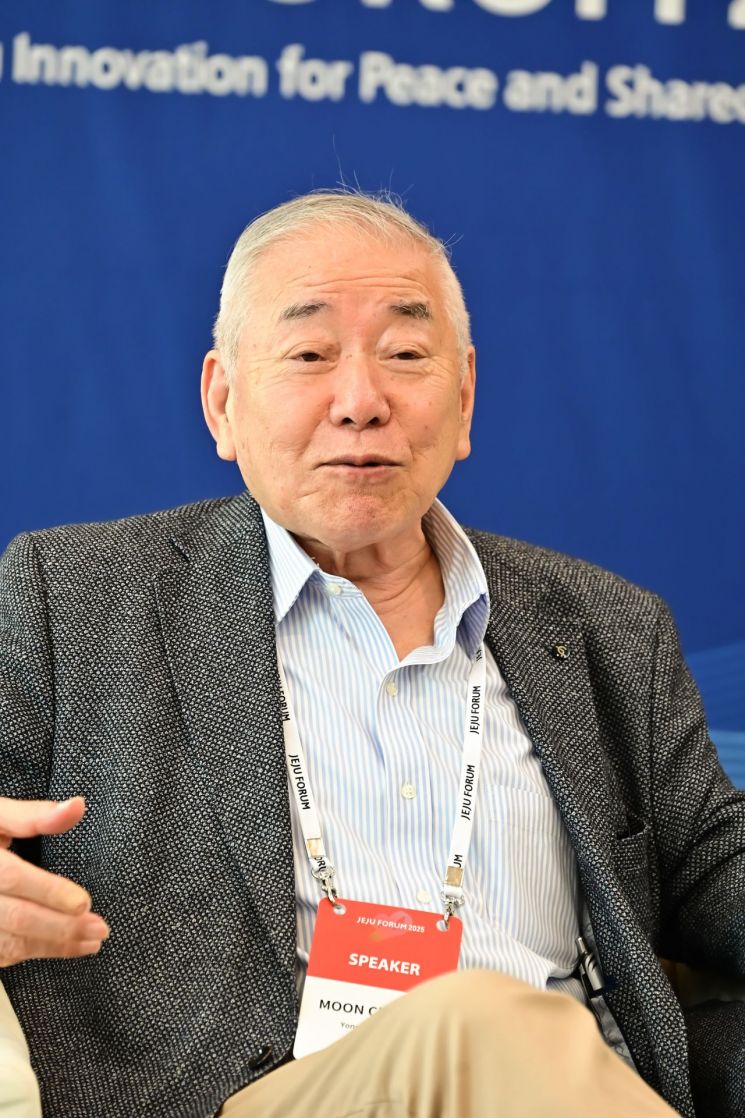 Moon Jungin, Honorary Special Professor at Yonsei University (former Special Advisor for Unification, Diplomacy, and Security to the President), is giving an interview to Asia Economy at the Jeju International Convention Center on the 30th of last month. Jeju Forum Secretariat
Who is Professor Moon Jungin? The 'key strategist' in foreign and security policy for the Kim Daejung, Roh Moo-hyun, and Moon Jaein administrations
Professor Moon is a senior expert who played a central role in foreign and security policy across the Kim Daejung, Roh Moo-hyun, and Moon Jaein administrations. As a renowned international political scientist, he was deeply involved in developing the theory behind the 'Sunshine Policy.' He is the only scholar to have attended both inter-Korean summits in 2000 and 2007 as a special delegate, witnessing the events firsthand. During the Moon Jaein administration, he served as Special Advisor for Unification, Foreign Affairs, and Security to the President. He was also considered for positions such as Director of National Security and Ambassador to the United States. Although he was not directly involved in Lee Jaemyung's presidential campaign, he served as an advisor to the Global Responsible Power Committee under the Democratic Party's Central Election Countermeasures Committee, a foreign and security advisory group.
Below is Professor Moon's profile.
▲Born in Jeju in 1951 ▲Ohyun High School ▲Department of Philosophy, Yonsei University ▲Professor, Department of Political Science and International Studies, Yonsei University ▲Special delegate to the 1st and 2nd inter-Korean summits ▲Chairman, Presidential Advisory Committee for the Northeast Asian Era ▲President, Korea Peace Studies Association ▲Director, East Asia Foundation ▲Ambassador for International Security Affairs, Ministry of Foreign Affairs and Trade ▲Special Advisor for Unification, Foreign Affairs, and Security to the President, Blue House, Moon Jaein administration ▲Chairman, Korean Peninsula Peace Forum ▲Distinguished Professor, Korea National Defense University ▲Chairman, Sejong Institute ▲Honorary Special Professor, Yonsei University (current)
© The Asia Business Daily(www.asiae.co.kr). All rights reserved.


















