How Should the New Administration Tackle Its Many Challenges?
Proposals for Active Regulatory Reform
"Political Culture of Tolerance and Restraint Must Take Root"
After six months of turmoil following the declaration of martial law, the Lee Jaemyung administration has been inaugurated. In the June 3 presidential election, candidate Lee Jaemyung garnered a vote share close to a majority, but the election also revealed structural divisions along regional, generational, and gender lines. The new government, which was launched immediately without even forming a presidential transition committee, faces a host of urgent tasks both domestically and internationally. Compared to six months ago, the economy has worsened and the external environment has deteriorated. Political and social conflicts within our society have also deepened. Where should we begin to address these issues?
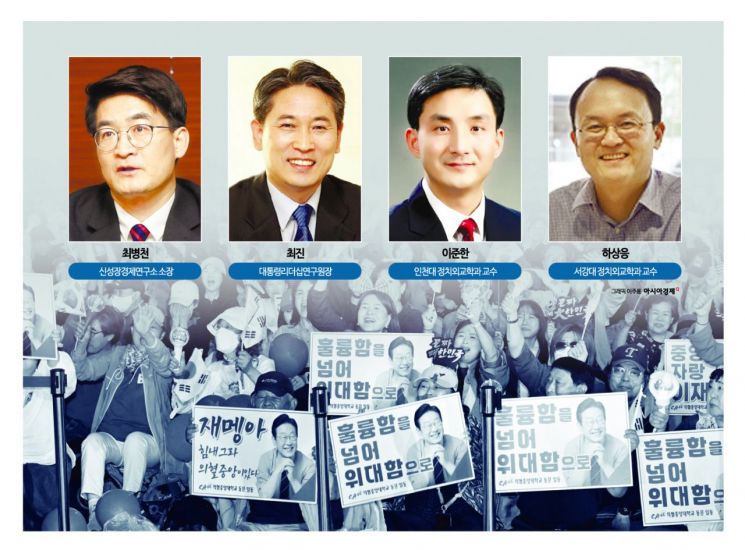
Asia Economy sought expert opinions on the challenges that President Lee, the Democratic Party of Korea?which has become the ruling party?and the People Power Party?which is now the opposition?must address. The expert interviews have been reconstructed in the format of a virtual roundtable. Participants included Junhan Lee, professor of political science and international relations at Incheon National University; Byungcheon Choi, director of the Center for New Growth Economy; Jin Choi, president of the Presidential Leadership Institute; and Sangung Ha, professor at Sogang University.
-What is the significance of this presidential election?
▲Jin Choi: The central issue of this election was the call for judgment on the illegal martial law. The martial law incident, which was broadcast live for three hours and watched by the entire nation, left a deep imprint on the public subconscious, leaving little room for other variables to influence the outcome. There has likely never been a domestic or international precedent where the candidate of the party responsible for triggering an early presidential election was re-elected as president.
▲Byungcheon Choi: This election was a judgment on both martial law and impeachment. It was an election that reflected the public’s political evaluation of the People Power Party as a political force. The impeachment process that followed the December 3 martial law last year was concluded with the Constitutional Court’s ruling on April 4. However, that was a decision concerning the presidential duties, and this election reflected the public’s political judgment on that issue. In short, the significance of this election lies in the judgment on martial law and impeachment, as well as the public’s verdict on the People Power Party as a political force.
▲Sangung Ha: This election combined two messages that the public desires. On one hand, there are calls for a thorough purge of insurrectionist forces; on the other, there are demands for national unity. Since President Lee Jaemyung did not secure more than 50% of the vote, the results show that the public did not lean entirely toward either side. We must now seek creative solutions that can achieve both of these conflicting goals.
▲Junhan Lee: I believe this election should serve as a turning point for changing the political culture of Korea, moving away from both imperial-style and powerless presidencies.
-Many social conflicts surfaced in our society from the declaration of martial law to the presidential election. How should these be resolved?
▲Junhan Lee: As the Constitutional Court justices noted in their ruling, Korean politics must recognize the existence of opposing sides and practice tolerance and restraint. Through such efforts, political culture can change.
▲Jin Choi: National unity will not come easily. Political divisions that have intensified for three to eight years will not be resolved overnight. Instead, I would urge the government to focus entirely on livelihood issues. By concentrating on people’s livelihoods, the government will naturally distance itself from partisan politics and be compelled to pursue cooperation. Ultimately, focusing on livelihoods is the key to solving all problems.
▲Sangung Ha: Since both the executive and legislative branches are now under the Democratic Party’s control, paradoxically, there may be less discord. Above all, policies should be pursued based on whether they serve the national interest.
▲Byungcheon Choi: When power is concentrated, the instinct for checks and balances also intensifies. The Democratic Party’s situation is similar in many ways to the Uri Party in 2004. They should recall the lesson of losing momentum for reform after pushing for four major reform bills. It is necessary to consider how to set the agenda and to make efforts to ensure that the reforms pursued are seen as necessary and restrained by centrist voters.
-What should be the new president’s priorities?
▲Byungcheon Choi: The president can support legislative power and should identify reforms that can be implemented administratively. It would be preferable for the administration to be remembered not as a government that spent a lot of money over five years, but as a progressive government that actively pursued regulatory reform. A regulatory reform bureau should be established, staffed with top talent and those with political acumen, to systematically push regulatory reforms on a monthly or bimonthly basis.
▲Junhan Lee: The president should take the lead in establishing a political culture of tolerance and restraint for social integration. It is also important to create jobs and revitalize the economy for the sake of people’s livelihoods.
▲Jin Choi: The government must focus on people’s livelihoods. In particular, it should prioritize tasks directly related to the economy, including trade issues with the United States. Livelihood issues are directly linked to the president’s competence and are areas where immediate results can be achieved, such as passing commercial law reforms within one to two weeks.
▲Sangung Ha: The economy is the public’s greatest concern. Among the tasks facing the president, the most urgent is to revive the economy. Trade issues, in particular, must be addressed swiftly.
-The People Power Party has become the opposition after three years. What changes are needed?
▲Sangung Ha: The party should not seek opportunities for political strife, but should work for the national interest. When the ruling party works for the national interest, the opposition should actively cooperate, and if the government pursues private interests, only then should it criticize. If the party is seen as constantly seeking unnecessary political disputes, it will not be viewed favorably by the public.
▲Jin Choi: The opposition must first put its own house in order. It should resolve its internal divisions and, for the time being, allow the new government to work freely. Constant attacks will not win public support. If the party attacks indiscriminately, it will face severe backlash when it tries to criticize in the future.
▲Byungcheon Choi: The party must address figures such as former President Yoon Sukyeol, those who supported martial law, and those who spread conspiracy theories about election fraud. It should elect new leadership through a party convention and, while maintaining checks and balances, also reach agreements on necessary reforms for the country.
▲Junhan Lee: The party should accept the election results and embrace the spirit of cooperation. It should practice politics that prioritize the entire nation over the interests of its own party.
-What should be the government’s priorities for the first month or 100 days?
▲Byungcheon Choi: Agenda-setting must be done well. The wisdom to exercise restraint in the use of power and to prioritize agenda-setting has become more important. Since the general election last year, the rhetoric of centrist expansion, growth, integration, and industrial focus centered on candidate Lee Jaemyung has been meaningful, but the policy support was weak. The government must now show a different approach.
▲Jin Choi: Appointments for people’s livelihoods will be the first test. The cabinet should be formed with personnel focused on people’s livelihoods. The most important thing is to establish a competent presidential office. If the staff is disorganized, everything will go awry. Like President Kim Daejung, the president should minimize the number of close aides and campaign staff, and instead appoint practical and competent personnel. The top priority is to assemble a capable secretariat.
© The Asia Business Daily(www.asiae.co.kr). All rights reserved.
![Clutching a Stolen Dior Bag, Saying "I Hate Being Poor but Real"... The Grotesque Con of a "Human Knockoff" [Slate]](https://cwcontent.asiae.co.kr/asiaresize/183/2026021902243444107_1771435474.jpg)















