Full-scale Launch of Three Major Special Prosecutor Investigations
Prosecution Service Begins Organizational Restructuring
The atmosphere within the prosecution is unsettled as the Lee Jaemyung administration has announced plans for a "major overhaul" of the prosecution service. With organizational restructuring at a level that could amount to the dismantling of the prosecution being anticipated, there is growing unrest both inside and outside the organization, with some saying, "The prosecution is finished." In particular, as many as 120 prosecutors are expected to be dispatched for the three major special prosecutor investigations?the "Insurrection Special Prosecutor Act," the "Kim Keonhee Special Prosecutor Act," and the "Sergeant Chae Special Prosecutor Act." This has led to increasing concern within the prosecution about a potential paralysis of its core functions, such as a gap in investigations into public livelihood cases, due to the large-scale redeployment of personnel.
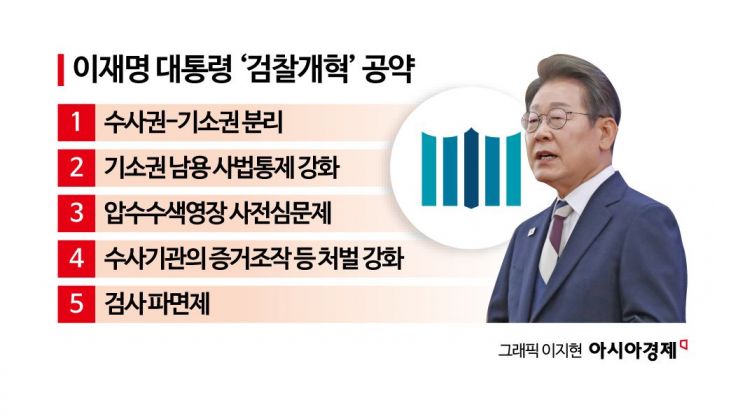
According to the legal community on June 9, President Lee Jaemyung had promised strong prosecution reform in his policy pledges during his candidacy. The key points include: ▲ separation of investigative and prosecutorial powers ▲ strengthening judicial oversight to prevent abuse of prosecutorial authority ▲ introduction of a pre-approval system for search and seizure warrants ▲ tougher penalties for evidence fabrication by investigative agencies ▲ and the implementation of a prosecutor dismissal system.
The biggest issue among these is the separation of the prosecution's investigative and prosecutorial powers. The Moon Jaein administration had limited the prosecution's direct investigative authority to six types of crimes: corruption, economic crimes, crimes by public officials, election crimes, defense procurement crimes, and major disasters, and later further reduced this to only corruption and economic crimes at the end of its term. However, President Lee has repeatedly pledged to completely separate investigation and prosecution. Under this plan, investigative authority would be transferred to the police and other agencies, while the prosecution would be reorganized into either a Prosecution Office or an Indictment Office. Although specific measures have not yet been announced, it is expected that prosecution reform will proceed with as high a priority as public welfare reforms.
A chief prosecutor at a district prosecutor's office in Seoul stated, "The new administration's prosecution reform plan involves a complete revision of the Criminal Procedure Act, which currently designates prosecutors as the primary agents of investigation." There are also internal concerns about possible retaliation, such as audits and disciplinary actions against prosecutors who previously investigated or indicted President Lee, as well as special prosecutor investigations. President Lee had been indicted on 12 charges related to eight cases, including the Daejang-dong, Baekhyeon-dong, and Wirye New Town development projects; sponsorships for Seongnam FC; remittance to North Korea by Ssangbangwool; violations of the Public Official Election Act; subornation of perjury; and alleged misuse of Gyeonggi Province corporate credit cards, and was undergoing five separate trials. Taking into account personnel changes and investigation team replacements, the total number of prosecutors who have investigated Lee's cases is estimated at about 150. Lee Changsoo, the head of the Seoul Central District Prosecutors' Office, and Cho Sangwon, the fourth deputy chief, both of whom resigned together on May 20, had also investigated the Seongnam FC sponsorship case as chief and deputy chief of the Seongnam District Prosecutors' Office, and indicted Lee as a third-party bribery suspect.
An official well-versed in prosecution affairs commented, "There are so many people involved in the investigation of the president that the new administration is said to be having difficulty appointing senior prosecutors. If Prosecutor General Sim Woojeong is replaced, it will mark the beginning of both the disarmament and the reform phase of the prosecution organization."
However, it remains uncertain whether the "exodus" of prosecutors, which has occurred with every change of administration, will materialize in earnest this time. In particular, with the appointment of Oh Gwangsu, a former special investigations prosecutor, as Senior Presidential Secretary for Civil Affairs, there is speculation that the pace of prosecution reform may be moderated. In the legal market, demand for former prosecutors at law firms is also declining due to a decrease in criminal cases. A lawyer at a major law firm who is a former chief prosecutor said, "If you are at the chief prosecutor level or higher, it is difficult to work in fields other than criminal defense when you move to a law firm," adding, "There is no shortage of personnel, so the competition to recruit former prosecutors is not that fierce." In fact, the number of criminal cases, which exceeded 2.02 million in 2016, dropped to 1.17 million in 2022, and although it rose slightly last year, it was recorded at 1.24 million.

© The Asia Business Daily(www.asiae.co.kr). All rights reserved.
![Clutching a Stolen Dior Bag, Saying "I Hate Being Poor but Real"... The Grotesque Con of a "Human Knockoff" [Slate]](https://cwcontent.asiae.co.kr/asiaresize/183/2026021902243444107_1771435474.jpg)
















