KDCA Investigating Epidemiological Case of Man in His 40s
Who Recently Traveled to Indonesia
As a patient infected with the Zika virus has been identified in South Korea for the first time in two years, health authorities have urged the public to take precautions against mosquito bites when visiting countries at risk of infection, including those in Southeast Asia.

The Korea Disease Control and Prevention Agency (KDCA) announced on June 4 that a man in his 40s, referred to as Mr. A, who recently traveled to Bali, Indonesia, was confirmed to have contracted the Zika virus in Jeju on May 30 after returning to Korea.
Mr. A was bitten by mosquitoes while in Bali. Three days after returning to Korea, he visited a medical facility with symptoms including chills, maculopapular rash, conjunctival injection, and myalgia. Laboratory tests confirmed a positive result, but his health condition is reportedly improving.
Zika virus infection is transmitted by forest mosquitoes infected with the Zika virus, a type of flavivirus. After an incubation period of 3 to 14 days, symptoms such as maculopapular rash, fever, conjunctival injection, arthralgia, and myalgia may appear. In addition to mosquito bites, cases of transmission through sexual contact, transfusion of infected blood products, vertical transmission from mother to child, and laboratory exposure have also been reported.
The fatality rate is extremely low, and although severe neurological complications may rarely occur, most patients recover with sufficient rest. However, if a pregnant woman is infected, it can lead to preterm birth or stillbirth, and the baby may be born with microcephaly or congenital malformations.
According to the KDCA, there have been no cases of Zika virus infection transmitted by local mosquitoes in Korea, but imported cases have been reported over the years. As of last year, Zika virus infections had occurred in 92 countries, including those in the Americas, and many cases were reported in Southeast Asian countries such as Thailand, which are popular destinations for Korean travelers.
Globally, there were 56,601 reported cases of Zika virus infection in 2023, 44,957 cases last year, and 12,660 cases as of last month in 2025. From 2023 to last month, most cases (108,897) were reported in Brazil, with 1,106 cases in Thailand and 47 in Singapore.
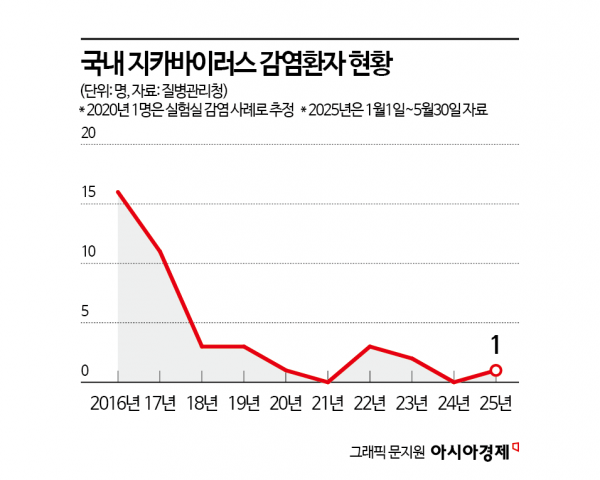
In Korea, there were two reported cases in 2023, but none last year. Since 2016, a total of 40 cases have been reported, with 39 of them being imported from overseas, except for one laboratory-acquired infection. It is estimated that 10 cases each were imported from the Philippines and Thailand, 7 from Vietnam, and 2 each from the Maldives and Indonesia.
The KDCA emphasized that, as there is no vaccine or treatment for Zika virus, preventing mosquito bites is most important, and urged travelers to countries where the infection occurs to follow preventive guidelines. Before traveling, people should check the KDCA website for region-specific infectious disease information and prepare mosquito repellents, nets, and coils. During travel, it is advised to avoid grasslands and mountains, wear bright-colored long-sleeved shirts and long pants, and stay in accommodations with screens or mosquito nets and good air conditioning.
Ji Youngmi, Commissioner of the KDCA, stated, "Since there is no vaccine or treatment for Zika virus infection, preventing mosquito bites is of utmost importance. If you develop suspicious symptoms within two weeks after being bitten by mosquitoes in a high-risk country, please visit a medical facility, inform the healthcare provider of your overseas travel history, and receive prompt diagnosis and treatment."
© The Asia Business Daily(www.asiae.co.kr). All rights reserved.


















