First Meeting After Appointment of U.S. Ambassador
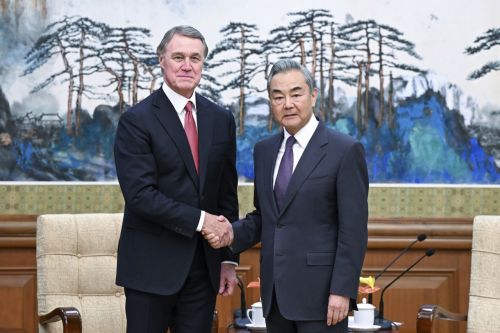 Wang Yi, member of the Political Bureau of the Communist Party of China and Minister of Foreign Affairs (right), held his first meeting with David Perdue, the newly appointed U.S. Ambassador to China, on the 3rd (local time). Photo by AP, Xinhua, Yonhap News
Wang Yi, China's top diplomat and member of the Political Bureau of the Communist Party of China as well as Minister of Foreign Affairs, once again voiced dissatisfaction with the Trump administration in the United States during his first official meeting with David Perdue, the newly appointed U.S. Ambassador to China.
On the 3rd (local time), Bloomberg News, citing a statement from the Chinese government, reported that during a bilateral meeting held in Beijing, Foreign Minister Wang Yi stated, "The United States has recently introduced a series of negative measures on unfounded grounds, thereby undermining China's legitimate rights and interests." He further emphasized, "The United States must create the necessary conditions for U.S.-China relations to return to the right track."
In response, Ambassador Perdue posted on the social media platform X (formerly Twitter) that during the meeting, he had stressed the Trump administration's key policy priorities such as trade, fentanyl, and illegal immigration. He also stated that ongoing communication between the two countries is important.
Bloomberg News noted that this meeting took place amid continued mutual accusations between the two countries over violations of the U.S.-China trade agreement. China claims that the United States violated the bilateral agreement reached in Geneva, Switzerland, on May 10-11, while the United States counters that China has failed to fulfill its promise to lift export restrictions on critical minerals such as rare earth elements.
Currently, the Chinese government points to several U.S. measures as "unfair and discriminatory," including the introduction of export control guidelines for artificial intelligence (AI) semiconductors, restrictions on the sale of semiconductor design software, and plans to revoke student visas for Chinese nationals.
President Donald Trump has expressed hope that a phone call with Chinese President Xi Jinping, following his inauguration in January, could ease trade tensions. However, Bloomberg News noted that it remains unclear whether such a call is actually being arranged. Kevin Hassett, Chairman of the White House National Economic Council (NEC), said on the 1st that "a conversation between the two leaders is expected as early as this week," adding that "both sides are communicating daily." U.S. Treasury Secretary Scott Besant also contributed to this optimism.
Some observers have criticized President Trump for being fixated on a phone call with the Chinese leader. The U.S. political media outlet Politico reported, citing sources, that "President Trump is obsessed with a call with President Xi Jinping in order to break the deadlock in trade negotiations." The report also added that President Trump is not adequately reflecting the predicament the United States faces both domestically and internationally. While there is a need to reset the $600 billion U.S.-China trade relationship, the United States faces the challenge of responding to China's export restrictions on rare earth elements, which serve as a pressure card against the U.S.
© The Asia Business Daily(www.asiae.co.kr). All rights reserved.
![Clutching a Stolen Dior Bag, Saying "I Hate Being Poor but Real"... The Grotesque Con of a "Human Knockoff" [Slate]](https://cwcontent.asiae.co.kr/asiaresize/183/2026021902243444107_1771435474.jpg)
















