First Prime Minister Tasked with Minimizing Administrative Vacuums
Lee Appoints Trusted Aides with Proven Competence and Loyalty
Kang Hoon Sik, a "Yeouido Strategy Expert," Named Chief Presidential Secretary
Kim Minseok, a four-term lawmaker from the Democratic Party, is being strongly considered as the inaugural Prime Minister in the Lee Jae Myung administration. It is also reported that Kang Hoon Sik, a three-term Democratic Party lawmaker, has been appointed as the new Chief Presidential Secretary.
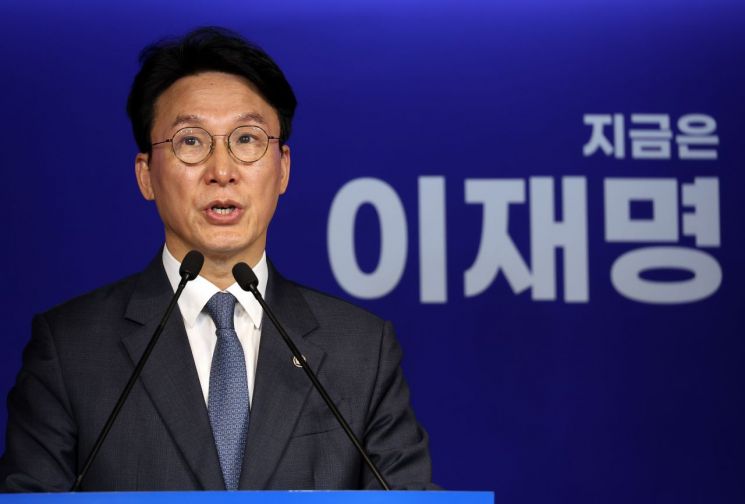 On the 11th of last month, Kim Minseok, Standing Co-Chairman of the Democratic Party, held a press conference at the Democratic Party headquarters in Yeongdeungpo-gu, Seoul, to announce his position regarding the confirmation of Kim Moonsoo as the presidential candidate of the People Power Party. Photo by Yonhap News
On June 4, President Lee Jae Myung officially began his term and is expected to make key appointments, including the Prime Minister, Director of the National Intelligence Service, and Chief Presidential Secretary, in order to minimize any administrative vacuum. Given that he must assume responsibility for state affairs without the formation of a presidential transition committee, it is anticipated that appointments will focus on individuals whose policy expertise and political acumen have been thoroughly vetted, with an emphasis on a "working government."
Kang Hoon Sik, who is being mentioned as the new Chief Presidential Secretary, led Lee Jae Myung's primary campaign. Born in 1973, he represents Asan-eul in South Chungcheong Province. He is regarded as a strategic expert in Yeouido, recognized for his meticulous work ethic and practical skills. If appointed as Chief Presidential Secretary, he is expected to play a crucial role in facilitating communication between the presidential office and the ruling party. President Lee has issued his "first executive order" to establish an emergency task force for stabilizing people's livelihoods, prioritizing urgent economic and inflation measures, which will require close cooperation between the presidential office and the ruling party.
Kim Minseok, who is being considered for the position of inaugural Prime Minister, is classified as a pro-Lee (pro-Lee Jae Myung) figure. He earned President Lee's deep trust by playing a key role during Lee's presidential campaign. Kim drew national attention after being elected to the National Assembly in both the 15th general election in 1996 and the 16th in 2000, even being mentioned as a potential future presidential candidate.
However, after facing a difficult period due to the controversy over responsibility for the 2002 Roh Moo Hyun?Chung Mong Joon presidential candidate unification, he made a political comeback by being re-elected to the National Assembly in the 21st general election in 2020. He enjoys strong support within the party, having served as the party's Senior Supreme Council member. The widespread interpretation of the Kim Minseok prime ministerial nomination is that it aims to establish strong leadership in the early days of the administration. Observers note that, in order to unite a society divided by martial law, impeachment, and an early presidential election, as well as to minimize any administrative vacuum, it is necessary to prioritize the appointment of close aides whose political and strategic abilities and loyalty have been proven.
Kim Minseok previously served as the Democratic Party's Policy Committee Chairman when President Lee was the party leader, and last year, he led the party to a landslide victory in the general elections as Chief of the General Situation Room. In August of the same year, he solidified his standing within the party by being elected Senior Supreme Council member at the party convention, and in this presidential election, he further distinguished himself by serving as Standing Co-Chairman of the Election Committee. Within the party, he is known for his outstanding political skills and clear ideological stance.
Notably, Kim Minseok drew attention last year by being the first to predict the December 3 Martial Law declaration by former President Yoon Suk Yeol. In August of last year, when former President Yoon appointed Kim Yong Hyun as Minister of National Defense, Kim Minseok claimed it was a "martial law preparation operation," sparking controversy. However, five months later, former President Yoon did in fact declare martial law, and Kim Minseok later received apologies from conservative media outlets that had previously criticized his prediction.
Kim Minseok is also known to have earned President Lee's strong trust during the process of overcoming martial law and impeachment. On December 8 of last year, he publicly called for the immediate stripping of former President Yoon's military command authority and the arrest and investigation of Kim Yong Hyun and other martial law-related figures, issuing the Democratic Party's position for the "swift and fundamental resolution of the insurrection." Writer Yoo Si Min praised this as "a perfect sentence, message, and rhetoric."
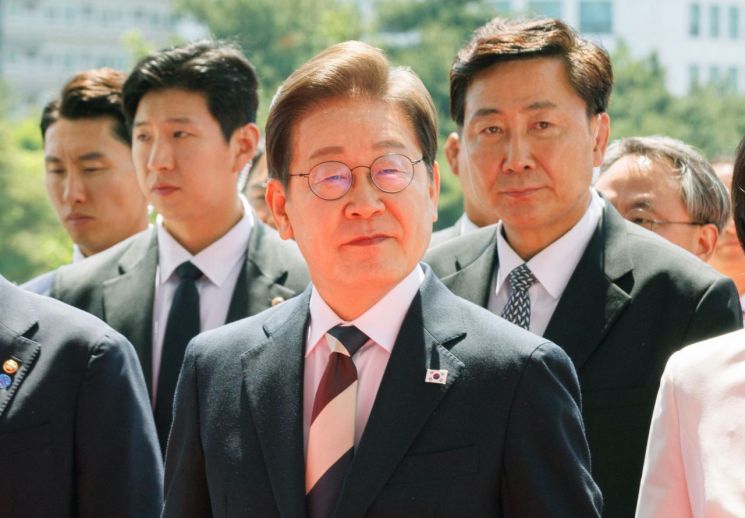 President Lee Jae Myung arrived and is moving at the National Assembly in Yeouido, Seoul, on the morning of the 4th to take the oath of office. Photo by Yonhap News
The inaugural Prime Minister of the Lee Jae Myung administration is expected to take on major responsibilities, including cabinet appointments and the overall management of state affairs. As the central axis of the cabinet, the Prime Minister will need to quickly replace ministers appointed by the previous administration to reduce administrative gaps, and will also have to lead major economic and diplomatic initiatives, such as tariff negotiations with U.S. President Donald Trump. Although the Prime Minister requires parliamentary approval, the ruling bloc currently holds more than 190 seats, which is expected to expedite the formation of the cabinet.
Meanwhile, Jung Sung Ho, a Democratic Party lawmaker known as the leading figure among pro-Lee Jae Myung members, appeared on MBC Radio on June 4 and said, "(Kim Minseok) played the most central role in the second phase of Lee Jae Myung's leadership, and he was the person President Lee consulted for political decisions. As the early days of the administration are extremely challenging and the economy is in crisis, it is essential to have someone with a strong grip and shared understanding with the President to overcome these difficulties together."
With the formation of President Lee's cabinet underway, attention is also being paid to whether discussions on the "responsible prime minister" system will gain momentum. In a statement on constitutional amendments released on May 18, President Lee said, "The President should respect the authority of the Prime Minister so that the Prime Minister can more firmly fulfill his or her duties. The appointment of the Prime Minister should require a recommendation from the National Assembly." He also proposed, "A new constitutional institution should be established with the participation of the President, Prime Minister, relevant ministers, and heads of local governments."
© The Asia Business Daily(www.asiae.co.kr). All rights reserved.


















