President Lee Wins Over 17.28 Million Votes, Sets New Record
Fails to Achieve 90% Average Vote Share in Gwangju and Jeonnam
Partial Victory Criticized for Falling Short of Initial Goals
Local Election Nominations Next June Expected to Be Affected
Democratic Party Faces Expanded Political Options, Including Strategic Nominations
Local Political Circles Emphasize the Significance of Overcoming Multiple Variables for Victory
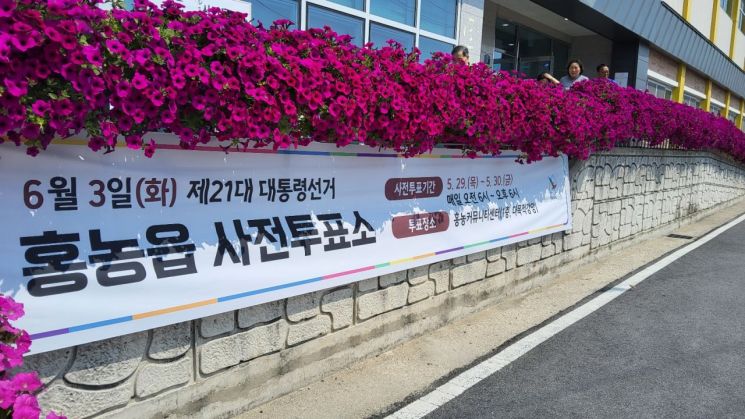 On the 29th and 30th of last month, the early voting site in Hongnong-eup, Yeonggwang for the 21st presidential election. Photo by Jinseok Shim
Although Lee Jae Myung, the Democratic Party’s presidential candidate, was elected as the 21st President of South Korea, the political circles in Gwangju and Jeonnam are not entirely optimistic. This is because they failed to achieve their initial goal of securing more than 90% of the vote, resulting in what can be seen as only a partial success. The political strategy that had previously allowed the voices of Honam within the Democratic Party to grow is now likely to recede somewhat. Furthermore, this outcome is expected to become a variable in the candidate nomination process for the upcoming local elections, which are now just a year away.
According to the National Election Commission on June 4, President Lee secured victory in the June 3 presidential election with a total of 49.42% of the votes (17,287,513 votes). Kim Moon Soo, the People Power Party candidate, received 41.15% (14,395,639 votes), while Lee Jun Seok, the Reform New Party candidate, garnered 8.34% (2,917,523 votes).
In the exit polls released by the three major terrestrial broadcasters (KBS, MBC, SBS) at around 8 p.m. the previous day, Lee Jae Myung of the Democratic Party was projected to receive 51.7%, Kim Moon Soo of the People Power Party 39.3%, and Lee Jun Seok of the Reform New Party 7.7%.
Although President Lee did not achieve the anticipated majority, he still garnered more than 17 million votes, setting a new record for the highest number of votes in a presidential election. This far surpassed the previous record of 16,394,815 votes obtained by former President Yoon Suk Yeol in the 20th presidential election. Overcoming numerous controversies and setbacks that had plagued his political career, President Lee succeeded in bringing about a change of government after three years.
For the Democratic Party, this was a historic victory, but the political circles in Gwangju and Jeonnam are unable to celebrate wholeheartedly. The failure to achieve the much-touted "90% vote share" during the campaign has put the goal of "expanding Honam’s political influence" on hold.
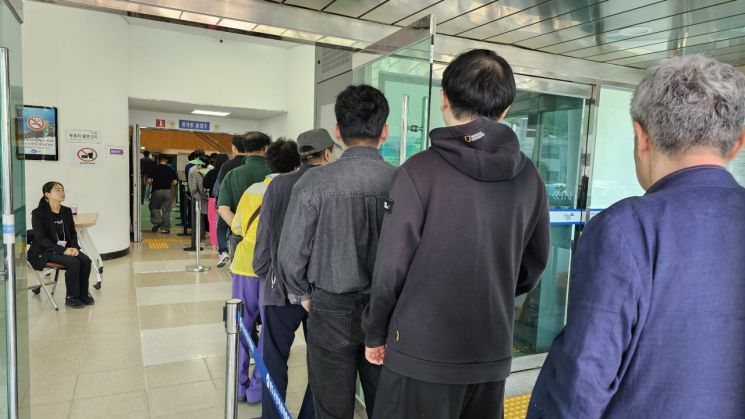 The scene at a polling station in Wando, Jeonnam, which showed the highest support for President Lee Jae Myung in the 21st presidential election. Photo provided by a reader
In fact, this election was triggered by the illegal emergency martial law declared by former President Yoon Suk Yeol. There was a clear and compelling justification for a change in government. From the early stages of the Democratic Party primary, the sentiment of "Eodaemyung" (meaning "Lee Jae Myung is inevitably the presidential candidate") spread not only in Gwangju and Jeonnam but nationwide.
For the 21st presidential election, establishing a "winning formula" became an even more crucial factor. This led politicians in Gwangju and Jeonnam to campaign for "overwhelming" victory, appealing to local voters for more than 90% support.
The underlying strategy was to achieve support levels comparable to those of former Presidents Kim Dae Jung (94.73%) and Roh Moo Hyun (93.4%), thereby strengthening their positions within the party and reviving Honam’s political influence. However, President Lee’s vote share in this election remained at 84.77% in Gwangju and 85.87% in Jeonnam, falling short of expectations.
By region, Gwangsan-gu in Gwangju recorded the highest support at 85.16%, while Wando, the constituency of lawmaker Park Jie Won?often called the "Little President" of Jeonnam?showed the highest support in Jeonnam at 89.90%. However, all fell short of the 90% threshold. Not a single constituency in Gwangju or Jeonnam reached 90%.
This has now become a significant variable for the local election strategies scheduled for next year (June 3). In local political circles, there is talk that the unofficial regional vote shares from this presidential election will become the most important criterion for nominations. This was directly or indirectly mentioned by several politicians during the campaign.
For the mayoral race in Gwangju and the gubernatorial race in Jeonnam, several potential candidates have already begun behind-the-scenes preparations. Movements are also being detected among those eyeing positions as superintendents of education, heads of basic local governments, and members of metropolitan and basic councils.
In the Gwangju mayoral race, current mayor Kang Gi Jung, lawmaker Min Hyung Bae, and Buk-gu district head Moon In are being mentioned as potential candidates. Additionally, former lawmakers Lee Byung Hoon and Lee Hyung Seok, as well as Democratic Party Standing Election Committee Chairperson Jung Eun Kyung, are also being discussed, either by their own intention or by others.
For Jeonnam governor, current governor Kim Young Rok is leading the pack, with lawmakers Shin Jung Hoon, Joo Cheol Hyun, Lee Gae Ho, and Seo Sam Seok also planning to run. Based solely on the presidential election vote shares, all of these candidates’ constituencies remained within the 85?86% range, offering little to distinguish themselves.
Furthermore, it is reported that during the presidential campaign, President Lee personally visited various regions and conducted comprehensive evaluations, including constituency management. While it may be unreasonable to directly link the presidential vote shares to nominations, there is speculation that they will have some impact. As politicians preparing to run in the local elections heavily emphasized their association with Lee Jae Myung during the campaign, this trend is expected to accelerate.
Especially given the experiences of being outperformed by the Cho Kuk Innovation Party and the Progressive Party in the Damyang county mayoral by-election last April and the Yeonggwang county mayoral by-election last October, there is a growing possibility that the nomination rules will be revised more meticulously.
This is why the "strategic nomination variable," which has been consistently discussed in some quarters, is drawing attention. Of course, considering the local sentiment of "Still Lee Jae Myung," and the fact that the region showed the highest support nationwide, some predict that the likelihood of strategic nominations is low. However, it is also clear that it is difficult to make definitive statements at this point.
The local political community is, for now, taking a reserved stance on these analyses and criticisms.
A local metropolitan council member explained, "This presidential election began against the backdrop of the previous administration’s political collapse. The results were, to some extent, predictable," adding, "Our region set a high target of 90% in considering how we should approach victory."
He continued, "It would have been better if we had achieved results comparable to those of former Presidents Kim Dae Jung and Roh Moo Hyun. To be honest, this is not an atmosphere where we can wholeheartedly celebrate the outcome," adding, "Still, every party member in the region campaigned with one heart. The fact that more than 8 out of 10 people supported Lee Jae Myung is a remarkable result. Although we failed to achieve our initial goal due to various factors such as the growing conservatism among young people and the demonization of Lee Jae Myung by certain religious groups, I do not believe this will be directly linked to nominations."
© The Asia Business Daily(www.asiae.co.kr). All rights reserved.
![Clutching a Stolen Dior Bag, Saying "I Hate Being Poor but Real"... The Grotesque Con of a "Human Knockoff" [Slate]](https://cwcontent.asiae.co.kr/asiaresize/183/2026021902243444107_1771435474.jpg)
















