The research team led by Professor Hoonseung Jwa from the Department of Electrical Engineering, Electronics, and Computer Science at DGIST (President Kunwoo Lee) announced on June 4, 2025, that they have become the first in Asia to win the Best Paper Award at the IEEE RTAS (Real-Time and Embedded Technology and Applications Symposium) 2025, the most prestigious international conference in the field of real-time systems.
IEEE RTAS is one of the world's top two academic conferences in real-time systems, organized by the Institute of Electrical and Electronics Engineers (IEEE). It is a prestigious international venue where core technologies are presented to ensure the reliability and real-time performance of safety-critical systems such as autonomous vehicles, industrial robots, and aviation control systems.
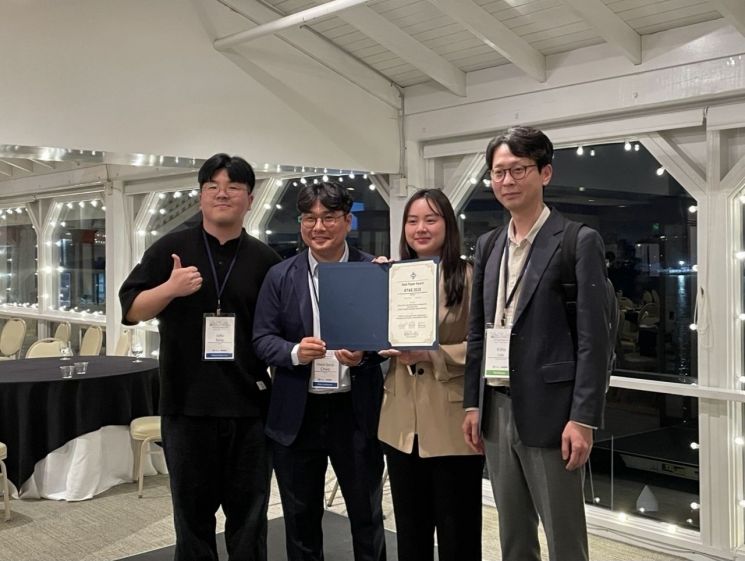 Professor Hoonseung Jwa (second from left) and his research team are holding the plaque for the Best Paper Award.
This award marks the first time in the 31-year history of the RTAS conference that a researcher affiliated with a university or research institute in Asia has received this honor. It is especially significant as it demonstrates that Korea's technological capabilities in the field of real-time systems are now recognized globally. Notably, a total of 109 papers were submitted to RTAS 2025 from around the world, but only one was selected for the Best Paper Award.
The winning paper, "CROS-RT: Cross-Layer Priority Scheduling for Predictable Inter-Process Communication in ROS 2," proposes the world's first technology to address the structural limitations that hinder cross-layer real-time performance in the Robot Operating System ROS 2.
ROS 2 is composed of multiple layers, including the application layer, middleware (DDS), and kernel layer. However, because the priority ordering among these layers is inconsistent, there have been issues with real-time communication delays.
The research team conducted a precise analysis of these structural problems and developed a cross-layer priority scheduling technology that applies both priority propagation and kernel thread control techniques. Experimental results demonstrated that this technology can reduce the worst-case latency by up to 89.3% compared to conventional ROS 2, earning significant attention from the academic community.
Professor Hoonseung Jwa stated, "This award is especially meaningful because it shows that creative research initiated in Korea has led to practical solutions in the global robotics and real-time systems fields," adding, "We will continue to accelerate the development of core foundational technologies for intelligent systems that require reliability and safety."
This research was supported by the National Research Foundation of Korea and the Institute for Information & Communications Technology Planning & Evaluation (IITP). The paper was co-authored by Sohyun Kim (first author), a student who graduated from the DGIST undergraduate program and is currently enrolled in the integrated master's and doctoral program, Juho Song (co-author), as well as Professor Sangun Oh from Korea University and Professor Gilho Lee from Soongsil University.
Meanwhile, Professor Hoonseung Jwa previously received the Best Paper Award at IEEE RTSS (Real-Time Systems Symposium), another top international conference in the field, in 2012. With this latest achievement, Professor Jwa has become the only real-time systems expert in Asia to win the Best Paper Award at both RTSS and RTAS.
© The Asia Business Daily(www.asiae.co.kr). All rights reserved.
![Clutching a Stolen Dior Bag, Saying "I Hate Being Poor but Real"... The Grotesque Con of a "Human Knockoff" [Slate]](https://cwcontent.asiae.co.kr/asiaresize/183/2026021902243444107_1771435474.jpg)















