Trump Unveils $175 Billion 'Golden Dome' Missile Defense Plan
"Ukraine's 'Spider Web Operation' Stuns the World"
"Difficult to Counter High-Efficiency Tactics Using Inexpensive Drones"
There are growing concerns about the effectiveness of the space-based missile defense system (MD) "Golden Dome," which President Donald Trump has pledged to complete by 2029 at a cost of $175 billion (approximately 240 trillion won). On June 2 (local time), Yonhap News, citing the American weekly magazine Newsweek, reported, "Following Ukraine's 'Spider Web Operation,' which shocked the world by destroying more than 40 Russian strategic bombers with inexpensive drones, the importance of drones in modern warfare has once again come to the forefront, raising further questions about the effectiveness of President Trump's 'Golden Dome' missile defense plan."
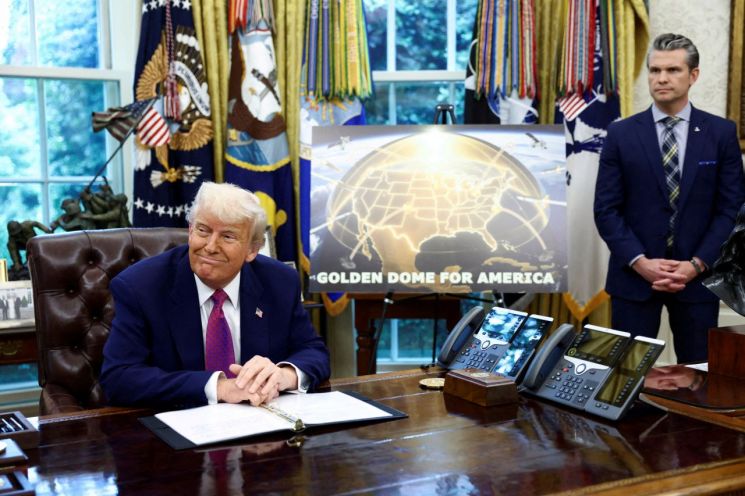 On the 20th of last month (local time), President Donald Trump of the United States announced the Golden Dome missile defense shield. Photo by Reuters Yonhap News
President Trump announced the "Golden Dome" plan on the 20th of last month. He stated his intention to deploy a next-generation missile defense system, similar to Israel's Iron Dome, during his term. In particular, the plan aims to increase interception rates by utilizing space assets, such as space-based sensors mounted on satellites and space-deployed interceptors. The initial cost alone is expected to be $25 billion (about 35 trillion won), and the total construction cost is estimated to approach $175 billion (about 244 trillion won).
Amid concerns that the "Golden Dome" is inefficient compared to its enormous cost, pessimism about the system has grown following Ukraine's drone attack on June 1. In the operation, named "Spider Web," Ukraine sent small drones into Russia, evading detection, and stored them in vehicles disguised as cargo trucks. The drones were then moved to separate locations thousands of kilometers away and remotely launched to target four nearby Russian air bases. According to Ukrainian sources, this operation successfully struck more than 40 Russian military aircraft, including the supersonic variable-sweep wing strategic bomber Tupolev (Tu)-160, inflicting damage estimated at $7 billion (about 9.7 trillion won).
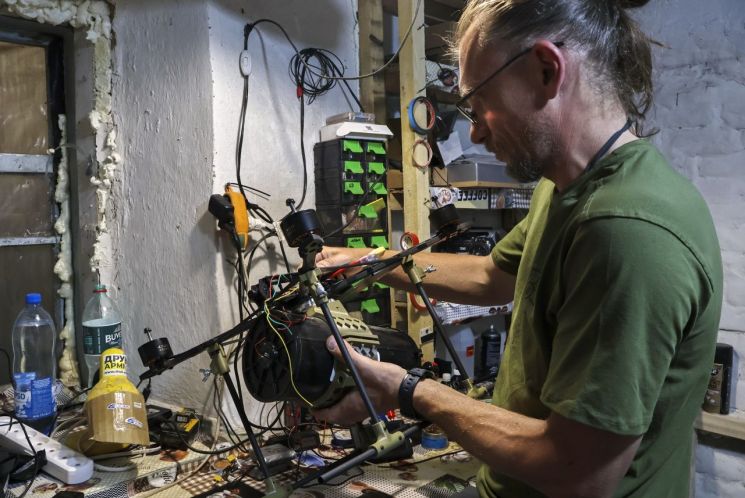 On the 2nd (local time), a soldier controlling a drone on the front line in the Zaporizhzhia region of Ukraine. Photo by EPA Yonhap News
As modern warfare increasingly centers around drones, some have assessed that the "Golden Dome" is an outdated concept that does not align with current trends. Newsweek pointed out, "As military technology rapidly advances, there is ongoing debate over whether expensive missile defense networks like 'Golden Dome' can keep up with 'low-cost, high-efficiency tactics' such as drones, which are transforming the nature of modern warfare."
Military analyst Max Boot wrote in an op-ed for the Washington Post (WP) that "future wars will not be fought with massive space-based missile defense networks like 'Golden Dome,' but rather with inexpensive and expendable drone units." Boot further argued, "If Ukraine can deploy drones this close to the core air bases of a country like Russia, how can the United States prevent China from carrying out similar operations against American air bases in the future?" He thus suggested that "Golden Dome" would be powerless in such scenarios.
Zachary Kallenborn, a drone warfare expert at the U.S. think tank Center for Strategic and International Studies (CSIS), also told Newsweek, "Drone attacks like those by Ukraine could be applied in other scenarios," adding, "Similar drone attacks from China are a legitimate concern." The average cost for Ukraine to produce a single drone is only $580 (about 790,000 won), meaning that with just the initial cost of "Golden Dome," more than 43 million drones could be produced.
© The Asia Business Daily(www.asiae.co.kr). All rights reserved.


















