Living Cost Index with High Perceived Inflation Rises by 2.3%
Fresh Food Prices Drop by 5%... Impact of Vegetables and Fruits
Last month, the consumer price index rose by 1.9%, dropping to the 1% range for the first time in five months. This was due to a significant decline in the prices of agricultural products and petroleum products. However, both the core inflation index and the perceived inflation index continued to rise in the 2% range.
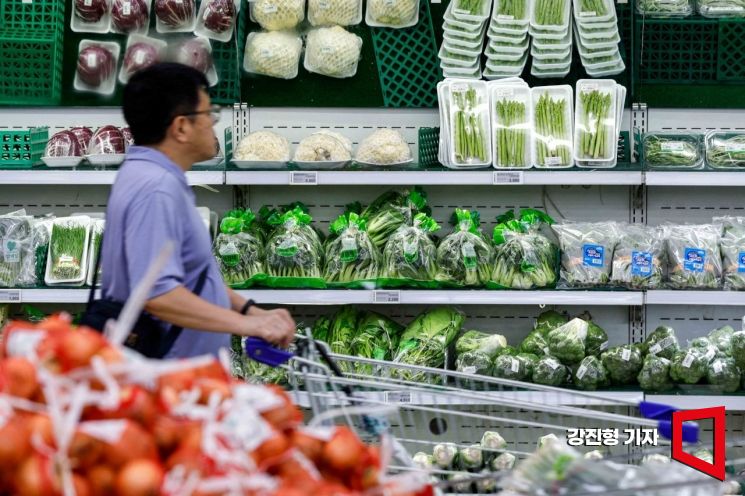 A customer visiting Hanaro Mart Yangjae Branch in Seocho-gu, Seoul is looking at the vegetable display.
According to the "Consumer Price Trends for May 2025" released by Statistics Korea on June 4, the consumer price index for last month was 116.27 (2020=100), up 1.9% from the same month last year. This is the first time in five months that the consumer price growth rate has been in the 1% range. From September (1.6%) to December (1.9%) last year, the rate remained in the 1% range for four consecutive months, but it rose to the low 2% range in January (2.2%), February (2.0%), and March and April (2.1%) of this year.
The core inflation index, which excludes items with large price fluctuations, continued to rise in the 2% range. The OECD-style index, which excludes food and energy, was 113.10, up 2.0%. This marks the second consecutive month in the 2% range, following the previous month's 2.1%. The domestic index, which excludes agricultural products and petroleum products, was 115.06, up 2.3%, maintaining a 2% range increase for three consecutive months since March (2.1%).
The living cost index, which closely reflects perceived inflation due to the high frequency of purchases, was 119.20, up 2.3%, slightly lower than the previous month's 2.4%. However, when looking only at food, the index recorded a 3.0% increase, following a relatively high rise after the previous month's 3.3%. The increase rate for non-food items was 1.9%. The living cost index including rent (both monthly and lump-sum deposits) was 2.1%, the same as the previous month.
The fresh food index was 124.51, down 5.0%. Since February (-1.4%), the index had been declining in the 1% range, but the drop widened last month. Although the index for fresh fish and shellfish, including fish and marine products, rose by 5.4%, the indices for fresh vegetables and fresh fruits fell by 5.5% and 9.7%, respectively. The increase in the supply of fresh vegetables due to improved weather conditions contributed to the decline. The drop in fresh fruit prices reflected the base effect from the previous year.
Breaking down agricultural, livestock, and fishery products, prices rose for pork (8.4%), domestic beef (5.3%), garlic (20.7%), mackerel (10.3%), imported beef (5.4%), radish (26.7%), and glutinous rice (26.2%). In contrast, prices fell for apples (-11.6%), oriental melons (-27.3%), green onions (-33.4%), tomatoes (-20.6%), napa cabbage (-15.7%), pears (-14.4%), and sweet potatoes (-8.7%).
© The Asia Business Daily(www.asiae.co.kr). All rights reserved.
![Clutching a Stolen Dior Bag, Saying "I Hate Being Poor but Real"... The Grotesque Con of a "Human Knockoff" [Slate]](https://cwcontent.asiae.co.kr/asiaresize/183/2026021902243444107_1771435474.jpg)















