Sargent, NYU Professor, Attends BOK International Conference
Warns Against Excessive Fiscal Spending: "Applies to All Countries"
At Conference Welcoming Dinner, Toasts: "Budgets Are Constraining"
Thomas John Sargent, Nobel laureate in economics and professor at New York University, visited the Bank of Korea on the 3rd, the day of the 21st presidential election, and emphasized that "a country should only spend as much as it earns." He warned against government fiscal deficits caused by excessive spending.
Professor Sargent made these remarks during a meeting with reporters immediately after the second day of the BOK International Conference, held at the Bank of Korea in Jung-gu, Seoul, on this day. When asked about the proper direction for Korea's overall economy, including fiscal policy under the incoming administration, he avoided giving a direct answer. However, he reiterated his long-held belief, saying, "Just as individuals must spend within their monthly income, the same applies to nations. A country should only spend as much as it earns. This principle applies everywhere, including the United States." During a toast at the welcoming dinner for the conference on June 2, Professor Sargent also declared, "Budgets are constraining." Professor Sargent, who was awarded the Nobel Prize in Economics in 2011 for his "empirical research on cause and effect in macroeconomics," has served as an overseas advisor to the Bank of Korea's Economic Research Institute since 2007.
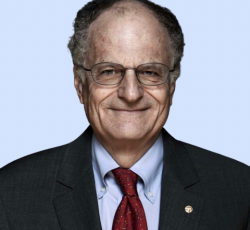 Thomas John Sargent, Professor at New York University. Bank of Korea
The problems caused by fiscal deficits in various countries were also highlighted several times during the two-day BOK International Conference held on June 2 and 3. Francesco Bianchi, professor at Johns Hopkins University, diagnosed during a session titled "The Impact of Fiscal Factors on Inflation in OECD Countries" that "about 80% of government finances during the COVID-19 pandemic were raised through the real value decline of debt due to unexpected inflation." He analyzed that the expansion of fiscal spending by countries during this period may have been a major factor behind the high inflation that later occurred worldwide.
Professor Bianchi stated, "The implementation of large-scale fiscal policies led to a sharp increase in debt, which heightened inflationary pressures and concerns about recession." He explained, "Although reliance on fiscal policy became necessary as monetary policy tools such as ultra-low interest rates left little room for intervention, I believe injecting such an excessive amount of money was a mistake." He further emphasized, "Since there is a possibility that fiscal spending could increase further in the future, it is important for central banks to maintain their independence."
Saki Bigio, professor at UCLA and a discussant at the conference, pointed out that if government spending surges, there could come a point where even inflation cannot offset fiscal deficits. In the United States, if government spending increases and the price of U.S. Treasury bonds falls, a rollover crisis could occur in which the government is unable to refinance its debt at maturity. Such warnings continued on the second day of the conference. Francis Warnock, professor at the University of Virginia, noted that the composition of U.S. Treasury bond investors has changed, and criticized the perception that rollovers will always be easy. He said, "Before the global financial crisis, about 40% of U.S. Treasury bonds were held by foreign governments, but now U.S. and foreign private investors hold the largest share." He added, "Private investors are different from foreign governments, which have motives beyond profitability for holding bonds. It is not appropriate to assume, from a position of privilege, that these investors will continue to hold U.S. Treasury bonds."
© The Asia Business Daily(www.asiae.co.kr). All rights reserved.
![Clutching a Stolen Dior Bag, Saying "I Hate Being Poor but Real"... The Grotesque Con of a "Human Knockoff" [Slate]](https://cwcontent.asiae.co.kr/asiaresize/183/2026021902243444107_1771435474.jpg)














