Exit Polls by Three Major Broadcasters Show 12.4 Percentage Point Gap
Small Business Owners Call for Politics to Revive the Local Economy
Hopes for Leadership That Unites Regions, Generations, and Genders
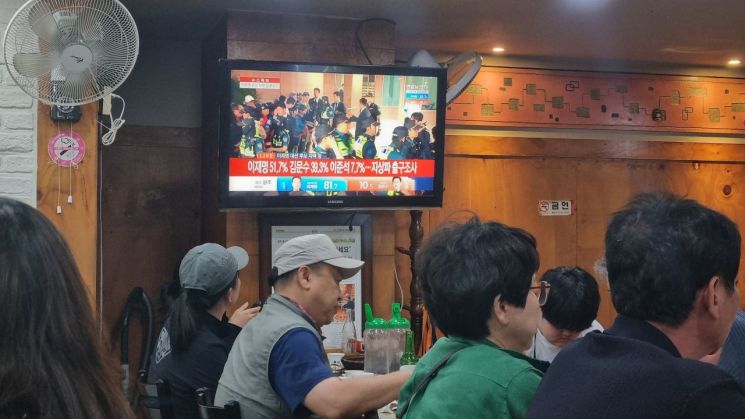 On the 3rd, the results of the public opinion survey by the three major terrestrial broadcasters are being shown on TV at a restaurant on Chungjang-ro, Dong-gu, Gwangju. Photo by Min Chanki
"This time, Lee Jaemyung should win." "Kim Moonsu and Lee Joonseok are also politicians needed in Honam."
On the 3rd, at the Asian Food Culture Street near the old city hall in Dong-gu, Gwangju.
After casting their votes in the presidential election, citizens gathered here in small groups for dinner. Unsurprisingly, the main topic of conversation was the results of the presidential election held that day. In Gwangju, a city known for its strong progressive leanings, most people predicted a victory for Lee Jaemyung, the candidate from the Democratic Party of Korea. However, some hoped for a strong showing from Kim Moonsu of the People Power Party and Lee Joonseok of the Reform New Party.
At a restaurant on Chungjang-ro in Dong-gu, citizens having dinner kept their eyes fixed on the TV, which was showing the results of the exit polls. Around 8 p.m., when the results indicated that their preferred candidate was leading, cheers erupted. On the other hand, some remained calm, saying that they needed to wait and see the final results.
According to the exit poll for the 21st presidential election conducted by the three major terrestrial broadcasters on this day, Lee Jaemyung received 51.7%, while Kim Moonsu received 39.3%, showing a gap of 12.4 percentage points. Lee Joonseok of the Reform New Party was expected to receive 7.7% of the vote.
When Lee Jaemyung recorded 81.7% in the Gwangju regional exit poll, citizens reacted with exclamations such as, "Wow, he surpassed 80%," and "We won."
Kim, a 34-year-old office worker, said, "For Gwangju to move forward, Lee Jaemyung, who has pledged a variety of policies for Honam including AI initiatives, should become president. Regardless of who wins, I hope the next president will implement policies that end conflicts based on region, gender, and generation, and promote unity."
Another citizen, Park, 27, said, "After watching the presidential debates, I thought Lee Joonseok was the most suitable candidate for president. I also felt that it is time to move beyond the two-party system and adopt a new political landscape."
The conversations among citizens naturally turned to their hopes for the new government. Small business owners lamented that, even after social distancing measures ended following COVID-19, sales had not yet recovered. Meanwhile, office workers and those in their 20s and 30s expressed hopes for policies promoting unity.
Jung, a 50-year-old small business owner, said, "I've been running my business here for over 20 years, but these days are the toughest. All around me, there are rental signs, and foot traffic has decreased. I hope the government will implement detailed policies to revive the local economy, rather than one-off measures like subsidies."
Song, a 38-year-old office worker, said, "I hope the new government will pursue politics that seek ways for us to live together, rather than dividing the people. Instead of arguing over who is right, it's time to think about how we can coexist. I hope politics becomes a promise of unity, not a language that fuels division."
Meanwhile, in the exit poll for the 21st presidential election conducted by the three major terrestrial broadcasters on the main voting day, June 3, Lee Jaemyung of the Democratic Party of Korea was projected to receive 51.7%, while Kim Moonsu of the People Power Party was projected at 39.3%. The gap between the two candidates was 12.4 percentage points, well outside the margin of error. Lee Joonseok of the Reform New Party was projected to receive 7.7% of the vote.
© The Asia Business Daily(www.asiae.co.kr). All rights reserved.
![Clutching a Stolen Dior Bag, Saying "I Hate Being Poor but Real"... The Grotesque Con of a "Human Knockoff" [Slate]](https://cwcontent.asiae.co.kr/asiaresize/183/2026021902243444107_1771435474.jpg)
















