The Organisation for Economic Co-operation and Development (OECD) has revised its forecast for South Korea's economic growth rate this year down to 1.0%. This adjustment reflects the contraction in trade and investment caused by the tariff war initiated by the Donald Trump administration in the United States. However, the OECD maintained its growth forecast for next year at 2.2%, unchanged from its previous projection.
In its economic outlook released on June 3, the OECD projected South Korea's growth rate for this year at 1.0%. This is a 0.5 percentage point decrease from the March forecast of 1.5%. In March, the OECD had already lowered its forecast by 0.6 percentage points.
The OECD's 1.0% projection is the same as that of the International Monetary Fund (IMF, 1.0%), and higher than the forecasts of other major institutions such as the Korea Development Institute (KDI) and the Bank of Korea (0.8%).
The OECD analyzed that "tariffs and external uncertainties are constraining exports and investment, while private consumption is expected to recover in the latter half of the year, supported by easing political uncertainties and rising real wages." The economic growth rate for next year was maintained at 2.2%, the same as the previous projection (2.2%).
For inflation, the OECD expects the rate to converge close to the target, at 2.1% this year and 2.0% next year.
The OECD stated, "While fiscal support may be appropriate in the short term, it should be accompanied by the establishment of a sustainable long-term fiscal management system," and recommended, "Monetary policy should pursue further easing, taking into account sluggish domestic demand."
Meanwhile, the OECD noted that labor market reforms could promote growth, alleviate elderly poverty, and reduce the opportunity costs associated with childbirth and childcare.
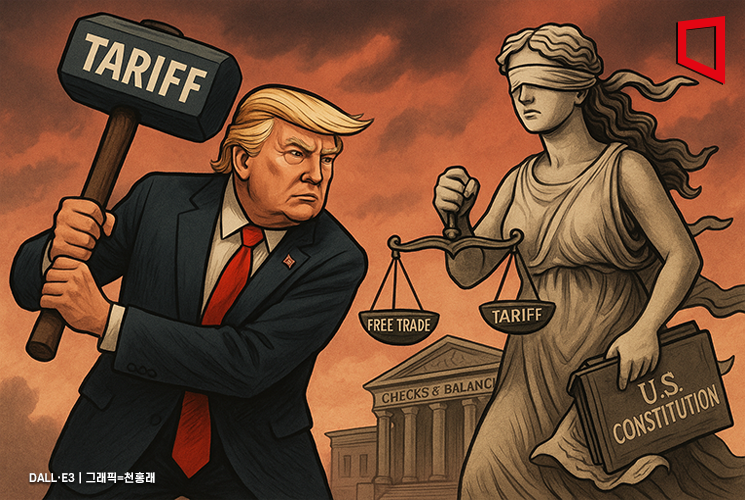
The OECD forecasts that the global economy will slow to 2.9% this year and next year. This represents downward revisions of 0.2 percentage points and 0.1 percentage points, respectively, compared to the previous outlook.
The United States, the world's largest economy and South Korea's second-largest export destination, is expected to see significant growth deceleration due to higher effective tariff rates and retaliatory measures by trading partners. The OECD lowered its growth forecasts for the U.S. to 1.6% for this year and 1.5% for next year.
For China, South Korea's largest export market, the OECD expects growth to slow due to tariff increases and other factors, but fiscal stimulus will partially offset this, resulting in projected growth rates of 4.7% this year and 4.3% next year.
The OECD assessed that "the global economy is becoming more challenging," and noted that "if trade barriers continue to rise, financial conditions worsen, business and consumer sentiment weakens, and policy uncertainty increases, these factors could have a negative impact on growth."
Regarding inflation, the OECD forecasts that G20 countries will see inflation ease to 3.6% this year and 3.2% next year. However, it also emphasized that there are significant risk factors for both growth and inflation projections, and that the extent and duration of the economic slowdown remain highly uncertain.
© The Asia Business Daily(www.asiae.co.kr). All rights reserved.
![Clutching a Stolen Dior Bag, Saying "I Hate Being Poor but Real"... The Grotesque Con of a "Human Knockoff" [Slate]](https://cwcontent.asiae.co.kr/asiaresize/183/2026021902243444107_1771435474.jpg)















