From 5,600 km² to 3,200 km²: Protected Area to Be Reduced
Excluded Zones Overlap with Miner-Owned Land
Experts Warn of Exposure to Illegal Mining
The Peruvian government has sparked controversy by deciding to reduce the protected area of the Nasca geoglyph site, a UNESCO World Heritage Site, by nearly half.
On June 2 (local time), British daily The Guardian and AP reported that the Peruvian Ministry of Culture has decided to shrink the Nasca protected area from the current 5,600 square kilometers to 3,200 square kilometers, a reduction of 42%.
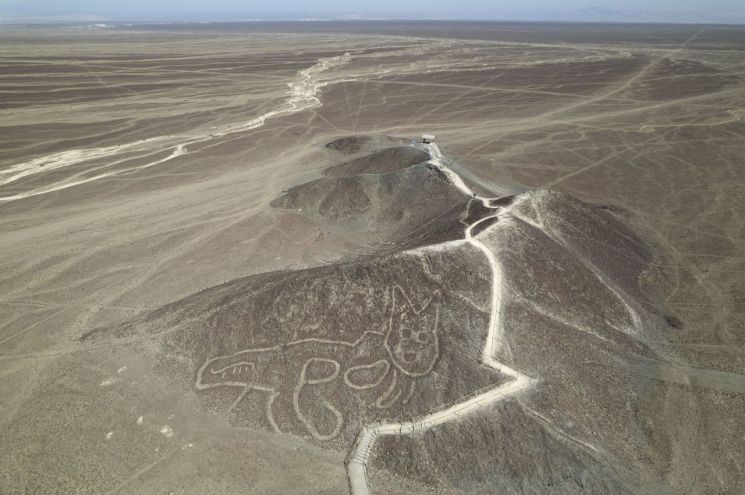
Regarding this decision, the Ministry of Culture explained that it was made "based on 20 years of research" and stated that "it does not affect the UNESCO World Heritage area." The reduced area is equivalent to the size of about 1,400 soccer fields.
The Nasca site is an area that features massive geoglyphs believed to have been created by ancient indigenous communities around 2,000 years ago. These geoglyphs were first discovered in the 1920s. The site contains hundreds of enormous drawings of animals such as hummingbirds, monkeys, cats, and whales, as well as geometric shapes, etched into the ground. To this day, it remains a mystery who created these drawings and for what purpose. The figures are so large that their full forms can only be seen from the air, such as by plane or helicopter. UNESCO designated the Nasca Plateau as a World Heritage Site in 1994.
Archaeologists and environmental activists are concerned that the Peruvian government's decision will expose the ancient site to illegal mining. The Nasca area contains mineral resources such as iron ore and gypsum, and the areas excluded from the protected zone overlap with regions owned by miners registered in the Mining Formalization Registry (REINFO).
A nonprofit organization established to protect the Nasca geoglyphs condemned the decision, saying it is an attempt to erase history. Environmental lawyer Cesar Ipenza criticized the government for "prioritizing mining over the environment." He also pointed out that "the regulatory system is being relaxed to benefit mining operators." Luis Jaime Castillo, an archaeologist and former Minister of Culture, said, "This area is already suffering from illegal mining." Mariano Castro, former Minister of the Environment, told AP, "This decision exposes the protected area to very serious risks," adding, "While this decision benefits certain groups, it is harmful to all Peruvians."
© The Asia Business Daily(www.asiae.co.kr). All rights reserved.

















