The Main Players in the First Half: Defense and Shipbuilding
Policy-Driven ETFs to Take Center Stage in the Second Half
Continued Optimism for Cutting-Edge Industries in the US and China
In the first half of the year, the main players in the exchange-traded fund (ETF) market were the defense and shipbuilding sectors. They recorded robust gains, with returns exceeding 100%. The industry expects that in the second half of the year, ETFs related to government policies and cutting-edge industries will be promising. This outlook is based on the continued growth potential of advanced industries such as artificial intelligence (AI), as well as the possibility of positive results from policy support.
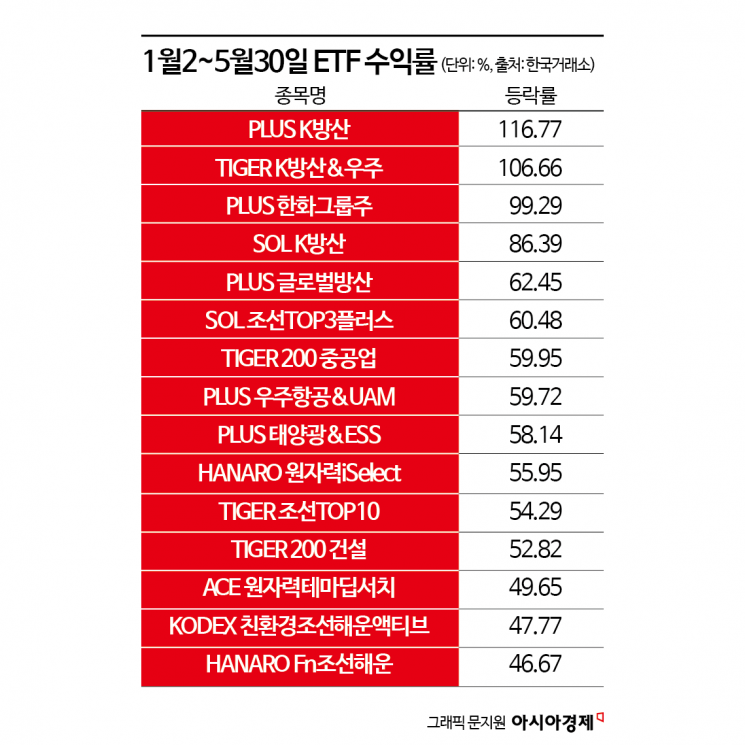
According to the Korea Exchange on June 4, defense stocks dominated ETF performance from January 2 to May 30 this year. The top performer was PLUS K-Defense, which posted a return of 116.77%. It was followed by TIGER K-Defense & Space (106.66%), PLUS Hanwha Group (99.29%), SOL K-Defense (86.39%), and PLUS Global Defense (62.45%).
For defense stocks, expectations for growth have increased due to rapid export growth, which has been driven by global geopolitical instability and the expansion of global defense budgets. Yang Seungyun, a researcher at Eugene Investment & Securities, stated, "Korean defense stocks have shown a gradual upward trend, with expanded overseas orders in 2022, export performance reflected in 2023, high export margins confirmed in 2024, and peer group rerating expected in 2025. Growth is not over yet, as there are still growth drivers such as market expansion and increased defense budgets by NATO."
Shipbuilding stocks also performed strongly. SOL Shipbuilding TOP3 Plus and TIGER 200 Heavy Industries recorded returns of 60.48% and 59.95%, respectively. The shipbuilding sector has entered a supercycle. The industry expects the boom to last for more than 10 years. Although new orders have slowed recently, the sector still holds an order backlog equivalent to three years of work, supporting expectations for continued growth. According to a researcher at Kiwoom Securities, "As of the first quarter of this year, the order backlog of the five major shipbuilders was about 147 trillion won, up 1.3% from the end of last year. Despite a slowdown in new orders and backlog growth this year due to the boom in new ship orders over the past three years, the five major shipbuilders still have enough new shipbuilding volume to fill their docks for about three years, giving them an advantage in price negotiations."
While sectors with momentum such as orders and earnings delivered high returns in the first half, experts advise that in the second half, it may be advantageous to look at ETFs related to election policies.
Policy-related ETFs include TIGER Korea Dividend Dow Jones, TIGER Holding Companies, Kodex Financial High Dividend TOP10 Target Weekly Covered Call, and Kodex Renewable Energy Active. Kodex Renewable Energy Active is an ETF that invests in renewable and eco-friendly energy such as solar, wind, nuclear, and hydrogen. With the global increase in power infrastructure investment, as well as the expansion of domestic investment in renewable energy and new energy technologies and the construction of energy highways, these ETFs are expected to benefit.
Additionally, ETFs such as TIGER Korea Dividend Dow Jones, TIGER Holding Companies, and Kodex Financial High Dividend TOP10 Target Weekly Covered Call are related to resolving the "Korea Discount," so policy expectations may be reflected. If policies such as dividend income reform and improvements in corporate governance are implemented, it is expected that there will be an expansion of cash dividends and valuation rerating across large-cap high-dividend stocks.
Investing in overseas companies related to cutting-edge industries also remains promising. Notable examples include Kodex US Humanoid Robot and TIGER China Tech TOP10. A representative from Samsung Asset Management emphasized, "The largest market that can be created by AI is the humanoid robot market. Due to intensifying global competition in humanoid development, US companies with capital and technological prowess, such as Nvidia and Tesla, are expected to lead the humanoid ecosystem going forward."
A representative from Mirae Asset Global Investments explained, "The combined market capitalization of the top 10 Chinese tech companies is only about one-tenth that of the US M7. Based on 2024 GDP, the US stands at $27 trillion and China at $18 trillion, so there is a high likelihood that Chinese tech stocks, especially those supported by the Chinese government, will be re-evaluated in the future."
If you are looking to invest in safe-haven assets, it may be worth paying attention to the ACE KRX Gold Spot ETF. In April this year, the international gold price hit an all-time high of $3,300 per ounce. Another positive factor is the news that, starting in July, the US will implement the final Basel III rules and recognize gold as a "high-quality liquid asset (HQLA)." Financial institutions are required to maintain a high-quality liquid asset ratio of at least 100% to prepare for liquidity crises. Previously, only 50% of the market value of gold was recognized, but now it will be recognized at 100%. In other words, gold's status as a safe-haven asset has been strengthened.
A representative from Korea Investment Management stated, "In addition to the existing factors behind the rise in gold prices, considering the expected interest rate cuts and increased demand for gold investment in the second half, gold is expected to play an effective role in asset allocation."
It is also expected to be promising to look for ETFs that could benefit from a US base rate cut. Related ETFs include Kodex US 30-Year Treasury Active. A representative from Samsung Asset Management said, "Given that concerns over the US fiscal deficit are already reflected, the current level of US long-term bond yields is considered attractive. We expect long-term bond yields to fall in the second half as the US lowers its base rate."
© The Asia Business Daily(www.asiae.co.kr). All rights reserved.

















