Waller: "If tariffs stabilize at 10% and inflation nears 2%, I will support a rate cut on 'good news'"
Temporary inflation impact from tariffs... "No need to overreact in setting policy rates"
"If the effective tariff rate stabilizes close to the low-tariff scenario (10%), inflation moves toward the target of 2%, and the labor market remains robust, I will support a rate cut in the second half of this year based on 'good news.'"
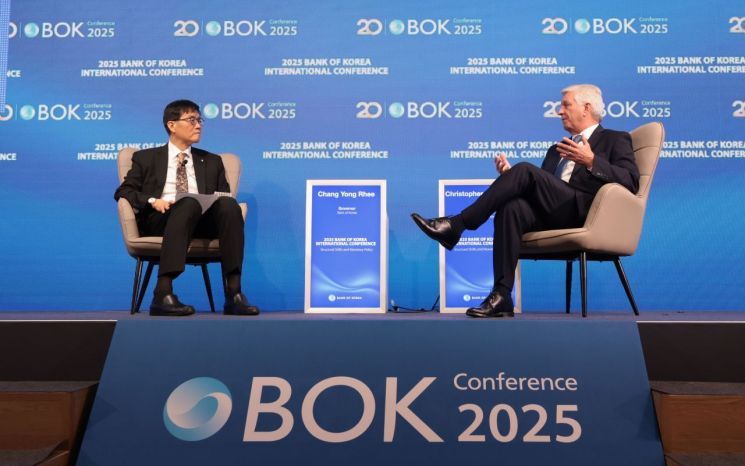 Lee Changyong, Governor of the Bank of Korea, and Christopher Waller, Member of the Board of Governors of the U.S. Federal Reserve, are having a discussion on the topic "U.S. Economic Outlook and Its Impact on Monetary Policy" at the "2025 BOK International Conference" held on the 2nd at the Bank of Korea in Jung-gu, Seoul. Photo by Yonhap News
Christopher Waller, Member of the Board of Governors of the U.S. Federal Reserve, made these remarks during his keynote speech on the topic "U.S. Economic Outlook and Its Impact on Monetary Policy" at the "2025 BOK International Conference" held at the Bank of Korea in Jung-gu, Seoul, on June 2. He stated, "The inflation increase due to U.S. tariffs will be temporary."
Waller had previously presented scenarios for both high tariffs (25%) and low tariffs (10%) in mid-April. Based on those scenarios, he projected that if high tariffs were applied, inflation as measured by personal consumption expenditures (PCE) could rise to 5% this year. If low tariffs were applied, inflation would rise to 3% and then gradually decline. Waller said, "The volatility in tariff announcements, U.S. court rulings, and last week's doubling of metal tariffs by the European Union are all contributing to uncertainty." However, he added, "For now, with the temporary reduction of tariffs on China, I observe the effective tariff rate to be around 15%, between the two scenarios."
He explained, "Tariffs will lead to an increase in unemployment, and, all other things being equal, that upward trend will persist." He added, "High tariffs will reduce spending, and companies will respond by partially cutting production and employment." He expects the impact of tariffs to be most pronounced in the second half of this year. However, he emphasized that the inflationary impact of tariffs will be temporary, as not all tariffs will be passed on to consumers. He said, "In the 10% scenario, I believe the burden will be distributed equally among consumers, importers, and exporters, each bearing one-third. In this case, inflation will rise by 0.3% in the short term." He also analyzed that if tariffs rise above 10%, companies will face limits and a greater share of the increase will be passed on to consumers.
Waller stated, "Given that tariff-driven inflation will not be persistent and inflation expectations will remain stable, I believe we do not need to place much weight on the short-term inflation effects of tariffs when setting policy rates." Fortunately, he added, the strong labor market and progress on inflation through April provide time to monitor trade negotiations and economic conditions.
During the subsequent policy discussion with Lee Changyong, Governor of the Bank of Korea, Governor Lee asked, "You said the impact of tariffs on U.S. inflation is temporary, but some other Fed governors have different views. How should we interpret this?" Waller replied, "Of course, each view is different, but the general consensus is that tariffs, unlike oil prices or other shocks, do not have lasting effects." He added, "Those with different opinions are actually more concerned because the surge in inflation since 2021 turned out to be more persistent than expected. However, at that time, there were overlapping factors such as a more persistent labor supply shock, supply chain disruptions, and expansionary fiscal policy responses, which is different from the current situation."
When asked whether he is concerned about inflation remaining above target if the U.S. policy rate is cut, he responded, "Headline PCE inflation rose 2.1% over the 12 months through April. This is not much higher than the 2% target and is approaching the target," dismissing such concerns. Regarding the recent rise in U.S. long-term Treasury yields, he said, "It is a response to questions about the sustainability of U.S. fiscal policy, as well as to tariffs and communications from the U.S. administration." Governor Lee added, "So far, there has been no clear sign of foreign investors adjusting their portfolios. I think there is a change in expectations or sentiment."
The BOK International Conference has been held since 2005 and marks its 20th anniversary this year. This year's conference is being held over two days, June 2 and 3, under the theme "Structural Shifts and Monetary Policy." Discussions will cover the latest research findings and policy cases on monetary policy, including the inflation targeting system, demographic structure, fiscal policy, climate change, and the impact of artificial intelligence (AI) technology on monetary policy, with the aim of drawing implications for the future.
© The Asia Business Daily(www.asiae.co.kr). All rights reserved.
![Clutching a Stolen Dior Bag, Saying "I Hate Being Poor but Real"... The Grotesque Con of a "Human Knockoff" [Slate]](https://cwcontent.asiae.co.kr/asiaresize/183/2026021902243444107_1771435474.jpg)















