Pro-European vs. Nationalist Showdown
Pro-European Candidate Projected to Lead by 0.6 Percentage Points
Final Results to Be Announced on June 2
On June 1 (local time), exit polls from the Polish presidential runoff indicated that the pro-European ruling party candidate is expected to narrowly lead over the right-wing nationalist opposition candidate.
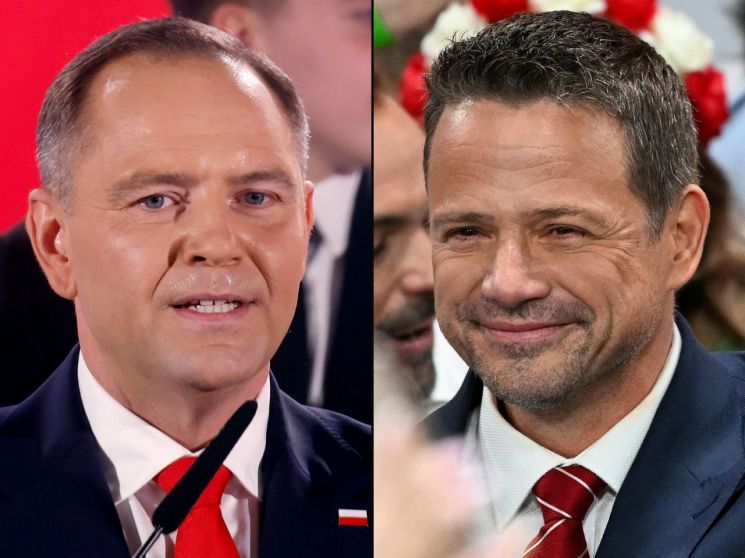
According to a poll released immediately after voting ended at 9 p.m. by public broadcaster TVP and polling agency Ipsos, Rafal Trzaskowski, the candidate of the ruling Civic Platform (PO), was projected to receive 50.3%, while independent candidate Karol Nawrocki, backed by the opposition Law and Justice Party (PiS), was expected to receive 49.7%.
Both sides claimed victory immediately after the exit poll results, but with the race within the margin of error, the final outcome is set to be announced on June 2. In the first round of voting held on May 28, Trzaskowski received 31.36% and Nawrocki 29.54%, allowing both to advance to the runoff.
Trzaskowski campaigned on liberal policies such as guaranteeing abortion rights and protecting LGBTQ rights, framing the election as a choice between Western liberalism and Eastern European nationalism. In contrast, Nawrocki, a conservative historian, argued that the Polish constitution should take precedence over European law, advocated for Poland's withdrawal from refugee agreements, and called for stronger security cooperation with U.S. President Donald Trump.
This presidential election became a direct confrontation between the centrist liberal government, which has sought to restore relations with the European Union (EU) since taking power, and the conservative camp promoting 'Poland First' policies, with polls showing a tight race until the very end of the runoff. The fact that far-right candidates received over 20% of the vote in the first round also became a variable in the runoff.
In Poland, the prime minister from the parliamentary majority party forms the cabinet and exercises executive power, but the president also wields significant influence, including command of the military, veto power over legislation, and the authority to grant pardons. Incumbent President Andrzej Duda, from PiS, defeated Trzaskowski in 2020 to win re-election, but is set to step down in August due to a three-term limit. During his tenure, he has checked Prime Minister Donald Tusk's reforms through the use of his veto power and other means.
If Trzaskowski wins, it is expected to accelerate the Tusk cabinet's key initiatives, such as judicial and media reforms and the expansion of women's rights. PO is the largest party in the six-party Civic Coalition (KO) that leads the coalition government, and Prime Minister Tusk serves as its leader.
On June 1 (local time), exit polls from the Polish presidential runoff indicated that the pro-European ruling party candidate is expected to narrowly lead over the right-wing nationalist opposition candidate.
According to a poll released immediately after voting ended at 9 p.m. by public broadcaster TVP and polling agency Ipsos, Rafal Trzaskowski, the candidate of the ruling Civic Platform (PO), was projected to receive 50.3%, while independent candidate Karol Nawrocki, backed by the opposition Law and Justice Party (PiS), was expected to receive 49.7%.
Both sides claimed victory immediately after the exit poll results, but with the race within the margin of error, the final outcome is set to be announced on June 2. In the first round of voting held on May 28, Trzaskowski received 31.36% and Nawrocki 29.54%, allowing both to advance to the runoff.
Trzaskowski campaigned on liberal policies such as guaranteeing abortion rights and protecting LGBTQ rights, framing the election as a choice between Western liberalism and Eastern European nationalism. In contrast, Nawrocki, a conservative historian, argued that the Polish constitution should take precedence over European law, advocated for Poland's withdrawal from refugee agreements, and called for stronger security cooperation with U.S. President Donald Trump.
This presidential election became a direct confrontation between the centrist liberal government, which has sought to restore relations with the EU since taking power, and the conservative camp promoting 'Poland First' policies, with polls showing a tight race until the very end of the runoff. The fact that far-right candidates received over 20% of the vote in the first round also became a variable in the runoff.
In Poland, the prime minister from the parliamentary majority party forms the cabinet and exercises executive power, but the president also wields significant influence, including command of the military, veto power over legislation, and the authority to grant pardons. Incumbent President Andrzej Duda, from PiS, defeated Trzaskowski in 2020 to win re-election, but is set to step down in August due to a three-term limit. During his tenure, he has checked Prime Minister Donald Tusk's reforms through the use of his veto power and other means.
If Trzaskowski wins, it is expected to accelerate the Tusk cabinet's key initiatives, such as judicial and media reforms and the expansion of women's rights. PO is the largest party in the six-party Civic Coalition (KO) that leads the coalition government, and Prime Minister Tusk serves as its leader.
© The Asia Business Daily(www.asiae.co.kr). All rights reserved.

















