On June 1, Gyeonggi Province announced 21 individuals, including militia leader An Seungwoo, from the "80 Independence Activists of the Year" in commemoration of Uibyeong Day.
This year, Gyeonggi Province, together with the Gyeonggi branch of the Liberation Association, is selecting 80 independence activists from the region to be revealed sequentially on major anniversaries related to the independence movement, in order to highlight their achievements. The first announcement was made during the 106th Samiljeol (March 1st Movement) commemoration with Cho Soang, followed by the release of 21 names on April 11, the anniversary of the Provisional Government's establishment. This is the third announcement.
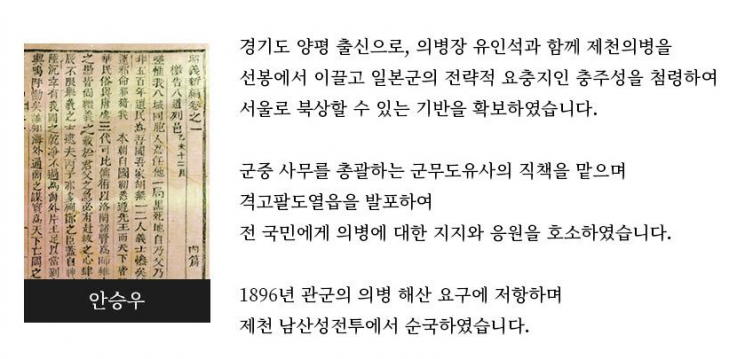
Among the individuals revealed this time, independence activist An Seungwoo, a native of Yangpyeong, led the Jecheon militia at the forefront alongside militia leader Yu Inseok. He captured Chungju Fortress, a strategic stronghold of the Japanese army, thereby securing a base for advancing north toward Seoul. He also served as the chief military administrator, issuing the "Gyeokgopaldo Yeoreup" proclamation to rally nationwide support and encouragement for the militia.
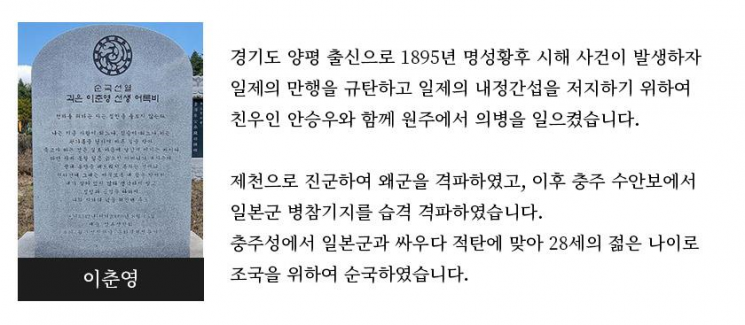
Independence activist Lee Chunyoung, from Jipyeong (present-day Yangpyeong County), attacked and destroyed a Japanese military supply base in Suanbo, Chungju. He later died at the age of 28 while fighting Japanese forces at Chungju Fortress, sacrificing his life for his country.
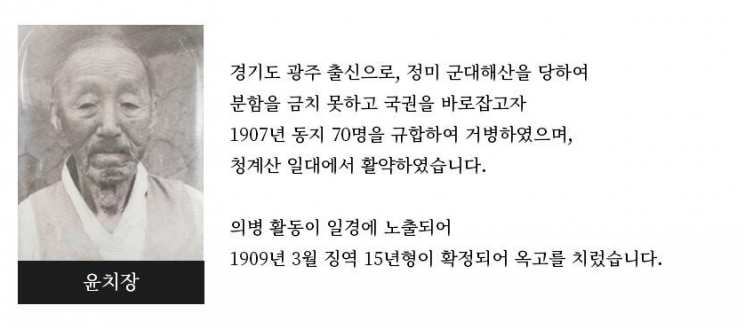
Independence activist Yoon Chijang, a native of Gwangju in Gyeonggi Province, took up arms with 70 comrades in 1907 in the Cheonggyesan area after the forced disbandment of the Korean military, aiming to restore national sovereignty. His militia activities were later exposed to the Japanese police, and in March 1909, he was sentenced to 15 years in prison and served time.
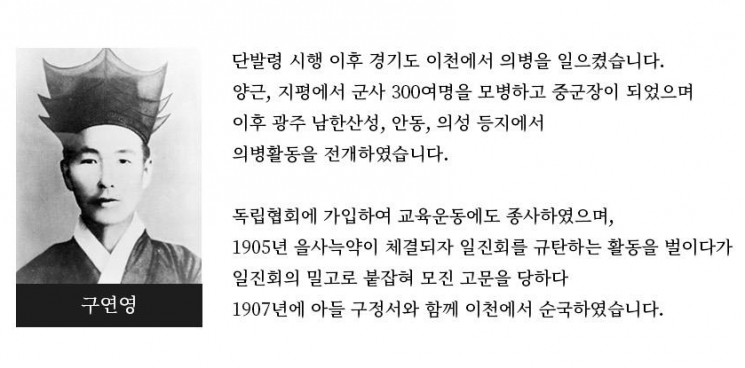
Independence activist Gu Inyoung raised a militia in Icheon after the enforcement of the short-hair ordinance. He recruited about 300 soldiers in Yanggeun and Jipyeong and became a middle commander. He later carried out militia activities in areas such as Namhansanseong in Gwangju, Andong, and Uiseong. He also joined the Independence Association and participated in the enlightenment movement. After the Eulsa Treaty was signed in 1905, he condemned the Iljinhoe and, in 1907, was executed by firing squad in Icheon along with his son Gu Jeongseo.
Other notable figures include: Kim Seokjin, who condemned the Five Eulsa Traitors, refused a title from the Japanese, and took his own life; militia leader Yoon Insun, active in northeastern Gyeonggi; Jeon Deokgi, who founded the Shinminhoe and led the youth movement through the Cheongnyeon Hakwoohoe; Lee Suheung, special intelligence officer of the Manchurian Army Headquarters; Sim Hun, author of anti-Japanese literature such as "When That Day Comes" and "Evergreen Tree"; militia member Jeong Juwon, active in Juksan, Yangji, Suwon, and Anseong; Shin Hyeongu, who participated in raising military funds in Yongin in 1908; Kim Baekseon, who served as the vanguard leader in Yu Inseok's militia unit; Gu Jeongseo, son of Gu Inyoung, who also engaged in enlightenment and militia activities; Han Sunhoe, a Cheondogyo leader who was imprisoned for raising independence funds; Lee Youngsoi, a key figure in the Hwaseong March 1st Movement who killed a Japanese police officer; Shin Nakgyun, who erased the Japanese flag from the photo of athlete Sohn Keechung's gold medal ceremony at the Berlin Olympics; Lee Gyuchang, who participated in the March 1st Movement and attacked township offices and police stations; Jo Gyerim, daughter of Cho Soang, who worked in the General Affairs Department of the Provisional Government's Ministry of Foreign Affairs in Chongqing; Won Cheonil, who took part in the independence movement in Yangju, Gyeonggi; Kim Maria, who shouted "Long Live Korean Independence" on the first anniversary of the March 1st Movement; and Yoon Maria, who, while attending Ewha Girls' High School, participated in a demonstration supporting the Gwangju Student Movement.
Gyeonggi Province will announce an additional 34 individuals from the 80 on July 24, the anniversary of the Bumin-gwan Incident.
The Bumin-gwan Incident occurred on July 24, 1945, when a bomb was detonated at the Bumin-gwan in Seoul by patriotic martyrs led by Jo Moonki, disrupting the Asia People's Unity Conference organized by pro-Japanese groups. This incident is considered the last major act of resistance during the Japanese colonial period. Information about the 80 Independence Activists of the Year can be found on the Gyeonggi Provincial Government website and the Instagram account of the Gyeonggi branch of the Liberation Association.
© The Asia Business Daily(www.asiae.co.kr). All rights reserved.
![Clutching a Stolen Dior Bag, Saying "I Hate Being Poor but Real"... The Grotesque Con of a "Human Knockoff" [Slate]](https://cwcontent.asiae.co.kr/asiaresize/183/2026021902243444107_1771435474.jpg)

















