The molecular causal relationship between a high-salt diet (salty foods) and the worsening of brain tumors has been demonstrated.
On June 1, KAIST announced that a research team led by Professor Lee Heungkyu of the Department of Life Sciences has, for the first time in the world, identified that a high-salt diet can alter the composition of gut microbiota. The team found that, in this process, the metabolic byproduct 'propionate' secreted by these microbes accumulates excessively in the gut, which can exacerbate brain tumors.
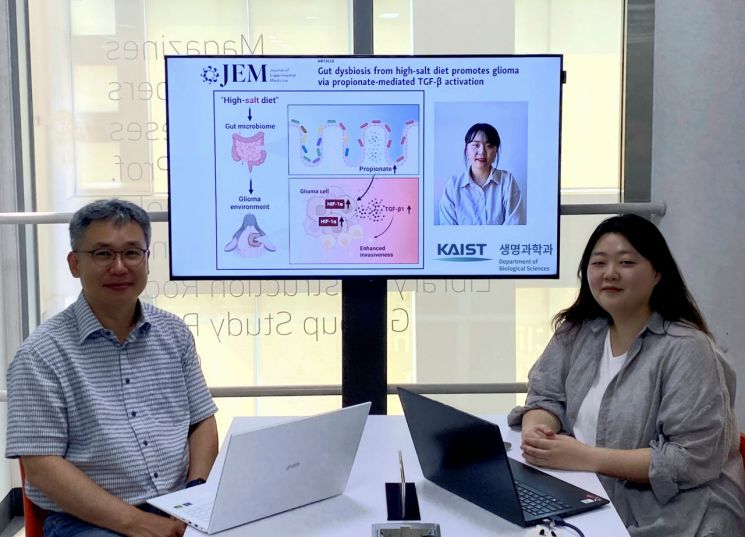 (From left) Professor Lee Heungkyu of the Department of Life Sciences, Dr. Kim Chaewon (monitor), Dr. Kim Hyunjin. Provided by KAIST
The research team demonstrated this finding through experiments using a mouse model of brain tumors. When tumor cells were injected into mice that had consumed a high-salt diet for four weeks, their survival rate was significantly lower, and tumor size was larger compared to mice fed a normal diet.
Notably, similar brain tumor aggravation was observed in experiments where gut microbiota were eliminated with antibiotics, or where germ-free mice were transplanted with fecal microbiota samples from mice that had consumed feces equivalent to those from humans on a high-salt diet. This indicates that changes in gut microbiota are a key factor in the worsening of brain tumors.
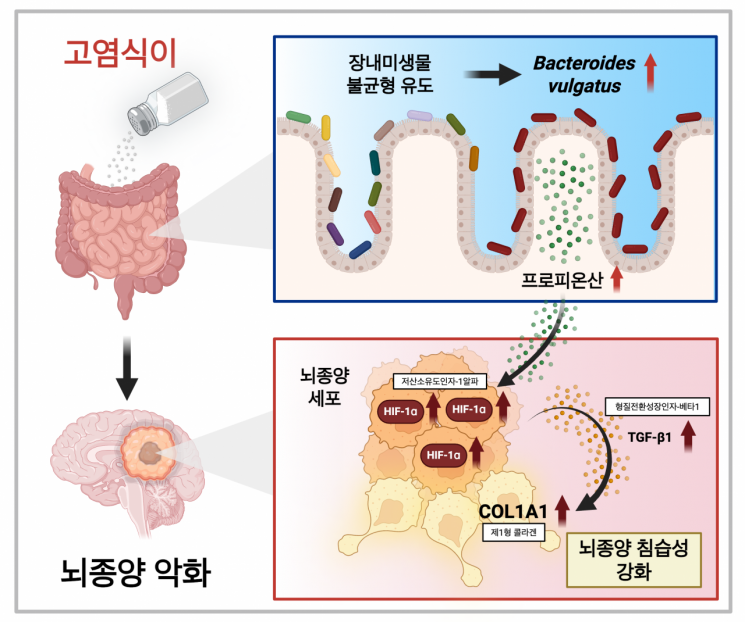
The research team also discovered that among the gut microbiota, the bacterium 'Bacteroides vulgatus' increases in response to a high-salt diet and elevates the expression of the 'propionate' enzyme.
Mice subjected to the high-salt diet experiment showed abnormally high levels of propionate in the gut. This substance activated 'hypoxia-inducible factor-1 alpha (HIF-1α)' in brain tumor cells, as if oxygen were insufficient, even when oxygen was actually sufficient.
Additionally, the team explained that the high-salt diet increased 'transforming growth factor-beta (TGF-β)', which led to excessive production of 'type I collagen (COL1A1)'. As a result, tumor cells spread more easily and their malignancy increased.
Professor Lee Heungkyu stated, "This study is the first in the world to demonstrate at the molecular level that consuming salty foods can alter the gut microbial ecosystem, and that metabolites produced in this process can worsen brain tumors." He added, "These research findings will serve as foundational data for future studies on the impact of dietary control on brain tumor patients and for developing gut microbiota-based therapeutic strategies."
This research was conducted as part of the Basic Research Program for Individuals and the Bio-Medical Technology Development Program, both supported by the Ministry of Science and ICT and the National Research Foundation of Korea.
The research results (paper) were published in the May 22 issue of the biomedical journal 'Journal of Experimental Medicine.' Dr. Kim Chaewon (currently a postdoctoral researcher at Boston Children's Hospital, affiliated with Harvard Medical School, USA) and Dr. Kim Hyunjin (postdoctoral researcher at the KAIST Institute of Life Science and Technology) participated as co-first authors.
© The Asia Business Daily(www.asiae.co.kr). All rights reserved.
![Clutching a Stolen Dior Bag, Saying "I Hate Being Poor but Real"... The Grotesque Con of a "Human Knockoff" [Slate]](https://cwcontent.asiae.co.kr/asiaresize/183/2026021902243444107_1771435474.jpg)
















