Citing Senior U.S. Defense Officials
Pentagon Denies WSJ Report After One Week
Only U.S. Attends Shangri-La Dialogue... China Absent
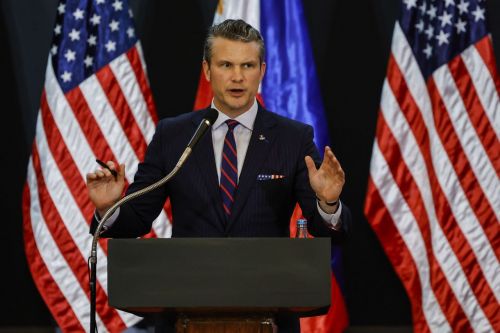 Pete Hegseth, U.S. Secretary of Defense, is holding a press conference in the Philippines on March 28. Photo by AP News
The Donald Trump administration, which has placed the highest priority on containing China, is not ruling out the possibility of reducing U.S. Forces Korea (USFK) as it formulates its Indo-Pacific strategy, according to a report by the Associated Press (AP) on May 29 (local time), citing multiple senior U.S. defense officials. This comes just a week after the U.S. Department of Defense denied a Wall Street Journal (WSJ) report that the Trump administration was considering a reduction of USFK.
According to AP, two senior defense officials who accompanied U.S. Secretary of Defense Pete Hegseth to Singapore for the Shangri-La Dialogue, an Asian security conference, stated that "the reduction of troops stationed in South Korea is not being ruled out in the process of determining the necessary force posture to best contain China in the region."
One official explained that while the number of USFK personnel has not yet been decided, future troop deployments will be optimized not only for defending South Korea from North Korea but also for deterring China. AP added that the officials spoke on condition of anonymity because the matter is not public.
The United States must effectively contain China, a challenger to its global hegemony, with limited defense personnel and resources. Victor Cha, Korea Chair at the Center for Strategic and International Studies (CSIS), noted at a seminar in March that the selection of Elbridge Colby as U.S. Deputy Secretary of Defense for Policy would "almost certainly put pressure on South Korea for 'strategic flexibility' of USFK." Cha also warned that "the U.S.-ROK alliance is facing a 'quiet crisis.'"
Xavier Brunson, Commander of U.S. Forces Korea, also stated at the Association of the United States Army (AUSA) LANPAC Symposium held in Hawaii on May 15 that "USFK is not solely focused on deterring North Korea. We are also focused on regional operations, activities, and investments as part of the broader Indo-Pacific strategy."
This month, reports emerged suggesting the possibility of a reduction in USFK. On May 22, WSJ reported that the U.S. Department of Defense was preparing a plan to relocate approximately 4,500 troops?15.7% of the roughly 28,500 U.S. troops currently stationed in South Korea?to other locations within the Indo-Pacific, including Guam, a U.S. territory. The Department of Defense denied this the following day, stating, "This is not true." USFK also issued a similar statement. The South Korean Ministry of National Defense stated, "There have been no discussions between South Korea and the United States regarding the withdrawal of USFK."
Meanwhile, the Shangri-La Dialogue, held in Singapore from today until June 1, is being attended by Secretary Hegseth, Japanese Defense Minister Gen Nakatani, and others. From South Korea, Cho Changrae, Director General for Defense Policy, is participating as the representative. While the Minister of National Defense has attended the Shangri-La Dialogue every year, this year, acting Minister Kim Sunho (Vice Minister) will not participate, considering the grave security situation on the Korean Peninsula and domestic political events such as the June 3 presidential election. Dong Jun, China's Minister of National Defense, is also absent, leading to the cancellation of U.S.-China military talks, according to the Hong Kong daily South China Morning Post (SCMP).
© The Asia Business Daily(www.asiae.co.kr). All rights reserved.
![Clutching a Stolen Dior Bag, Saying "I Hate Being Poor but Real"... The Grotesque Con of a "Human Knockoff" [Slate]](https://cwcontent.asiae.co.kr/asiaresize/183/2026021902243444107_1771435474.jpg)















