With the inauguration of President Lee Jaemyung, the six-month-long "vacuum in summit diplomacy" has come to an end. The diplomatic community has described this period as an unprecedented dark chapter in the history of South Korean diplomacy. While South Korea's diplomatic activities were brought to a halt due to the aftermath of the 12·3 martial law, the international landscape has undergone a major paradigm shift. Centered on the US-China power rivalry, the world order of liberalism that had persisted for over 80 years since World War II in the 1930s has begun to show signs of fracture. In addition, North Korea's increasingly sophisticated nuclear weapons and the deepening military cooperation between North Korea and Russia have introduced a new level of security threat on the Korean Peninsula. In this harsh diplomatic and security environment, the challenges that the Lee Jaemyung administration's "pragmatic diplomacy" must address are truly formidable.
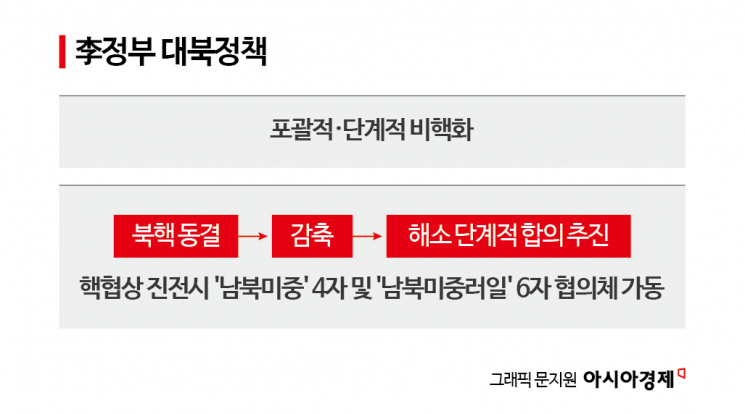
◆The Biggest Challenge for the New Administration: North Korea's Nuclear Program= During his presidential campaign, President Lee outlined a comprehensive and phased denuclearization peace regime, moving from "freezing nuclear capabilities" to "reducing them" and ultimately "completely eliminating the threat." While the ultimate goal of "denuclearization" is the same as the peace process pursued by the previous Moon Jaein administration, there are structural differences in the approach.
Unlike the Moon Jaein administration, which expected a "big deal" through direct summits between North Korea and the United States, the Lee Jaemyung administration seeks a phased approach, starting with freezing North Korea's nuclear capabilities and pursuing medium- to long-term agreements. Furthermore, if nuclear negotiations make progress, there are plans to activate a four-party (South-North-US-China) or six-party (South-North-US-China-Russia-Japan) cooperation framework.
Having already experienced failure in negotiations with President Donald Trump, North Korea has, since the end of 2023, promoted the "two hostile states" theory, distancing itself from the South Korean government while demonstrating closer military ties with Russia. Given how entangled the North Korean nuclear issue has become, it is difficult to expect significant progress within the term of a single administration.
Former Foreign Minister Kim Sung-hwan recently expressed concern at the Jeju Forum, stating, "Looking back, whenever our government changes, we always make various policy proposals to North Korea, but North Korea comes to the negotiating table only when it suits them." He added, "For the time being, regardless of the policies implemented, it will not be easy to improve inter-Korean relations." He also advised, "In the end, the new administration must conduct diplomacy in a way that maintains deterrence based on the South Korea-US alliance."
◆Pursuing Practical Interests through 'Balanced Diplomacy' with Four Major Powers= The Lee Jaemyung administration emphasizes "pragmatic diplomacy." This is interpreted as an intention to pursue tangible national interests through balanced diplomacy not only with the United States, but also with China, Japan, and Russia. As with all previous South Korean presidents, President Lee's top diplomatic priority is expected to be communication with President Trump.
It is likely that President Lee will visit the United States as soon as possible to hold a South Korea-US summit. This will be the first face-to-face meeting between the two leaders since the US tariff policies that shook the world. The administration will need to strengthen South Korea-US cooperation in the economic, military, and advanced technology sectors, while also addressing contentious issues such as the redeployment of US forces in Korea and defense cost-sharing in relation to the Taiwan Strait issue.
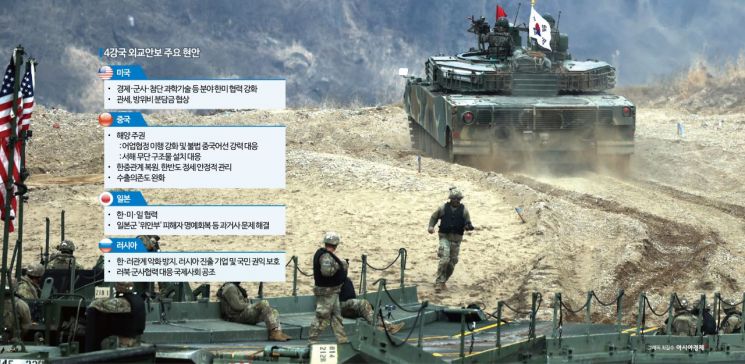
Restoring South Korea-China relations, which were rated the worst ever under the previous Yoon Sukyeol administration, is another challenge for the new administration. However, the new government has signaled a "strong response" on issues of maritime sovereignty, such as illegal fishing by Chinese vessels and the unauthorized installation of structures in the provisional measures zone of the West Sea. Regarding Russia, the administration is expected to prevent further deterioration of relations and take a pragmatic approach to protect the rights and interests of South Korean companies and citizens. Nevertheless, the government has made it clear that it firmly opposes illegal North Korea-Russia military cooperation and will work in coordination with the international community.
Korea-Japan relations, which have fluctuated with each administration, are met with both expectations and concerns. Supporters of the progressive government are likely to demand a clear stance on historical issues, such as the Japanese military "comfort women." President Lee has also pledged to "restore the honor of the comfort women victims." However, the new administration also recognizes the importance of South Korea-US-Japan cooperation amid the US-China conflict.
◆Time-Pressed 'Multilateral Diplomacy'... President Lee to Make Immediate Debut= President Lee does not have much time before making his debut on the international diplomatic stage. This month alone, there is a high possibility that he will attend key summits such as the Group of Seven (G7) and the North Atlantic Treaty Organization (NATO). Successfully hosting the Asia-Pacific Economic Cooperation (APEC) summit, which will be held in South Korea for the first time in 20 years in the second half of this year, is also a major task for the new administration. If the US and Chinese leaders visit South Korea simultaneously for APEC, it is expected to become a major diplomatic event that will draw global attention.
© The Asia Business Daily(www.asiae.co.kr). All rights reserved.
![Clutching a Stolen Dior Bag, Saying "I Hate Being Poor but Real"... The Grotesque Con of a "Human Knockoff" [Slate]](https://cwcontent.asiae.co.kr/asiaresize/183/2026021902243444107_1771435474.jpg)
















