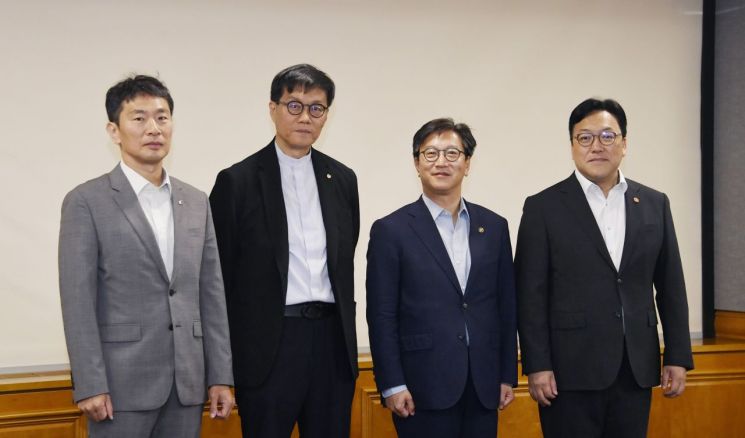
 Kim Beomseok, Acting Minister and First Vice Minister of the Ministry of Economy and Finance, is taking a commemorative photo with attendees before the start of the Macroeconomic and Financial Issues Meeting held at the Bankers' Hall in Jung-gu, Seoul, on the morning of the 30th. From left to right: Lee Bokhyun, Governor of the Financial Supervisory Service; Lee Changyong, Governor of the Bank of Korea; Kim Beomseok, Acting Minister; Kim Byunghwan, Chairman of the Financial Services Commission.
The government announced that it will continue to closely monitor external conditions, as volatility in the domestic financial and foreign exchange markets could once again increase due to the uncertainty surrounding the unconstitutionality ruling on the Trump reciprocal tariffs.
Kim Beomseok, Acting Minister and First Vice Minister of the Ministry of Economy and Finance, made this statement during the Macroeconomic and Financial Issues Meeting held on the 30th, which was attended by Lee Changyong, Governor of the Bank of Korea; Kim Byunghwan, Chairman of the Financial Services Commission; and Lee Bokhyun, Governor of the Financial Supervisory Service.
The attendees agreed that while the domestic financial and foreign exchange markets are generally stable, volatility could rise again depending on developments in the U.S. court rulings related to reciprocal tariffs. Therefore, they decided to continue monitoring external conditions, focusing on the F4 meetings.
Previously, on the 28th, the United States Court of International Trade (CIT) ruled that President Trump's broad imposition of tariffs based on the International Emergency Economic Powers Act (IEEPA) exceeded his authority and invalidated the tariffs. However, as the U.S. administration possesses various legal mechanisms to circumvent the court's decision, there are growing concerns that this ruling could increase uncertainty in trade negotiations between the United States and major countries.
Regarding the corporate bond market, the participants evaluated that overall issuance remains smooth and credit spreads are stable, supported by solid investment demand.
However, since market caution toward some non-investment-grade companies persists, the government will closely examine future corporate financing conditions. In addition, they will continue to monitor the impact of the Bank of Korea's interest rate cuts on household lending and the housing market in the Seoul metropolitan area.
© The Asia Business Daily(www.asiae.co.kr). All rights reserved.
![Clutching a Stolen Dior Bag, Saying "I Hate Being Poor but Real"... The Grotesque Con of a "Human Knockoff" [Slate]](https://cwcontent.asiae.co.kr/asiaresize/183/2026021902243444107_1771435474.jpg)
















