Some Rocks at Giant's Causeway Damaged
Practice of Inserting Coins Between Columns Causes Deterioration Over Time
"Coins Expand and Exert Pressure, Leaving Stains on the Stones"
It has been found that some of the rocks at Giant's Causeway, a tourist attraction located in Northern Ireland, are breaking apart. This is because the long-standing practice of tourists inserting coins between the rocks has continued for years.
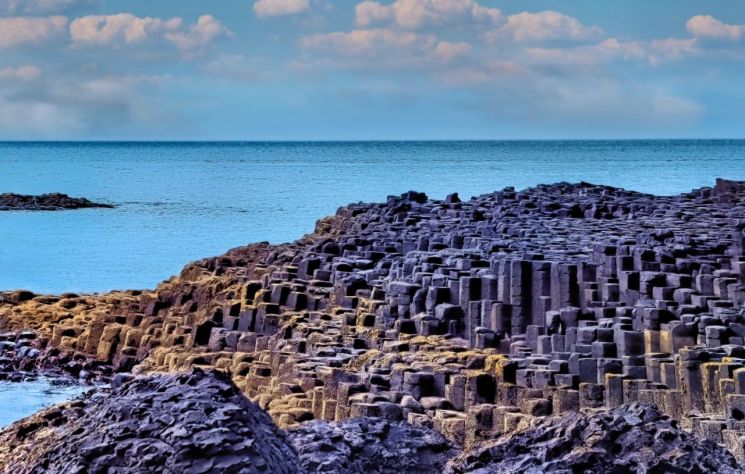
According to Yonhap News Agency, on the 28th (local time), the National Trust, the organization responsible for managing the United Kingdom's natural and cultural heritage, stated, "Tourists inserting coins into the gaps between the basalt columns are damaging this area, which has been designated as a World Heritage Site." The organization urged, "Please stop the practice of leaving coins, leave no trace behind, and help ensure that this natural heritage remains special for future generations."
This site, one of the most popular tourist destinations in Northern Ireland, was listed as a UNESCO World Natural Heritage site in 1986. Last year alone, it recorded 648,000 visitors. It is located at the foot of basalt cliffs along the boundary of the Antrim plateau and the coast in Northern Ireland. About 40,000 columnar joints rise dramatically above the sea, creating a spectacular view. The name "Giant's Causeway" comes from the legend that the Irish giant Finn McCool built it to cross over and confront his Scottish rival, Benandonner.
However, according to the British Geological Survey, tourists from around the world have inserted coins into the gaps between the basalt columns as a way to commemorate their visit, which has damaged both the appearance and structure of the rocks. Cliff Henry, a nature officer at the National Trust, pointed out, "As the coins rust, they expand to three times their original thickness, exerting tremendous pressure on the rocks and causing them to break apart." He also noted, "Afterward, as the coins corrode in seawater, unsightly streaks of copper, nickel, and iron oxides stain the stones."
In response, the National Trust, together with the Causeway Coast and Glens Heritage Trust, deployed stone conservation experts to safely remove coins from 10 pilot areas. It is estimated that removing all remaining coins will cost 30,000 pounds (about 55 million won). In addition, signs will be installed to instruct visitors not to leave coins in the rock crevices.
The issue of coins causing problems at tourist attractions has occurred before. Last year, the City of Rome in Italy considered introducing an entrance fee for the Trevi Fountain, one of the must-see tourist sites, as a measure to control the flow of visitors. The purpose was to manage the large crowds that make it difficult to properly view the fountain, and to prepare for an even greater influx of people during this year's Catholic Jubilee. Completed in 1762, the Trevi Fountain is regarded as a masterpiece of late Baroque architecture. The scene in the 1953 film "Roman Holiday," where Audrey Hepburn throws a coin into the fountain, is especially famous, and it is known that about 1 million euros (approximately 1.5 billion won) are collected there each year.
© The Asia Business Daily(www.asiae.co.kr). All rights reserved.
![Clutching a Stolen Dior Bag, Saying "I Hate Being Poor but Real"... The Grotesque Con of a "Human Knockoff" [Slate]](https://cwcontent.asiae.co.kr/asiaresize/183/2026021902243444107_1771435474.jpg)















