"Exact timetable cannot be provided...
Interview suspension will not last long"
The U.S. Department of State has stated that "there may be some delays" regarding the temporary suspension of interviews for U.S. visa applicants, including those applying for study and training programs. The department recommended that applicants "regularly check for available (visa interview) appointments."
At a briefing held on the 29th (local time), U.S. State Department spokesperson Tammy Bruce explained that the visa issuance process consists of two stages: application and interview. She emphasized, "It is still possible to apply for a visa," and advised, "Continue to check the online (interview reservation) system."
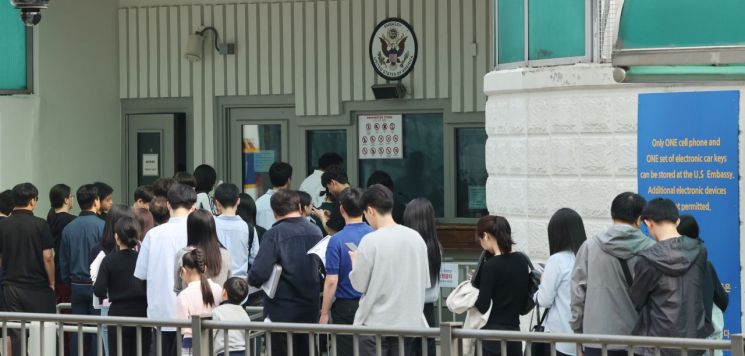
Previously, the State Department instructed a temporary suspension of visa interviews for F (study and language training), M (vocational training), and J (visiting scholar) visas until further notice. This measure was implemented to expand identity verification procedures, including the review of applicants' social networking services (SNS) activities.
Regarding the timing of future additional guidance, spokesperson Bruce stated, "You will receive further information, but I cannot provide an exact timetable. (The interview suspension) has an end point and it will be fairly quick." She added, "Once guidance is sent to the posts and embassies and consulates adjust their procedures, (interview) appointments will resume immediately."
Additionally, when asked about the specific criteria following Secretary of State Marco Rubio's announcement the previous day that the U.S. would aggressively cancel visas for Chinese students in key fields due to national security concerns, Bruce declined to provide details. She said, "We do not provide specific visa-related information for reasons of national security, negotiations, or diplomacy." She added, "Disclosing how we handle these matters could make such measures less effective."
She further stated, "We will not tolerate the Chinese Communist Party exploiting U.S. universities to enhance its military capabilities, conduct intelligence gathering, suppress dissenting voices, or steal U.S. research, intellectual property, and technology."
© The Asia Business Daily(www.asiae.co.kr). All rights reserved.
![Clutching a Stolen Dior Bag, Saying "I Hate Being Poor but Real"... The Grotesque Con of a "Human Knockoff" [Slate]](https://cwcontent.asiae.co.kr/asiaresize/183/2026021902243444107_1771435474.jpg)















