U.S. Court Rules Tariffs Under IEEPA Illegal
Navarro: "Other Measures Possible"... Mentions Trade Act Section 122
Nvidia's Surprise Earnings Support Stock Market
U.S. Q1 Growth Rate -0.2%... New Unemployment Claims Rise
The three major U.S. stock indexes opened higher on May 29 (local time) but later turned mixed. The market initially rose after a U.S. court blocked President Donald Trump's tariff policy and Nvidia reported a surprise earnings result. However, gains were erased as White House aides indicated they would pursue tariffs through alternative measures.
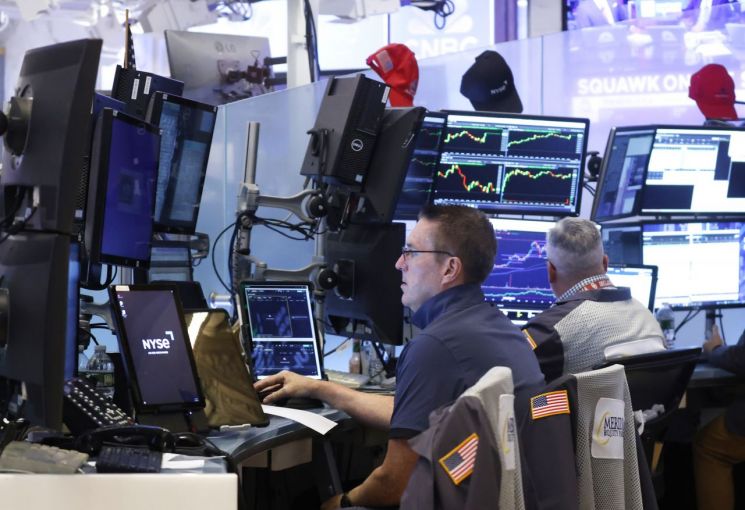
As of 11:40 a.m. on the New York Stock Exchange, the blue-chip Dow Jones Industrial Average (Dow) was down 69.24 points (0.16%) at 42,029.46 from the previous session. The large-cap S&P 500 index was up 14.37 points (0.24%) at 5,902.92, while the tech-heavy Nasdaq index was up 107.31 points (0.56%) at 19,208.25.
The previous day, the U.S. Court of International Trade ruled that President Trump's tariffs imposed under the International Emergency Economic Powers Act (IEEPA) were illegal. As a result of the ruling, the so-called "Liberation Day Tariffs" announced on April 2?which included a 10% base tariff on all global imports and reciprocal tariffs by country?were completely nullified. The White House immediately appealed, calling the decision a "judicial coup."
With Trump's tariff policy losing momentum, the market rallied at the open. However, as White House aides signaled their intention to continue imposing tariffs based on other legal grounds, the stock market gave up its earlier gains. Peter Navarro, White House advisor on trade and manufacturing and known as Trump's "tariff architect," said in an interview with Bloomberg TV that "if we lose on the IEEPA, we will take other measures," and that U.S. Trade Representative Jamieson Greer would soon announce available options. He also mentioned that Section 122 of the Trade Act, which allows for tariffs of up to 15% for as long as 150 days on countries with severe trade deficits, could serve as another legal basis for tariffs. The ruling is also weighing on investor sentiment by raising the possibility of delayed future trade negotiations and increasing uncertainty around tariff policy.
Adam Crisafulli, founder of Vital Knowledge, commented, "The tariff drama is not over yet," adding, "Trump has other legal workarounds for pushing his aggressive tariff agenda, and investors expect him to use them."
Despite the confusion over tariff policy, Nvidia's surprise earnings announcement after the previous day's close continues to support the stock market. Nvidia reported revenue of $44.06 billion and net income of $18.8 billion for the first quarter of fiscal 2026 (February to April 2025), up 69% and 26%, respectively, from the same period last year. Adjusted earnings per share (EPS) were $0.96. These results exceeded LSEG analyst estimates of $43.31 billion in revenue and $0.93 EPS. Revenue from the key data center segment, which includes AI chips and related components, rose 73% year-on-year to $39.1 billion, driving overall revenue growth. This demonstrates the continued expansion of demand for AI semiconductors, fueled by the proliferation of generative AI applications like OpenAI's ChatGPT.
James Demmert, founder and Chief Investment Officer (CIO) at Main Street Research, analyzed, "Nvidia's strong earnings report can energize overall investor optimism and help keep the focus on the power of artificial intelligence (AI), rather than the tariff and tax headlines coming out of Washington."
On the same morning, the U.S. Department of Commerce announced that the preliminary estimate for U.S. first-quarter gross domestic product (GDP) growth was an annualized decrease of 0.2% from the previous quarter. While this was a slight upward revision from the earlier estimate of -0.3%, the combination of weaker consumer spending due to tariff policy and increased corporate imports led to negative growth for the first time in three years since the first quarter of 2022 (-1.0%). New unemployment claims also increased. According to the U.S. Department of Labor, new unemployment claims for the week of May 18?24 totaled 240,000, up 14,000 from the previous week's 226,000 and above the forecast of 229,000.
U.S. Treasury yields were lower. The benchmark 10-year U.S. Treasury yield, a global bond market indicator, fell 4 basis points (1bp = 0.01 percentage point) from the previous day to 4.43%. The 2-year U.S. Treasury yield, which is sensitive to monetary policy, was down 4 basis points from the previous session to 3.94%.
By stock, Nvidia, which posted stronger-than-expected results, surged 4.92%. Cadence Design Systems and Synopsys, which had plunged the previous day on news that the Trump administration was considering restricting semiconductor design software exports to China, were up 1.77% and 1.04%, respectively.
© The Asia Business Daily(www.asiae.co.kr). All rights reserved.












