Consensus on Expanding R&D Budget... Kim Proposes Over 2 Trillion Won
Agreement on Allowing Retirement Pension Investment in Ventures
Differences on Export Expansion Strategies
Lee: "Government-led Market" vs. Kim: "Deregulation"
Ahead of the 21st presidential election, Lee Jae Myung, the Democratic Party candidate, and Kim Moon Soo, the People Power Party candidate, have each announced their core pledges for small and venture businesses, focusing on expanding the research and development (R&D) budget and securing additional fund resources. While both candidates agree on the need to increase investment for the growth of small and venture businesses, they have presented differing blueprints regarding the specific directions and objectives for fostering these companies.
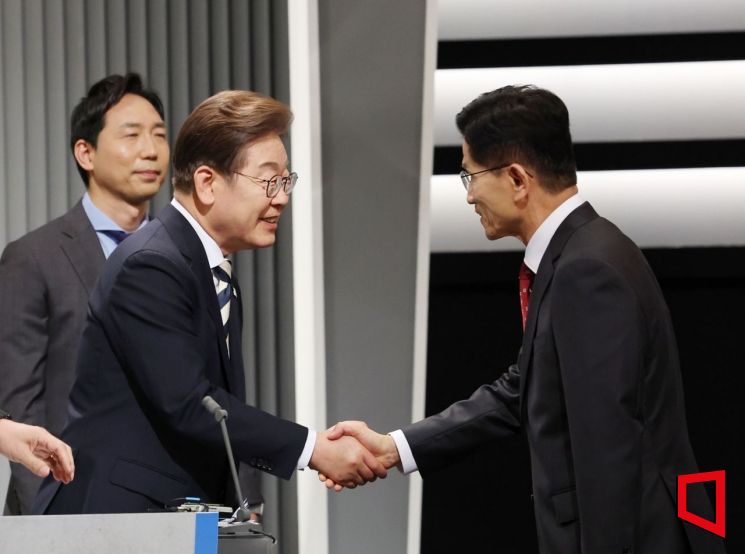 Lee Jae Myung, the Democratic Party presidential candidate, and Kim Moon Soo, the People Power Party presidential candidate, shake hands before the start of the 2nd candidate debate for the 21st presidential election hosted by the National Election Commission at the KBS Headquarters studio in Yeongdeungpo-gu, Seoul on the 23rd. Photo by the National Assembly Press Photographers Group
Consensus on Expanding R&D Budget and Parent Fund
According to the campaign pledges released by both candidates on the 28th, they both identified "expanding the R&D budget for small businesses" as the most urgent task for nurturing small and venture companies. This comes after last year’s R&D budget for small businesses was cut by nearly 23% compared to the previous year, resulting in many companies halting technology development or abandoning national projects.
Specifically, Lee Jae Myung proposed maintaining a certain proportion of the total national expenditure as the R&D budget and establishing mechanisms to counter unilateral cuts. He also pledged to restore the venture and startup-specific R&D budget that was reduced under the Yoon Suk Yeol administration, and to significantly expand the R&D budget dedicated to technology commercialization. Kim Moon Soo, while sharing the broad goal of "expanding the budget," sought to differentiate himself by presenting more concrete targets. His main proposals include increasing the R&D budget dedicated to small businesses by more than 2 trillion won by next year, and implementing a "government-private sector linked R&D operation" in which the government provides follow-up support when the private sector invests in venture companies.
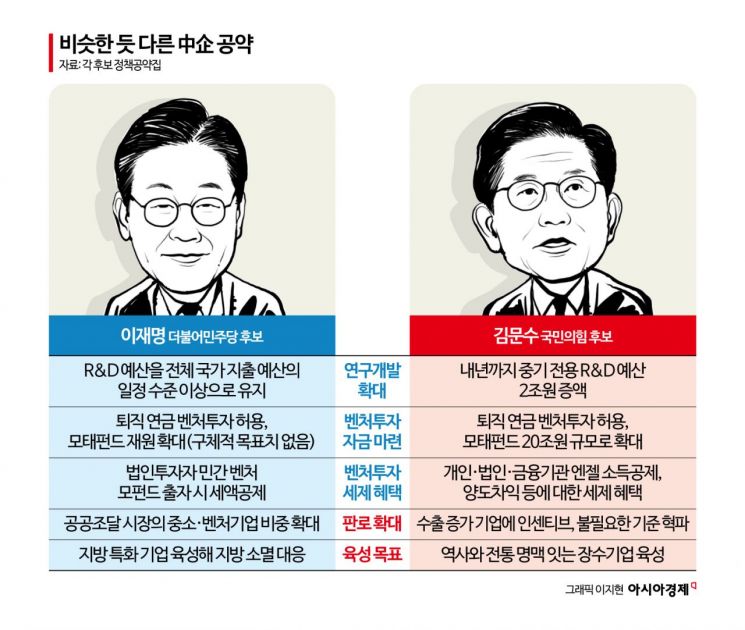
Both candidates also agreed that securing investment capital for discovering promising venture companies is an urgent priority. They both highlighted the long-standing demand in the venture industry to allow retirement pension funds to be invested in ventures. According to the Financial Supervisory Service, as of the end of last year, retirement pension reserves amounted to 432 trillion won. If this pledge is realized, it could trigger a large-scale investment boom in the venture sector. However, Lee Jae Myung added that guidelines should be established for investment methods that can diversify risk.
They also agreed on the need to "expand the parent fund resources" and "provide tax benefits for venture investment." Kim Moon Soo pledged to expand the parent fund resources to a total of 20 trillion won by 2030, while Lee Jae Myung, although he did not specify a concrete target, also listed a significant expansion of the parent fund budget as a key pledge. Regarding tax benefits for venture investment, KimMoon Soo promised much more aggressive policies. Lee Jae Myung stated that he would expand tax credits when corporate investors contribute to private venture parent funds, whereas KimMoon Soo proposed broad tax benefits for individuals, corporations, and financial institutions.
Differing Approaches to Export Expansion and Fostering Strategies
However, the two candidates outlined different visions for how to foster and set goals for small and venture businesses. In terms of expanding sales channels such as exports, Lee Jae Myung proposed a "government-led market" approach, while KimMoon Soo presented "deregulation" as his solution. The core of Lee Jae Myung's plan is to increase the share of small and venture companies in the public procurement market and expand public purchases of small business products. The public procurement market refers to the market in which the government or public institutions purchase necessary goods and services from private companies.
In contrast, Kim Moon Soo focused on eliminating unnecessary regulations to help companies become self-sustaining. Through the "1-10-10 Growth Ladder Project," which aims to foster 1% of small merchants into small businesses, 10% of small businesses into medium-sized businesses, and 10% of medium-sized businesses into mid-sized enterprises, he proposes to provide tax incentives to companies that achieve a certain level of export growth and to abolish unnecessary standards so that small businesses do not suffer disadvantages related to exports.
The candidates also differed on the specific direction for fostering small and venture businesses. Lee Jae Myung envisions developing small and venture companies into "regional specialty enterprises" to promote regional development and respond to the risk of local extinction, while Kim Moon Soo presented a blueprint for nurturing "long-lived companies" that carry on history and tradition. To this end, Lee Jae Myung aims to expand incentive matching from the parent fund when creating regional startup funds and to establish "Startup Parks," which are local innovation spaces. Kim Moon Soo plans to enact a "Special Act on Business Succession for Small Businesses" and to expand the existing concept of business succession to include third-party succession and mergers and acquisitions (M&A). He also plans to lower the maximum inheritance tax rate to the average level of the Organisation for Economic Co-operation and Development (OECD).
© The Asia Business Daily(www.asiae.co.kr). All rights reserved.


















