Choi Changhyuk Visits China
Vice Ministerial-Level Talks and Meetings with IT Companies
Identifying a Specific Country Behind the SKT Hacking Incident Is a Risky Notion
The two government agencies responsible for personal information protection in South Korea and China met to discuss the risks of personal data leaks in the era of artificial intelligence (AI), and pledged joint efforts between the two countries.
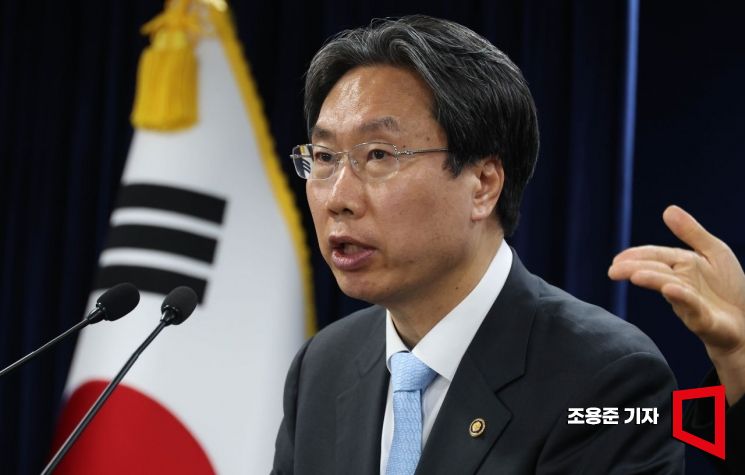 Changhyuk Choi, Vice Chairman of the Personal Information Protection Commission. Photo by Yongjun Cho
Changhyuk Choi, Vice Chairman of the Personal Information Protection Commission (pictured), met with Korean correspondents in Beijing, China, on May 29 and shared details of his meeting the previous day with Wang Jingtao, Deputy Director of the Cyberspace Administration of China, as well as roundtable discussions with Chinese companies such as AliExpress (Ali), Temu, DeepSeek, TikTok, and Xiaomi. These meetings took place amid growing concerns over personal information risks associated with the expansion of Chinese companies into the Korean market.
Vice Chairman Choi stated, "Although there are legal and institutional differences between the two countries, I believe that through dialogue and cooperation based on these differences, we can find common ground and create opportunities to resolve the issue of cross-border transfers of personal information. The Chinese side responded positively, indicating that they would continue working-level discussions going forward."
He added, "Regardless of which country's service is used, such as ChatGPT, it has become commonplace for the personal information of our citizens to be transferred to overseas servers. Especially with the widespread adoption of cloud services, transferring data to overseas servers is no longer viewed as cross-border transfer, so it has become impossible to prevent. However, because trust based on transparency is lacking, the issue of overseas transfers is somewhat problematic in the case of China."
He pointed out that Chinese laws such as the National Intelligence Law and Data Security Law stipulate that Chinese companies must provide data to authorities as needed, and said, "This is a concern for the Korean public and government, so I requested that such procedures be carried out transparently. I also suggested that, if there is ever a situation where data submission is requested from Korean companies, we should consult in advance to build trust. I received a positive response to this as well."
Vice Chairman Choi's visit to China also took place amid the recent resumption of Korean services by DeepSeek, a Chinese company that accepted recommendations from the Personal Information Protection Commission, and following allegations of Chinese involvement in the SK Telecom hacking incident.
Regarding the SK Telecom hacking incident, he said, "Since the police investigation is ongoing, it is difficult to draw conclusions about who was behind it. I believe it is somewhat risky to link the hacking to a specific organization or country. However, I mentioned the SK Telecom incident to the Chinese side and suggested that we should work to prevent hackers from using AI technology to infiltrate critical national infrastructure or important data. China responded positively to this suggestion."
He also said, "We shared the view that cooperation is needed to maximize the positive aspects of AI, and that joint efforts by both countries are necessary to prevent the spread of negative aspects."
Regarding Chinese IT companies, he commented, "Cross-border data transfers or outsourcing of data processing are very difficult under the Personal Information Protection Act, so violations may have occurred due to a lack of legal knowledge. They were not fully prepared in the early stages of their businesses, and problems arose because they initially took an aggressive approach. Yesterday, I heard several times that they are reaffirming their commitment to comply with domestic personal information protection laws."
Vice Chairman Choi also mentioned that, now that a communication channel has been established with the Cyberspace Administration of China, issues related to domestic online services such as Naver and Kakao, which are currently blocked in China, may be discussed in the future.
© The Asia Business Daily(www.asiae.co.kr). All rights reserved.
![Clutching a Stolen Dior Bag, Saying "I Hate Being Poor but Real"... The Grotesque Con of a "Human Knockoff" [Slate]](https://cwcontent.asiae.co.kr/asiaresize/183/2026021902243444107_1771435474.jpg)
















