Gangnam-gu's Apartment Prices See Third-Highest Growth Nationwide This Year
Statistical Expansion to Small Complexes and New Move-ins Drive Market Cap
'Reconstruction Project Gap' Also Plays a Role
"Strong Market Cap Is a Structural Trend"
In the real estate market, there has been a prevailing perception that it is only a matter of time before the total market capitalization of apartments in Gangnam-gu, Seoul surpasses 300 trillion won. According to Real Estate R114, the apartment market capitalization in Gangnam-gu remained in the low 200 trillion won range from 2021 to 2023, but as of the end of last year, it soared to 286.7428 trillion won, marking a remarkable 38.2% increase in just one year. This is the highest growth rate among the 25 districts of Seoul.
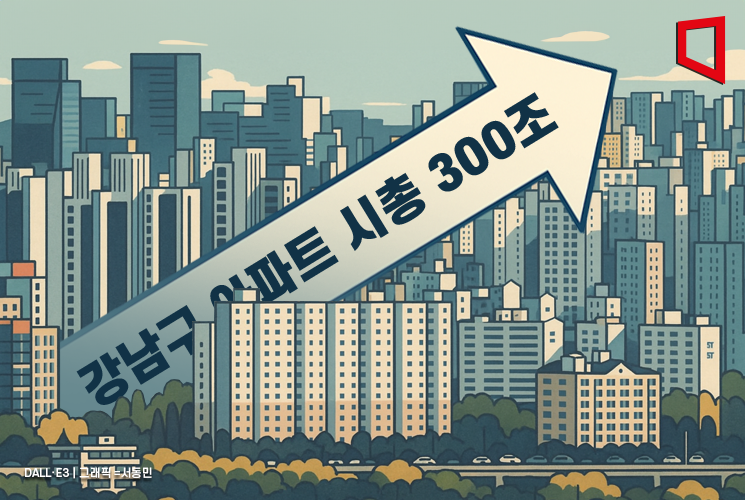
The rapid surge in Gangnam's market capitalization is the result of a combination of three factors: the full-scale move-in of large new apartment complexes, a continued rise in housing prices, and the expansion of statistical coverage through artificial intelligence (AI)-based data. Between 2023 and 2024, large complexes such as 'The H Firstier I-Park' in Gaepo-dong (6,702 units) and 'Gaepo Residence Xi' (3,375 units) began occupancy in Gangnam-gu, accounting for 26.8% of Seoul's total new housing supply. In addition, according to data from the Korea Real Estate Board, the cumulative apartment price increase rate in Gangnam-gu this year is 5.18%, ranking third nationwide after Gwacheon (5.84%) and Songpa (5.60%). Furthermore, with Real Estate R114 introducing an AI-based price service that includes even small complexes in its statistics, the market capitalization has increased even more rapidly. However, in outlying areas such as Nowon and Dobong, market capitalization has decreased even under similar conditions, indicating that the gap between regions is actually widening.
This phenomenon is also seen as a signal of a structural trend in which 'income polarization' is leading to 'housing polarization.' High-income groups, who have easier access to apartments, quickly absorb the benefits of asset price increases and secure both homes for personal use and investment, while middle- and lower-income groups are unable to keep up with the pace of price increases, resulting in a growing disparity.
The gap between income brackets in household income has recently widened. In particular, the ability of high-income groups to purchase homes has grown even further. According to the '2025 Q1 Household Trends Survey' recently released by Statistics Korea, the top 20% income group (quintile 5) saw their income rise by 5.6% compared to a year earlier, and the fourth quintile by 5.8%, both outpacing the overall average increase of 4.5%. The third and second quintiles saw increases of 2.9% and 1.9%, respectively, showing that the lower the income, the lower the growth rate. In fact, the first quintile saw a 1.5% decrease compared to a year ago. According to Hana Securities, the price-to-income ratio (PIR) for the top 10% high-income group is 4.9 years, which is more than twice as low as the overall average of 12 years.
The rapid pace of redevelopment projects in Gangnam-gu has also contributed to the rise in market capitalization. Ham Youngjin, head of the Real Estate Research Lab at Woori Bank, analyzed, "Gangnam is a region highly favored by construction companies because of the profitability and strong sales of branded apartments," adding, "Supply continues to be concentrated there." In particular, with bidding for construction companies in Apgujeong District 2 starting this month, a full-scale reconstruction boom is expected to begin.
If President Lee Jaemyung's policy of easing redevelopment regulations, which he pledged as a campaign promise, continues, the market capitalization of Gangnam-gu could grow even further. Ham also stated, "The increase in Gangnam-gu's market capitalization is not a temporary rise but a shift into a structural growth trend," adding, "This could become a decisive factor in further widening the asset gap."
© The Asia Business Daily(www.asiae.co.kr). All rights reserved.

















