Report on the Export Impact by Item of U.S. Tariff Policy
Employment Shock Expected Across Upstream and Downstream Industries if Production Moves to U.S.
Semiconductors Unlikely to Face Significant Short-Term Impact
The Bank of Korea has analyzed that among South Korean industries, the automobile sector would be hit the hardest if the current U.S. tariff policy continues. The analysis projects that automobile exports to the U.S. would decrease by 4%, and if production bases are relocated to the U.S. as a countermeasure, the resulting employment shock would be significant, affecting both upstream and downstream industries.
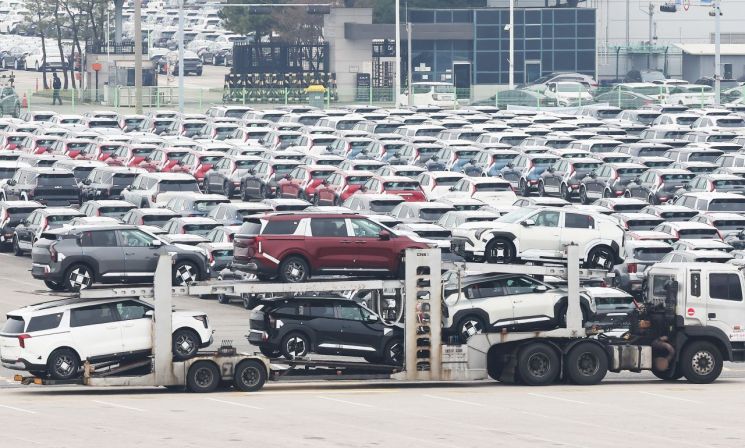
According to the Bank of Korea’s report titled "Export Impact by Item of U.S. Tariff Policy" released on the 29th, if the U.S. tariff policy persists, the export of automobiles as goods in terms of domestic GDP is expected to decline by 0.6%, while exports to the U.S. are projected to fall by 4%.
This analysis is based on a scenario where current deferred tariff rates are maintained. The scenario assumes a 10% base tariff on all countries except China, Canada, and Mexico, with tariffs on steel, aluminum, automobiles, and auto parts remaining at 25%. For semiconductors and pharmaceuticals, a 10% tariff is assumed to be imposed in the second half of the year, with no further changes.
The automobile industry is expected to suffer the most because the proportion of exports to the U.S. reached 47% last year, and since the share of Chinese automobiles in the U.S. market is minimal, there is little chance of benefiting from a shift in demand, unlike other sectors. Lim Ungji, Deputy Director of the International Trade Team at the Bank of Korea, stated, "Although the impact of price increases on exports following the imposition of tariffs in early April has not yet materialized in earnest, the effect of tariffs is expected to become increasingly evident going forward." He added, "If automobile production in the U.S. is further expanded to avoid tariffs, exports may decrease even more in the mid- to long-term."
The relocation of production bases to the U.S. could also affect the domestic economy. In fact, domestic finished vehicle manufacturers plan to increase local production in the future, and large parts suppliers may consider relocating to the U.S. in the long term to follow these manufacturers. Lim noted, "For small auto parts suppliers with annual sales of less than 10 billion won (88%), joint relocation is limited, and due to the nature of the industry, it is difficult to find alternative demand sources. If domestic production by finished vehicle manufacturers decreases, sales declines will be substantial." He further explained, "With employment in the sector totaling 330,000 people, and considering related upstream and downstream companies, the employment shock could also be significant."
For the steel and aluminum industries, under the same scenario, exports of goods in terms of GDP are expected to decrease by 0.3%, and exports to the U.S. by 1.4%. Among these, the metal industry, which has a large share in the U.S. market and is subject to a high 25% tariff, is expected to see the largest decline in exports. Lim stated, "Although tariffs were imposed in March, the effect is not yet visible due to a three- to four-month lag between contracts and shipments," but also predicted, "The negative impact will become clear from the third quarter when existing contracts expire."
The report forecasts that, similar to the automobile industry, the steel industry will also see a reduction in domestic production and exports in the mid- to long-term as domestic companies plan joint overseas relocations with demand industries, posing a threat to the domestic manufacturing ecosystem.
Semiconductors are expected to be relatively unaffected by tariffs. Exports of goods in terms of GDP are projected to decrease by 0.2%, while exports to the U.S. are expected to drop by 0.5%. Recent export trends indicate that memory prices have rebounded since March due to preemptive demand in anticipation of potential tariffs, making the immediate impact of tariffs appear positive. The report notes that, given the weak U.S. production base for semiconductor memory, the likelihood of export declines due to overseas relocation is not high.
The report states, "Short-term exports of automobiles and steel are expected to decrease, and there will also be long-term effects from production relocation to the U.S." It further points out, "In particular, the automobile industry has strong upstream and downstream linkages and a large number of small partner companies, raising concerns about a broader impact on the economy and employment." The report emphasizes, "In this situation, it is crucial to enhance our technological competitiveness, and the key is securing science and engineering talent." It adds, "We need to create an incentive structure that encourages outstanding domestic talent to pursue science and engineering fields and to choose domestic jobs over overseas opportunities."
© The Asia Business Daily(www.asiae.co.kr). All rights reserved.
![Clutching a Stolen Dior Bag, Saying "I Hate Being Poor but Real"... The Grotesque Con of a "Human Knockoff" [Slate]](https://cwcontent.asiae.co.kr/asiaresize/183/2026021902243444107_1771435474.jpg)
















