Growth Rate Could Drop to 0.7% This Year if US-China Conflict Reignites
Smooth Negotiations Could Lead to 0.9% Growth This Year
There is a forecast that if the recently eased US-China trade conflict reignites and the situation deteriorates, South Korea's economic growth rate this year could be limited to 0.7%.
On the 29th, the Bank of Korea released a revised economic outlook, projecting South Korea's economic growth rate for this year at 0.8%. Along with this, the bank analyzed and announced alternative scenarios reflecting uncertainties in the growth trajectory. The Bank of Korea explained that although global trade tensions have somewhat eased recently due to US-China trade negotiations, the direction of future US tariff policies and uncertainties in the negotiation process remain as variables. Therefore, the bank analyzed alternative scenarios to account for these factors.
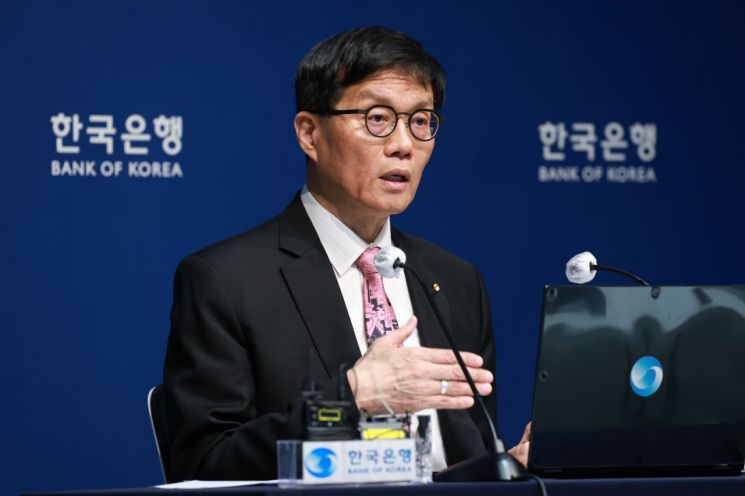 Lee Changyong, Governor of the Bank of Korea, is answering questions at a press conference held after the Monetary Policy Committee meeting on the 29th. Bank of Korea
According to the Bank of Korea's analysis, if the US-China trade conflict reignites and negotiations between the US and other countries also break down, resulting in mutual tariffs reverting to half the level of the currently suspended tariffs, the domestic growth rate could be 0.1 percentage point lower than the baseline forecast this year and 0.4 percentage point lower next year. This means that South Korea's economic growth rate could be limited to 0.7% this year and 1.2% next year. In this case, the inflation rate this year would be only minimally affected, but next year it is projected to be 1.6%, which is 0.2 percentage point lower than the baseline projection of 1.8%. A Bank of Korea official explained, "The reason the impact is greater next year than this year is that, under each scenario, the tariff paths begin to diverge from the baseline forecast starting in the third quarter of this year."
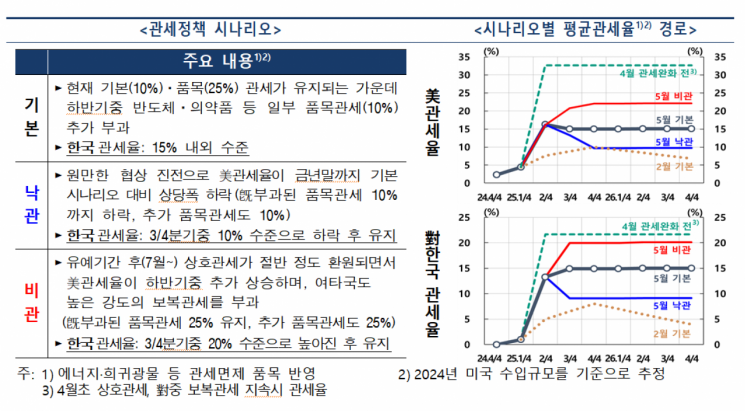
On the other hand, if trade negotiations with all countries, including China, proceed smoothly during the tariff suspension period and US tariffs are significantly reduced by the end of this year, the domestic growth rate is expected to be 0.1 percentage point higher than the baseline forecast this year and 0.2 percentage point higher next year. In this case, the growth rate would be 0.9% this year and 1.8% next year. The inflation rate is also expected to be only minimally affected this year, but next year it is projected to be 1.9%, which is 0.1 percentage point higher than the baseline projection.
At a press conference on this day, Bank of Korea Governor Lee Changyong stated, "After comprehensively considering various factors, we forecast this year's growth rate at 0.8%. However, uncertainties surrounding the future growth path remain high, and there are risk factors in both upward and downward directions. The possibility of rapid and smooth trade negotiations with major countries and the implementation of additional economic stimulus measures by the new government could serve as upward factors, while prolonged trade conflicts and the imposition of additional tariffs by item could act as downward factors."
© The Asia Business Daily(www.asiae.co.kr). All rights reserved.
![Clutching a Stolen Dior Bag, Saying "I Hate Being Poor but Real"... The Grotesque Con of a "Human Knockoff" [Slate]](https://cwcontent.asiae.co.kr/asiaresize/183/2026021902243444107_1771435474.jpg)
















