A Look at the Policy Pledge Booklet: Growth Strategy Centered on AI
Emphasis on Democracy in Light of "12.3 Martial Law"... Includes Judicial Reform
The policy pledge booklet for Lee Jae Myung, the Democratic Party's presidential candidate for the 21st presidential election, omits the notable "Basic" series from the 20th presidential election and instead emphasizes growth centered on artificial intelligence (AI). Given that the 12·3 Martial Law is a major reason for the holding of this 6·3 presidential election, "democracy" is also highlighted as a central theme in the pledge booklet.
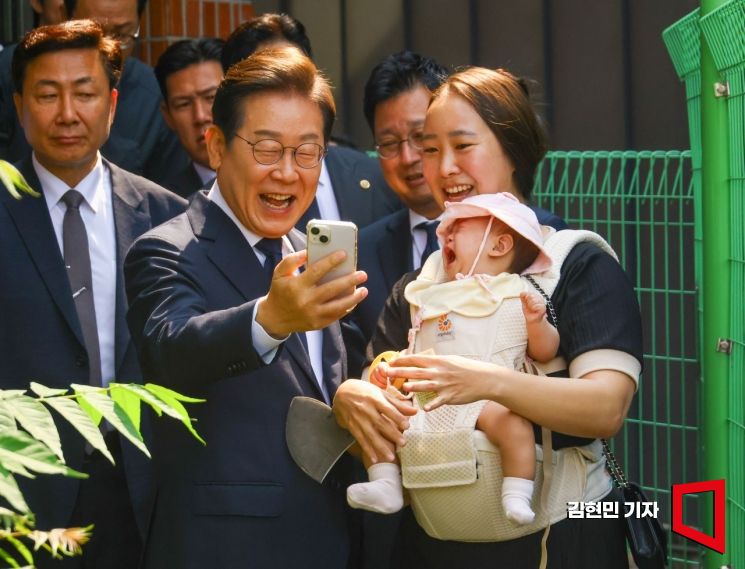 Lee Jae Myung, the Democratic Party presidential candidate, is taking a selfie with citizens at the early voting station in Sinchon-dong Community Center, Seodaemun-gu, Seoul on May 29, 2025. Photo by Kim Hyun Min
When comparing Lee's pledges from the 20th and 21st presidential elections, the current booklet does not include content related to the "Basic" series, such as Basic Society, Basic Income, or Basic Finance. Although Lee announced his plan to establish a Basic Society Committee on his Facebook page on May 22, stating, "We will move toward a basic society where the national community is responsible for the basic lives of the people," this was not specified in the pledge booklet. However, the pledge to "create a society that guarantees the basic lives of all citizens," which aims to promote a society where universal basic services are ensured, was included.
The keyword that has taken the place of the Basic series is "growth." Lee presented recovery, growth, and happiness as his three major visions. Unlike the previous election, where only visions were presented, he proposed a "Real Growth" economic strategy targeting three goals: becoming one of the top three AI powers, achieving a 3% potential growth rate, and ranking among the top five national powers.
As outlined in the Real Growth strategy, the core axis of growth is AI. Lee emphasized the government's responsibility for the AI industry by strengthening the role of the National Artificial Intelligence Committee, a presidential body, as the AI control tower. He also announced plans to establish a Chief of AI Policy in the presidential office and appoint a Chief Artificial Intelligence Officer (CAIO). The pledge to create a Deputy Prime Minister for Science and Technology, which Lee's rival Kim Moon Soo of the People Power Party promised and Lee himself mentioned in the 20th presidential election, was omitted from this booklet.
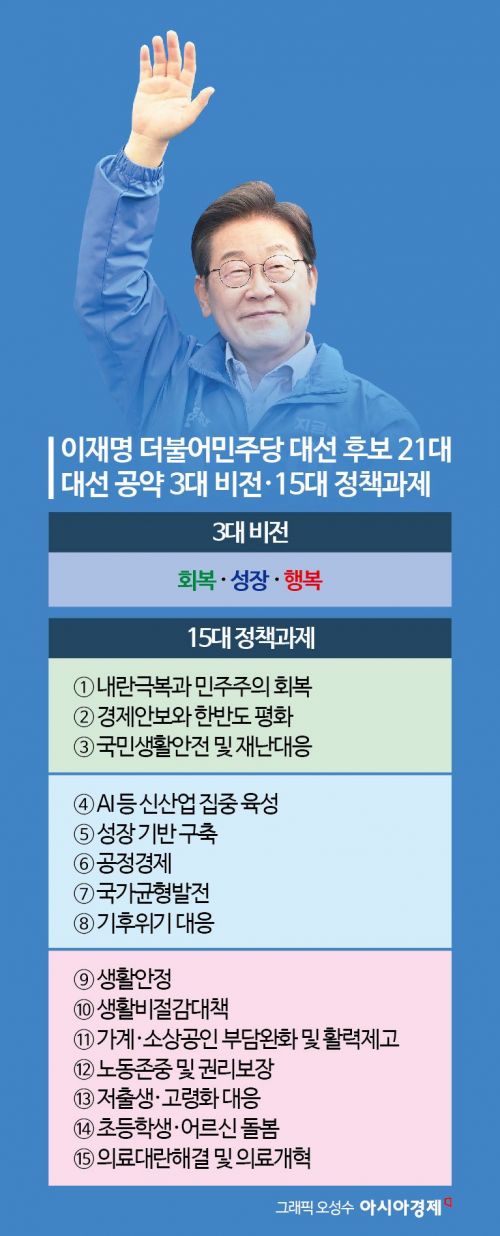
Another key theme of the pledge booklet is "democracy." Since this election stems from the 12·3 Martial Law, the "recovery" vision is introduced first among the three visions. This contrasts with the previous election, where the "New Economy" was the first of five visions. It is also noteworthy that the policy pledges for each vision explicitly mention "overcoming rebellion and restoring democracy." Lee included constitutional amendments in his pledges, such as establishing a National Integration Committee, promoting civilian control of the military, introducing a four-year presidential term with the possibility of re-election, and strengthening the requirements for declaring martial law and for requesting reconsideration.
Pledges that the Democratic Party has been pursuing are also included under the category of democracy. Notably, the judicial reform policy includes wording about increasing the number of Supreme Court justices, which has been controversial as a so-called judicial retaliation bill. Lee has previously stated that "now is not the time to discuss" appointing non-lawyer Supreme Court justices or increasing the number of justices. On May 29, Cho Seung Rae, head of public relations for the Democratic Party's election committee, said regarding the judicial reform pledge, "Everyone agrees that the judiciary needs improvement or change," and added, "It is obviously necessary to improve national convenience."
Pledges to reorganize government ministries have also drawn attention. Lee promised to establish a Ministry of Climate and Energy to actively respond to carbon neutrality and the energy transition, as well as to restructure the Ministry of Economy and Finance. Regarding the establishment of the Ministry of Climate and Energy, Lee stated, "An independent ministry is necessary because we must focus on supporting the energy transition in response to the climate crisis." As for the Ministry of Economy and Finance, he said, "There is a need to separate the budget function, and the Financial Services Commission currently handles both supervision and policy tasks, so there is a need to separate those as well." He also pledged to expand and strengthen the Ministry of Gender Equality and Family into the Ministry of Gender Equality and Family Affairs.
© The Asia Business Daily(www.asiae.co.kr). All rights reserved.
![Clutching a Stolen Dior Bag, Saying "I Hate Being Poor but Real"... The Grotesque Con of a "Human Knockoff" [Slate]](https://cwcontent.asiae.co.kr/asiaresize/183/2026021902243444107_1771435474.jpg)
















