Democratic Party Releases Policy Pledge Book
Government's Budgetary Authority Expected to Be Reduced
National Assembly's Oversight of Public Institutions to Be Strengthened
Lee Jae Myung, the presidential candidate of the Democratic Party of Korea, has pledged to reorganize the Ministry of Economy and Finance. As Lee has hinted at separating the budgetary functions of the ministry, it appears that efforts to weaken the overall structure and authority of the ministry will accelerate. In particular, the government's right to approve increases in the National Assembly's budget?meaning that the National Assembly must obtain government consent to increase project budgets?is expected to be significantly weakened.
 Lee Jae-myung, the presidential candidate of the Democratic Party of Korea, is giving a speech at a campaign rally held on May 28 at Wangsimni Station Plaza in Seongdong-gu, Seoul. 2025.5.28 Photo by Kim Hyunmin
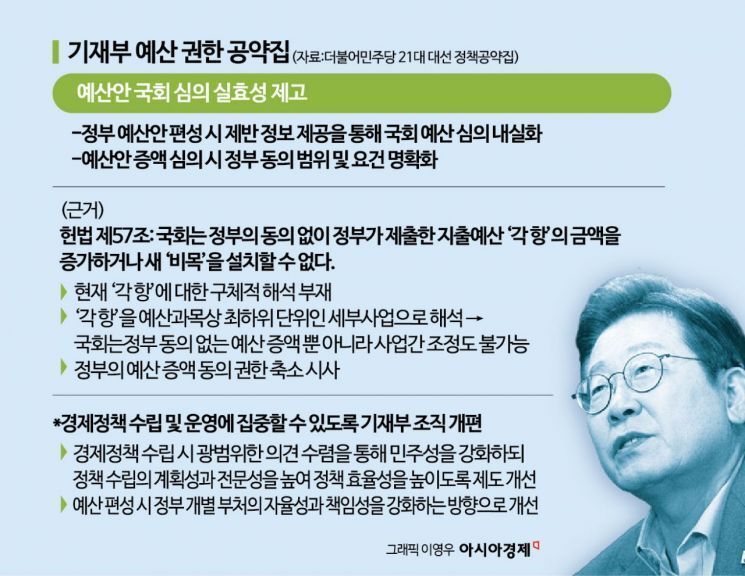
On May 28, the Democratic Party of Korea released Lee's 21st presidential election policy pledge book, which includes these plans. The previous day, Lee told reporters, "I think the Ministry of Economy and Finance needs to be restructured," and added, "There may be a need to separate its budget formulation functions." While the pledge book does not specify the exact direction of the organizational separation, it does state that the ministry will be reorganized to focus on economic policy planning and implementation, and that the scope and requirements for government consent when reviewing budget increases will be clarified.
According to the pledge book, the government's right to consent to budget increases is expected to be substantially weakened. The government's core authority stems from its right to approve increases. This is based on Article 57 of the Constitution, which states, "The National Assembly may not increase the amount of any item of expenditure or establish a new item in the budget submitted by the government without the government's consent." However, the Constitution does not clearly define what an "item" means. As a result, the government has interpreted "item" as the lowest-level unit in the budget classification, known as a detailed project. The government budget is generally classified into sector, sub-sector, program, unit project, and detailed project.
Therefore, the National Assembly has not had the authority to increase the budget or adjust the budget size for each detailed project without government consent. For example, even if the National Assembly wanted to reduce the budget for Detailed Project A and increase the budget for Detailed Project B by the same amount within the same program?thus keeping the overall program budget unchanged?it still needed to obtain government consent for the increase in Detailed Project B.
However, if the Democratic Party's pledge to clarify the meaning and scope of "item" is implemented, changes to the authority over budget increases between the National Assembly and the government are expected. If the National Finance Act is amended to specify that "item" refers to the program unit, it would become possible to adjust budgets between detailed projects without government consent. In this case, only government consent for increases at the program level would be required. A government official stated, "This would in effect significantly weaken the Ministry of Economy and Finance's budgetary authority," and added, "It appears that the core government authority of approving increases will be substantially restricted."
Control over Fund Management and Public Institutions Also at Stake
The pledge book also includes measures to check the Ministry of Economy and Finance's authority over budget and fund management. Strengthening the requirements for transfers between accounts and funds is interpreted as a move to curb the ministry's traditional practice of using funds to cover revenue shortfalls. While this aims to enhance transparency and predictability in budgeting, it conflicts with the fiscal authorities' previous emphasis on the need for integrated fiscal management. There are concerns that the flexibility of the budget could be undermined, especially given the lack of clear measures to increase revenue.
The ministry's decision-making power over the overall operation of public institutions is also expected to be greatly weakened. Lee has announced plans to increase the proportion of private members on the Public Operations Committee to at least two-thirds, and to require that the government's mid- to long-term financial management plans for public institutions include plans for functional restructuring, changes in major shareholders, and disposal of held shares, all of which must be reported to the National Assembly. This means that, going forward, the National Assembly will be briefed in advance on major issues such as mergers and consolidations of key public enterprises.
There are also plans to align the terms of presidents and executives of major public institutions with the presidential term. The maximum term of public institution presidents and executives would be limited to the remainder of the appointing president's term, in order to prevent so-called "holdover appointments." The pledge also includes a plan to strengthen managerial accountability by linking management performance to basic annual salaries when determining executive compensation at public institutions.
© The Asia Business Daily(www.asiae.co.kr). All rights reserved.
![Clutching a Stolen Dior Bag, Saying "I Hate Being Poor but Real"... The Grotesque Con of a "Human Knockoff" [Slate]](https://cwcontent.asiae.co.kr/asiaresize/183/2026021902243444107_1771435474.jpg)
















